

If you’ve typed “how to be a better wife” into a search bar, chances are you’re not looking for a gold star. You’re probably tired, a little discouraged, and quietly worried that something between you and your husband has slipped, and that it’s at least partly on you.
Let me say the most important thing first: wanting to be a better wife doesn’t mean you’re a bad one. It means you’re paying attention. Most women who search this question are already carrying a lot, and the last thing they need is a list that boils down to “smile more and do more.”
So this isn’t that list. Below you’ll find a quick way to figure out what’s really off in your marriage, 12 practices that make a real difference (with the exact words to use), what to do when you’re too exhausted or resentful to try, and a simple 7-day plan to start.
The short version: being a better wife isn’t about doing more. It’s about listening without a phone in your hand, asking directly instead of hinting, saying what you admire out loud, staying on his side in public, and keeping a life of your own. The 12 practices below show you how, with the exact words to use.
What “a better wife” really means
Here’s the reframe that matters most: being a better wife is almost never about doing more. It’s about doing a few specific things differently.
Most marriages don’t drift apart because one person stopped trying. They drift because two people who love each other slowly stop feeling seen by each other. He feels criticized; you feel unappreciated. He goes quiet; you get louder. Nobody’s a villain, but the distance grows anyway.
A better wife, then, is simply a wife who has learned to close that distance on purpose, in small, repeatable ways, while staying fully herself. That’s the whole goal. Not perfection, not martyrdom, not becoming someone your husband didn’t marry.
Start here: an honest 2-minute self-check
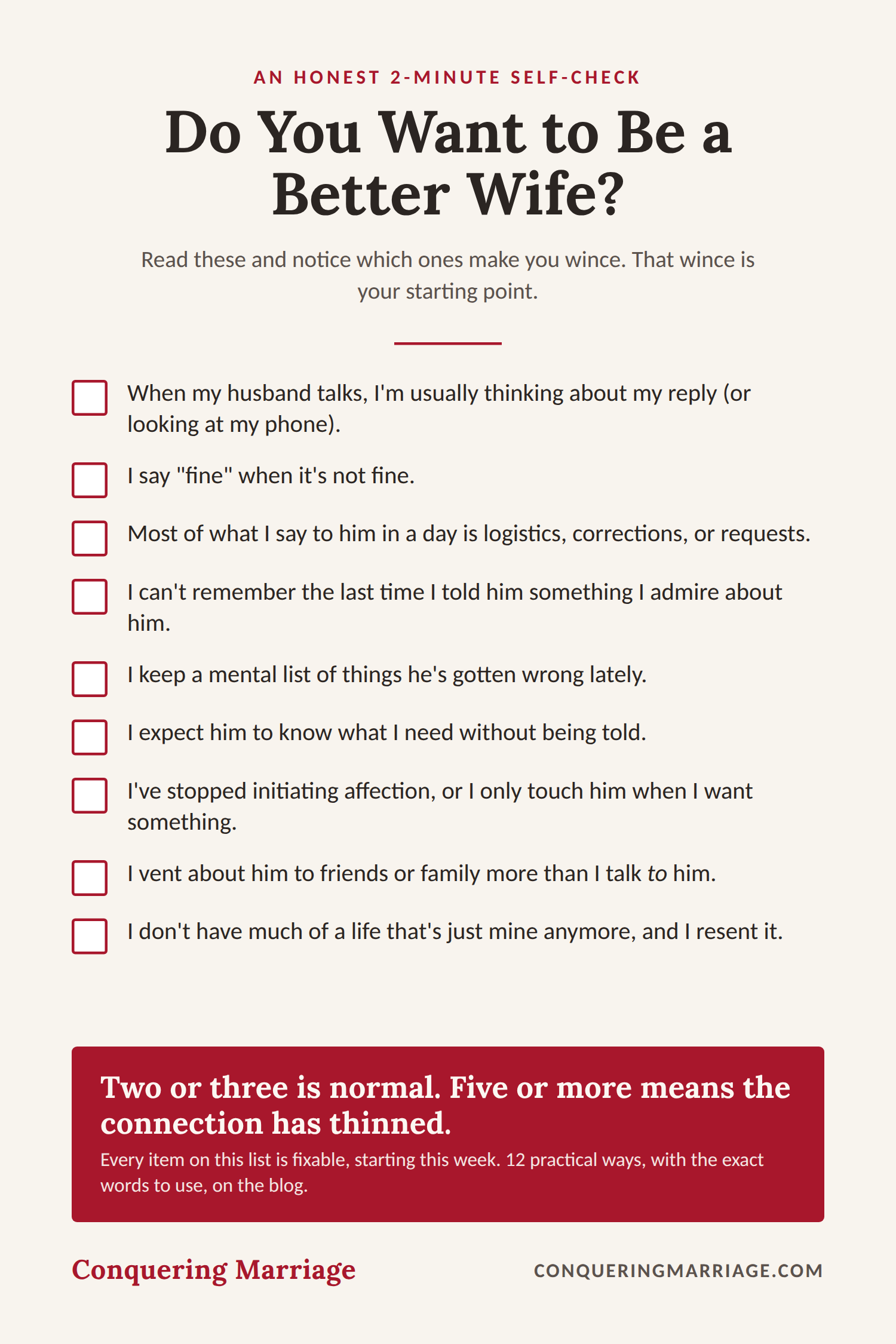
Before you change anything, get concrete. Read these and notice which ones make you wince a little. That wince is your starting point.
- When my husband talks, I’m usually thinking about my reply (or looking at my phone).
- I say “fine” when it’s not fine.
- Most of what I say to him in a day is logistics, corrections, or requests.
- I can’t remember the last time I told him something I genuinely admire about him.
- I keep a mental list of things he’s gotten wrong lately.
- I expect him to know what I need without being told.
- I’ve stopped initiating affection, or I only touch him when I want something.
- I vent about him to friends or family more than I talk to him.
- I don’t have much of a life that’s just mine anymore, and I resent it.
Two or three of these are normal in any long marriage. Five or more usually means the connection has thinned out. The good news is that every single item on that list is fixable, starting this week.
12 practical ways to be a better wife to your husband
These are grouped into four areas: how you listen, how you speak, how you show up, and how you take care of yourself. Pick the area where your self-check stung the most and start there.
How you listen
1. Put the phone face down when he talks.
It sounds too simple to matter. It isn’t. Feeling like an interruption in your own home is corrosive, and phones are the number-one way spouses accidentally communicate “you’re not that important.” Try this for one week: anytime he starts telling you something, phone goes face down, body turns toward him. You’ll be surprised how much more he starts sharing.
2. Ask one more question.
When he tells you about his day, his frustration at work, or the thing his brother said, resist the urge to solve it, relate it back to yourself, or move on. Ask one follow-up: “What was the worst part of that?” or “What do you think you’ll do?” One extra question tells him you’re actually interested, not just being polite. Relationship researcher John Gottman calls these small moments bids for connection, and how often they’re answered is one of the strongest predictors of whether a couple stays close.
3. Let him be quiet without taking it personally.
A lot of people, husbands especially, process by going quiet first and talking later, sometimes days later. If you interpret his silence as rejection and chase it, he’ll retreat further. Instead, try: “You seem like you’ve got something on your mind. I’m around whenever you want to talk about it. No pressure.” Then actually leave it. Giving him room is not the same as giving up.
How you speak
4. Ask directly instead of hinting (and drop “I shouldn’t have to ask”).
This one is a marriage-changer. Hinting, sighing, and “shouldn’t have to ask” feel justified, and they almost never work. A direct, kind request works far more often:
“Could you handle bedtime tonight? I’m running on empty and I’d really love thirty minutes to myself.”
Not: “I guess I’ll do bedtime again.” The first is an invitation; the second is an indictment. He can say yes to an invitation.
5. Change the ratio of what he hears from you.
Count, for one day, how much of what you say to your husband is a request, a correction, or a logistics update. For a lot of wives it’s the vast majority. Nobody thrives on that. Aim to add three “no-agenda” comments a day: a thank-you, an observation, a joke, a memory. “I was thinking about that trip to the coast today. That was a good weekend.” It costs nothing and it changes the whole temperature of the house.
6. Say the specific thing you admire, out loud.
“Thanks for taking out the trash” is fine. “I noticed how patient you were with Ellie when she was melting down. I don’t know how you stay that calm” is something he’ll replay in his head for days. Men often hear far less genuine admiration than they need. Be specific, be sincere, and don’t attach a request to it.
7. Apologize cleanly.
A real apology has no “but.” “I’m sorry I snapped at you in front of your mom. That wasn’t fair and I’d like to do better.” Full stop. Not “I’m sorry, but you were…” A clean apology is one of the fastest trust-builders in any marriage, and it models for him how to give one back.
8. Keep his private things private.
Venting about your husband to friends or family feels harmless, but it does two things: it reinforces your negative story about him, and it puts him at a permanent disadvantage with people who’ll remember the vent long after you’ve forgiven him. If you need to process something, talk to him, or to one confidant who is genuinely for your marriage. And speak well of him when he’s not in the room. People notice, and so will he.
How you show up
9. Initiate affection with no strings attached.
A hand on his back as you pass, a real hug (not the two-second pat), a kiss that lasts longer than a peck. Non-sexual touch is how a lot of husbands feel wanted, and many wives stop offering it once the years pile up. If intimacy has faded, this is the gentlest place to restart: low pressure, high signal. (If sex itself has become a sore spot, be honest about it rather than letting it silently become the elephant in the room. See “What if the physical side of our marriage has faded?” in the FAQ below.)
10. Be on his side in public, and disagree in private.
Correcting his story at dinner, rolling your eyes at his joke, contradicting his parenting in front of the kids: these feel small, and they land hard. Rule of thumb: in public, you’re a team. If you disagree with something he did, say so later, privately, and directly. He’ll feel safe with you in a way that no compliment can create.
11. Protect his hobby, and take an interest in it.
The garage project, the Saturday ride, the fantasy league. It’s tempting to see his hobby as time stolen from the family. Try seeing it as the thing that refills him. Ask about it, occasionally join in, and don’t keep score. A husband who feels supported in what he loves tends to show up more generously everywhere else.
How you take care of yourself (the one people skip)
12. Keep (or rebuild) a life that’s yours.
This may be the most overlooked item on any “better wife” list. A wife who has let go of her own friendships, interests, rest, and ambitions gradually has nothing left to bring to the marriage except need, and quiet resentment. Taking care of yourself isn’t selfish; it’s the source of everything above. Book the walk. Sign up for the class. Go to bed at a decent hour. Your husband married a whole person.
“I’m too tired and too resentful to do any of this”
If that’s where you are, please don’t skip this section. It’s for you.
Resentment is usually a sign that you’ve been giving more than you’ve been getting for a long time, and nobody has noticed, including maybe you. Trying to “be a better wife” from that place feels like being asked to run a marathon with a sprained ankle.
So don’t run. Do three things instead.
First, name it, to yourself, honestly. “I’m resentful because I feel like I carry everything and he doesn’t see it.” Write it down. Resentment loses a lot of its power once it has words.
Second, make one direct ask (practice #4) about the thing you’re most resentful about. Not the whole list. One thing. “I’ve been feeling really alone with the mornings. Could you own getting the kids to school on Tuesdays and Thursdays?” You’re testing whether he’ll respond once he knows what you need. Many husbands will. If he does, that’s your foothold.
Third, do one thing from the list that costs you nothing, probably #1 (the phone) or #6 (the specific compliment). You’re not doing this because he’s earned it. You’re doing it because it’s the fastest way to make the house feel less like a battlefield, which makes everything else easier.
And if you’ve done all of that, repeatedly, and he still doesn’t meet you at all? That’s worth looking at honestly. See “What if my husband isn’t trying at all?” in the FAQ below.
What being a better wife is not
Because there’s a lot of bad advice out there, let’s be clear:
- It’s not shrinking. You don’t get better by having fewer needs, opinions, or boundaries.
- It’s not fixing him. You can change your half of the dance; you can’t choreograph his.
- It’s not tolerating harm. If there’s contempt, control, or abuse in your marriage, the question isn’t “how do I be a better wife.” It’s “how do I get safe and get help.” The Gottman Institute’s research found that contempt is the single greatest predictor of divorce; it is not something a wife can out-nice. Please talk to a counselor, or, if you’re in immediate danger, call the National Domestic Violence Hotline at 1-800-799-7233 (text START to 88788, or visit thehotline.org). Outside the U.S., search for your country’s domestic violence helpline.
A simple 7-day plan to start
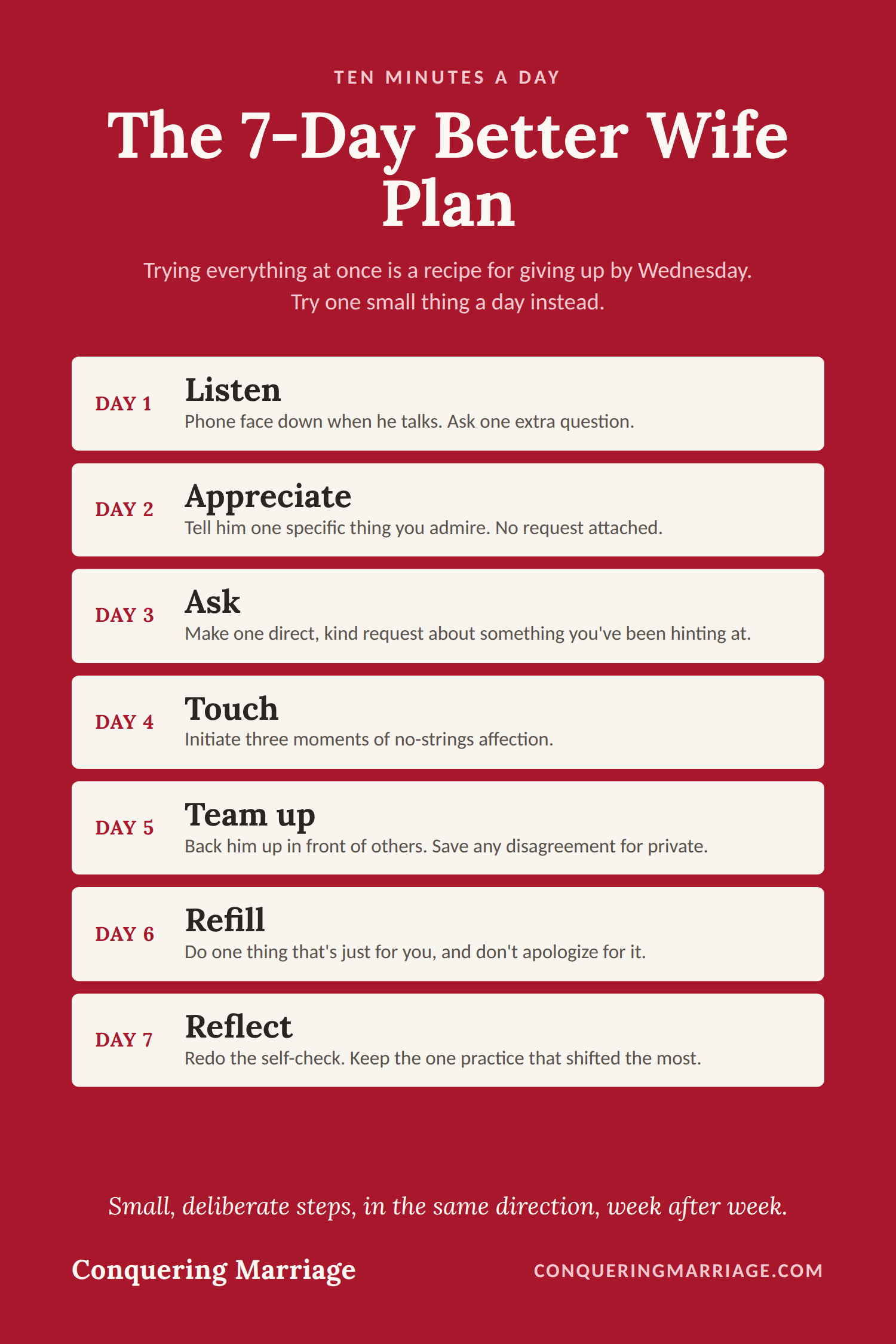
Trying all 12 at once is a recipe for giving up by Wednesday. Try this instead: ten minutes a day, tops.
- Day 1 — Listen. Phone face down every time he talks. Ask one extra question.
- Day 2 — Appreciate. Tell him one specific thing you admire about him. No request attached.
- Day 3 — Ask. Make one direct, kind request about something you’ve been hinting at.
- Day 4 — Touch. Initiate three moments of no-strings affection.
- Day 5 — Team up. Back him up in front of the kids or others; save any disagreement for later, in private.
- Day 6 — Refill. Do one thing that’s just for you, and tell him you’re doing it, without apologizing.
- Day 7 — Reflect. Redo the self-check. What shifted? Pick the one practice that made the biggest difference and keep it going next week.
Don’t be surprised if, somewhere around day four, he is a little softer, a little more talkative, a little more present. That’s the shift you’re looking for. Small, deliberate steps, in the same direction, week after week.
Pairs with The 14-Day Reconnect Plan
The 7-day plan above pairs with The 14-Day Reconnect Plan: two weeks of ten-minute actions to feel like a couple again, with the words to say on the hard days. Free for subscribers.
Frequently asked questions
What are the qualities of a good wife?
Not a personality type. The wives whose marriages thrive over decades share a handful of habits: they listen without multitasking, ask for what they need directly, show appreciation in detail and often, stay on their husband’s side in public, and keep a life of their own. Everything else (how tidy the house is, how you dress, whether you cook) is style, not substance.
How can I be a better wife emotionally?
Start by noticing your own feelings before they turn into criticism. “You never help” is usually “I feel alone.” Say the feeling underneath, make a direct ask, and give him a chance to respond. Emotionally strong wives aren’t the ones with no needs; they’re the ones who can name their needs without weaponizing them.
How do I be a better wife when I’m exhausted?
Don’t add anything. Subtract. Drop the hinting and the phone-scrolling, and make one direct request for help with the thing draining you most. Then take one item off your own plate. A rested wife with three good habits beats an exhausted wife trying fifteen.
What if my husband isn’t trying at all?
Give it a fair test: two to three weeks to see any softening, four to six for a real shift, with you doing your part consistently, including at least a couple of direct, kind asks. Many husbands respond quickly once they feel less criticized and know exactly what’s needed. If nothing changes at all, no softening, no effort, then it’s time for a bigger conversation, and possibly a counselor. This guide on how to reconnect with your husband walks through that conversation.
What if the physical side of our marriage has faded?
Start with the no-strings touch in practice #9; it rebuilds warmth without pressure. Then name it, directly and without blame: “I miss us. Can we talk about it? Not to fix it tonight, just to be honest.” A long, unspoken gap almost always has a reason underneath it (exhaustion, resentment, feeling unwanted, a health change), and finding that reason together is the actual fix. Silence is the only option that guarantees nothing changes.
How can I be a better wife after a big fight?
Cool down first (a real break, not a silent-treatment break), then go back with a clean apology for your part, no “but,” and one thing you’d like to do differently next time. Here’s a fuller walkthrough on how to heal a relationship after a fight.
Should I try to be a better wife if I’m not even sure I want to stay married?
Yes, for a defined stretch, say 30 days. Not because you owe it to him, but because you deserve to make that decision from a clear-eyed place rather than an exhausted one. If you’re in that season, you may also want to read Is My Marriage Over? and What to Do When You’re Not Happy in Your Marriage.
How can I be a better wife after having kids?
Lower the bar and raise the honesty. The first few years with small children are the hardest stretch of most marriages. Divide the load out loud, protect ten minutes a day that’s just the two of you, and touch base with each other before you both collapse. More here: how not to hate your husband after kids.
One last thing
You searched for this because you care. That’s already the biggest ingredient. Pick one practice from the list, just one, and do it today. Then come back tomorrow and do it again. That’s how marriages get better: not with a grand gesture, but with a wife who quietly decided to close the distance, one small step at a time.
Free: The 14-Day Reconnect Plan
Fourteen days, ten minutes a day, nothing he has to agree to first.