
It’s over, or at least the loud part is. He’s in the other room or in the car or asleep with his back to you, and you’re standing in the kitchen replaying it. The thing he said. The thing you said back, which was worse. And underneath the anger, the question that brought you here: how do you heal a relationship after a fight like that, and does it go back to normal?
Yes, usually. Often it isn’t the fight that does the damage. It’s what happens in the two days after it: the forced midnight conversation that starts round two, the three days of silence, the apology that turns into a trial. Healing after a fight is a skill, it has an order, and most of it can be started by one person. This article gives you the first 48 hours in order, with the words to say at each step.
The short version: take at least 20 minutes apart before you say anything else. Tonight, one small move toward him, no debrief. Tomorrow morning, be warm and don’t bring it up. Within 48 hours, have one ten-minute conversation about what it was about and what you’ll each change. Then let it go.
Two things first. If the fight frightened you, or if it’s one of a hundred and the hundredth felt different, read when it wasn’t just a fight before anything else here. And if he’s gone quiet and you’re not sure whether to wait or go to him, there’s a whole section on that; read it before you text him.
Table of Contents
First: which kind of fight was it?
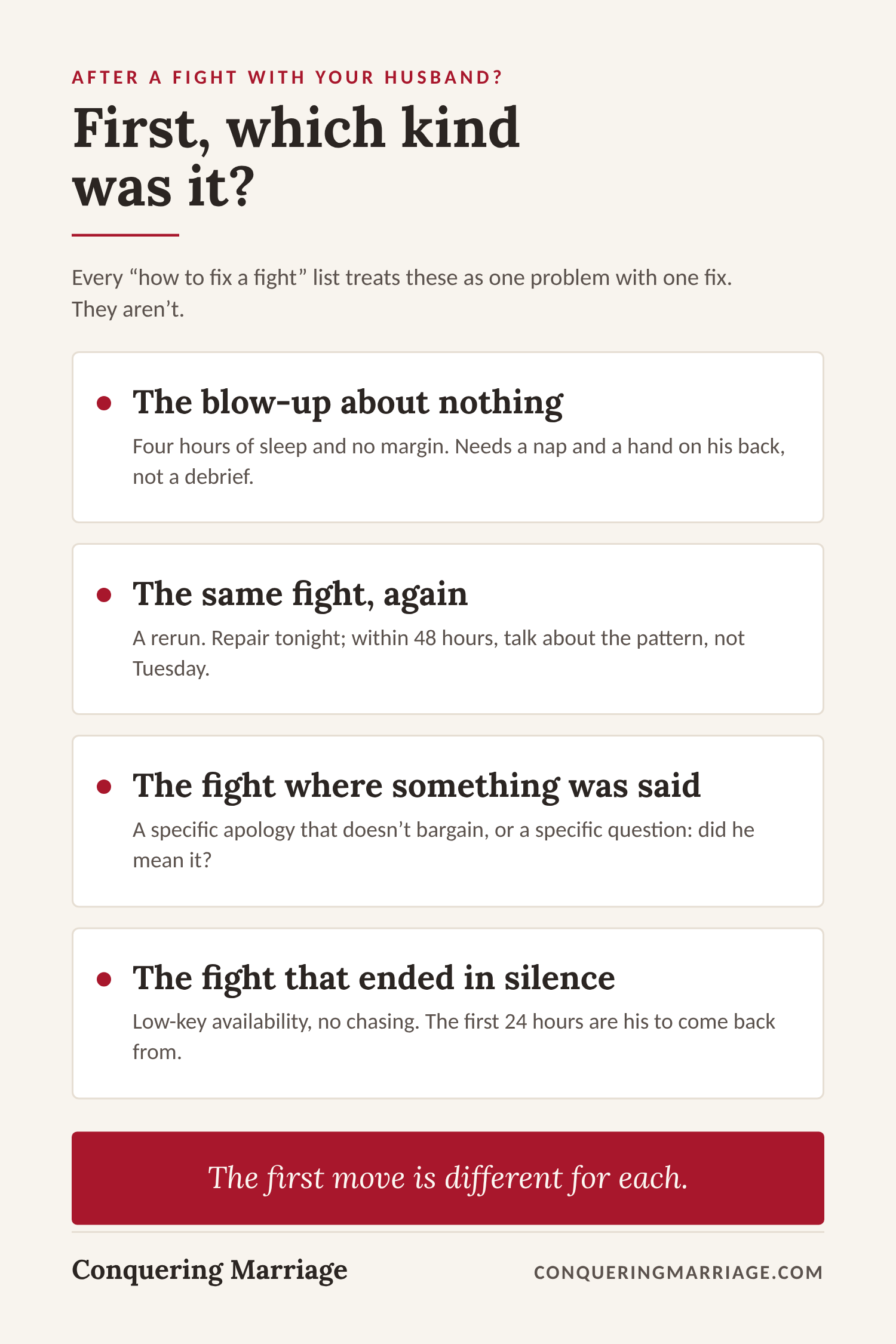
Every “how to fix a fight” list treats a tired Tuesday blow-up and a fight that left a mark as the same thing. They aren’t, and the first move is different for each. Find yours.
1. The blow-up about nothing
It started over the dishwasher or the directions or who was supposed to call the school, and it got loud fast because you were both running on four hours of sleep and no margin. Nothing was said that you’ll remember next month. First move: don’t make it into something. Twenty minutes apart, then one small, warm move tonight, and no debrief. Fights like this don’t need a conversation; they need a nap and a hand on his back. If you push to process it, you’ll turn a weather event into a storm system.
2. The same fight, again
You could have recited his lines before he said them. The money. His mother. How much you do and how little he notices. This isn’t a fight so much as a rerun, and both of you are tired of the script. First move: repair tonight the same way (small, warm, no debrief), and then, within 48 hours, have the ten-minute conversation, but have it about the pattern, not about Tuesday. The question isn’t who was right about the money; it’s why the two of you keep ending up here.
3. The fight where something was said
One of you said the thing. “Maybe we shouldn’t have gotten married.” The comparison to his father. The word you’ve both agreed never to use. The fight itself may have been small; what was said in it isn’t. First move: the same cooling-off, and then an apology that is specific and doesn’t bargain, or, if he said it, a specific ask: what did he mean, and did he mean it. The conversation matters most for this kind, and so does the apology section inside it. If what was said was a threat, or frightened you, that’s a different situation; see when it wasn’t just a fight.
4. The fight that ended in silence
He walked out, or he’s been civil and absent for two days, or you have, and the house has gone cold. Nobody is yelling, and nothing is healing either. First move: low-key availability and no chasing. If he goes silent after a fight is the whole section for this one. In short: the first 24 hours are his to come back from. The days after that are yours to open a door, without pushing him through it.
Whichever kind it was, the sequence below is the same; what changes is how much weight each step carries. For a blow-up about nothing, you can usually stop after the morning.
How to reconnect with your husband after a fight: the first 48 hours
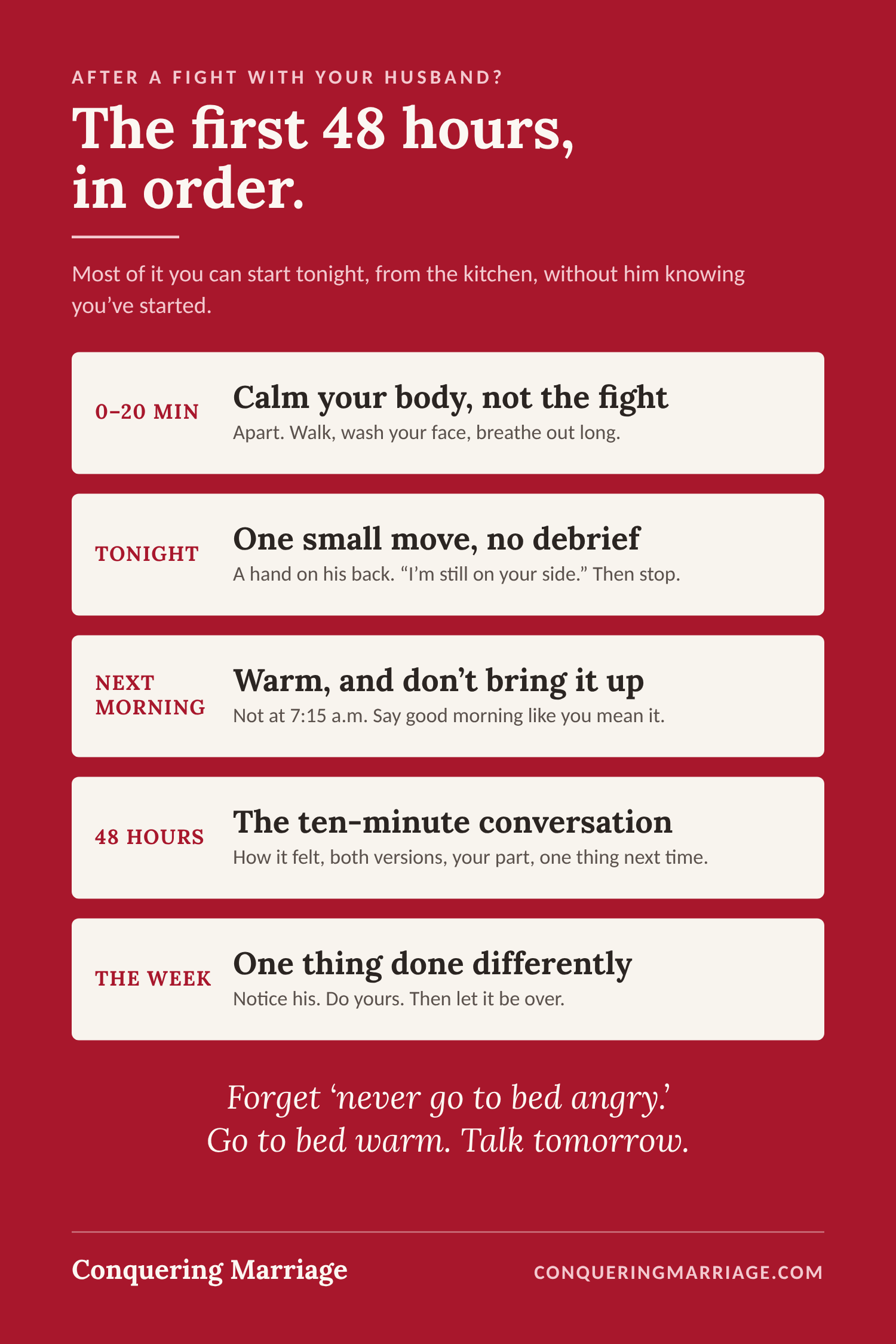
The first 20 minutes: calm your body, not the fight
If your heart is pounding and you can feel your own pulse in your neck, you’re not in a state to fix anything, and neither is he. The Gottman Institute calls this flooding. Once your heart rate climbs past about 100 beats a minute, your body is in fight-or-flight. The part of you that can listen, choose words, and remember that you love him has gone offline. Their guidance is a break of at least 20 minutes apart. Julie Gottman puts it at 20 to 30 minutes, and no more than 24 hours before you come back to each other. That’s why the sequence below reconnects the same evening, even though the real conversation can wait a day or two.
So the first thing to do after a fight is nothing, for 20 minutes, apart. Not scrolling through the evidence for your case, not texting your sister a transcript, not rehearsing the line you should have used. The break only works if your mind actually leaves the fight. Walk around the block. Wash your face. Put the laundry away. Breathe out longer than you breathe in. If you can only do one thing, go outside.
If you need to call the break yourself, say so without making it a verdict: “I need twenty minutes. I’m not leaving this, I just can’t think right now. I’ll come find you.” The second sentence matters. “I need a break” on its own can sound like a door closing, and a man who is also flooded will hear it that way.
Tonight: one small move, no debrief
Here’s the rule you were probably raised on: never go to bed angry. It’s bad advice. Two people who are still flooded, or exhausted, or both, trying to resolve a fight at 11:40 p.m. because a rule says they must, usually start round two. Couples who recover well from fights often don’t resolve them that night. They repair that night and resolve later.
A repair is small. It’s the thing that says “we’re still us” before anything is sorted out. Repair looks like a hand on his back as you pass. A cup of tea put down next to him without a word. “I’m going up. I love you, even tonight.” A joke about the thing you were fighting over, if it’s that kind of fight. The content doesn’t matter; the signal does. You are telling him the fight has not changed what you are to each other.
If you want words, keep them to one line and attach nothing to them: “That got ugly, and I hated it. I’m still on your side. Can we talk properly tomorrow?” If you’re not in the same room, it works as a text. A text even has one advantage: he can read it when he’s ready, instead of having to answer it to your face.
Then stop. Don’t follow the line with “but.” Don’t ask him to agree that it got ugly. Don’t ask him whether he’s still on your side. A repair that needs a response isn’t a repair; it’s a test, and he can feel the difference. If he grunts, or says “fine,” or says nothing, you’ve still done it. It landed; it just hasn’t shown yet. If he’s gone fully quiet and you’re not sure whether to leave it, read the silence section before you do anything else tonight.
So forget “never go to bed angry.” Go to bed warm, and talk tomorrow.
One exception. If “repair” would mean smoothing over something that frightened you, don’t. Things thrown, a wall punched, a threat, a grip on your arm: that isn’t a fight to be repaired tonight. See when it wasn’t just a fight.
Tomorrow morning: warm, and don’t bring it up
The morning after is where most wives undo the repair. You wake up, it’s still there, and the temptation is to open with it over coffee so it doesn’t hang over the day. Resist that. Mornings are rushed and public (kids, work, the clock), and a fight reopened at 7:15 a.m. gets neither of you anywhere except late.
Instead, be warm and ordinary. Say good morning like you mean it. Make his coffee if you usually do, and make it if you usually don’t. Touch him once. Talk about the day. You’re not pretending nothing happened; you’re showing him that the marriage is bigger than what happened, which is the thing that makes the later conversation possible. A husband who has been treated warmly all morning will come to a hard conversation that evening with his guard half down. One who has been given the cold shoulder will come to it armored.
If he’s the one who tries to bring it up at 7:15, you can hold the line gently: “I want to talk about it, properly, not in the next four minutes. Tonight, after the kids are down?” Then make sure tonight happens. The one thing worse than talking too soon is promising to talk and not doing it.
Want the warmth part done for you, one day at a time? Free: The 14-Day Reconnect Plan. One ten-minute action a day, with the exact words to say. Every day is something you can start on your own.
Within 48 hours: the ten-minute conversation
This is the part that actually heals it, and the part most couples skip, either because the repair felt like enough or because they’re afraid of starting it again. Ten minutes, within two days, while it’s still fresh enough to be honest about and far enough away to be calm about. Not at 11 p.m. Not in the car. Not with a glass of wine in your hand. Sitting down, phones elsewhere, one subject.
The Gottman Institute has an exercise for this called the Aftermath of a Fight. It walks a couple through five steps: how each of you felt, each of your versions of what happened, what old thing it touched, what each of you owns, and what you’ll do differently. It’s written for two willing people doing it together. Below is a ten-minute version you can lead with a husband who hasn’t read anything.
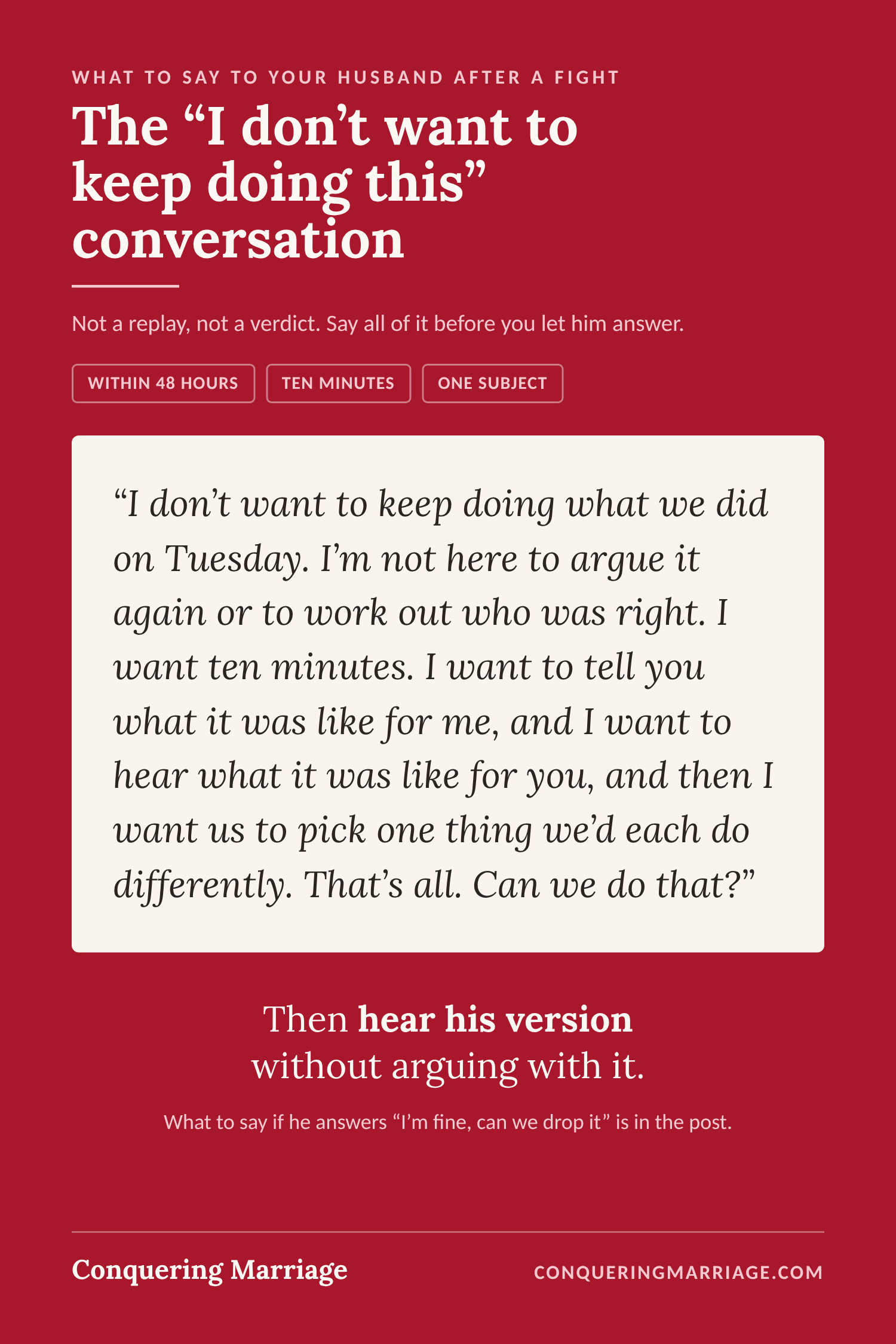
Here’s what to say to your husband after a fight to open it. Say all of it before you let him answer:
“I don’t want to keep doing what we did on Tuesday. I’m not here to argue it again or to work out who was right. I want ten minutes. I want to tell you what it was like for me, and I want to hear what it was like for you, and then I want us to pick one thing we’d each do differently. That’s all. Can we do that?”
Then the five parts, in order.
1. How it felt, for each of you. You go first, and the rule is feelings, not findings. “I felt dismissed. And underneath that I felt scared, because it’s the third time this month.” Not “you dismissed me.” Then ask him: “What was it like for you?” and let him answer badly. He may say “frustrated” and stop. That’s a start, not a failure.
2. His version and yours. Each of you says what you think happened, briefly, and the only rule is that nobody argues with the other person’s version. This is the step that feels impossible and changes the most. His version will be different from yours. It will have you being sharper, earlier, than you remember. It probably isn’t a lie; it’s what it looked like from where he stood. You don’t have to agree with his version. You have to let it be his. The Gottman Institute calls these two subjective realities, and once you’ve accepted that there are two, the fight stops being a trial.
(One limit: if his version always ends with everything being your fault, and you’ve started doubting your own memory, that isn’t two realities. Read when it wasn’t just a fight.)
3. What it touched. Fights that go big over small things usually landed on something older. “When you said you’d handle it and then didn’t, it hit the thing where I feel like I’m the only adult here.” Ask him the same: “Did it land on something for you?” He may not know. Don’t dig; the question is enough.
4. Your part, out loud. One sentence, specific, with no “but” and no trade. “I got contemptuous. The thing about your mother was below the belt, and I knew it when I said it.” That’s it. Don’t follow it with what he did. If he owns his part in return, good; if he doesn’t, you still said yours, and a husband who hears a clean apology once is more likely to offer one next time. There’s more on this below.
5. One thing, next time. Not a new system for your whole marriage; one small, concrete thing each. “Next time, if either of us says ‘twenty minutes,’ we take it, no argument.” Or: “I’ll ask before I assume you forgot.” Write it on your phone if you have to. Then you’re done. Stand up, touch him, make dinner. The conversation is ten minutes because ten minutes is all a conversation like this can carry, and because ending it on time is part of the repair.
The week after: one thing done differently
Healing isn’t finished when the conversation ends; it’s finished when the thing you each said you’d do differently actually happens once. Watch for his, and when you see it, say so: “You asked instead of assuming. I noticed.” Do yours, visibly. Then stop referring to the fight at all. It’s tempting to keep a fight alive for weeks as a reference point (“like on Tuesday, when you…”), usually because you’re still scared it will happen again. It might. But the fight is healed when it’s allowed to be over.
How to apologize so it lands (and how to take his)
An apology after a fight fails in three predictable ways: it comes with a “but,” it comes with an invoice, or it apologizes for the wrong thing.
The “but” is the obvious one. “I’m sorry I yelled, but you weren’t listening.” Everything before the “but” is now gone. If you have a “but,” say the apology and stop. Save the “but” for the conversation, where it belongs in part 1 as a feeling (“I felt unheard”) or in part 3 as what it touched.
The invoice is subtler. “I’m sorry. I just wish you could say sorry too.” Now the apology is a down payment on his, and he knows it. Apologize for your part because it was yours, and let his be his. You’re playing a long game here; a husband who has watched you apologize cleanly, with no bill attached, learns what one looks like.
The wrong thing is the one that stings. “I’m sorry you got upset” isn’t an apology; it’s a description of his reaction. Apologize for what you did: the tone, the word, the door. “I’m sorry I said that about your job. It wasn’t true and it wasn’t fair, and I said it because I wanted to hurt you back. I don’t want to be someone who does that.” That last sentence is the one that lands, because it’s about who you want to be, not about the score.
When he apologizes, and it’s clumsy, take it. “Sorry about last night” might be all he has, and it cost him more than it sounds. If you correct it (“sorry for what, exactly?”), you teach him that apologizing is a trap. Say “thank you” and let it count. You can always ask for the specific version later, in a calm moment, when it won’t feel like a grade.
What to say when he says “I’m fine” or “can we just drop it”
A lot of husbands would rather do anything than the ten-minute conversation, and “I’m fine, let’s just move on” is how they say so. It isn’t always avoidance; sometimes, for him, the repair really was enough and the fight is over. The way to tell is whether things are actually warm or just quiet.
If they’re warm, let him have it this time. You can have the conversation about the pattern later, when it isn’t tied to a specific fight. If they’re quiet, try once, with the ask made small: “I know you’d rather drop it, and I’m not going to go through it again. I need ten minutes, once, to say one thing and hear one thing, and then I’ll leave it. Tonight or tomorrow, your pick.” Giving him the choice of when, and promising a stop, is what makes it possible for a man who dreads these conversations to say yes.
If he still won’t, don’t force it, and don’t punish him for it. Say your part anyway, in one sentence, without the meeting: “Okay. For what it’s worth, I’m sorry about the thing I said about your mother. That’s all.” Then go on being warm. A single fight he won’t talk about usually isn’t a marriage problem. A husband who never, ever will is a pattern. How to reconnect with your husband has a section on the husband who doesn’t want to reconnect, and signs of a failing marriage covers when the quiet itself is the sign.
If he goes silent after a fight
This is the question wives ask most, and page after page about “healing after a fight” skips it: what if he just goes quiet? He’s not yelling; he’s gone. He answers in one word, he’s suddenly very busy in the garage, he’s asleep by nine. You can’t repair with someone who isn’t in the room.
First, work out which silence it is, because there are two and they need opposite things.
The flooded silence. Some men go quiet after a fight because they’re still flooded and they know that if they open their mouth it’ll get worse. This looks like withdrawal, but it’s self-control, and it usually lifts in a few hours to a day. In the Gottmans’ research, men were far more likely to shut down when flooded, and found it harder to come back down. The tell: he’s quiet but not cold. He’ll still pass the salt, still say goodnight, still let you touch him. What to do: leave him alone for the first 24 hours, warmly. Do the small repair (the tea, the hand on the back, the one-line text) and don’t ask for a response. Then be ordinary. Usually he comes back on his own by the next evening, and when he does, don’t say “finally.”
The punishing silence. The other kind is colder. He’s withholding: no eye contact, no goodnight, the children spoken to and you not. Days, not hours. It’s meant to be felt, and it’s meant to make you come to him. The tell is exactly that: the silence has a point, and the point is you. (If his silences frighten you, or you’ve learned to manage his mood so the next one doesn’t come, read when it wasn’t just a fight first.) What to do: don’t chase, and don’t match it. Chasing (repeated texts, following him from room to room, “are we okay? are we okay?”) rewards the silence with the attention it’s angling for. Matching it (your own freeze) turns one cold day into a cold week. Instead, open a door once a day and leave it open. Day one: the small repair, no words needed. Day two: one line, once: “I’m not going to chase you, and I’m not going anywhere. When you