
If you’re searching for how to reconnect with your husband, you probably already know the feeling I’m about to describe. You live in the same house. You talk every day. And somehow you can’t remember the last conversation that wasn’t about the kids, the schedule, or whose turn it is to deal with the thing.
You still love him. Most days you’re pretty sure he still loves you. But you feel more like co-managers of a small, busy household than two people who chose each other. And you’ve started to wonder whether this is just what marriage becomes, or whether something can be done.
Something can be done. Not by grand gestures or a weekend away (though those don’t hurt), but by a handful of small, specific moves that most couples never learn, because nobody teaches them. This guide walks you through them: how to tell what kind of distance you’re dealing with, 10 steps to close it (with the exact words to use), what to do if he doesn’t seem to want to try, and what a realistic timeline looks like.
The short version: figure out which kind of disconnected you are, stop waiting for the big conversation, and start with two-minute moments of turning toward each other. Ask for one specific thing instead of hinting. Say what you appreciate out loud. Give it four to six weeks of consistency before you judge whether it’s working. And if he isn’t trying at all, there’s a section below just for that.
Why couples drift apart (and why it’s usually nobody’s fault)
Here’s the part that might bring some relief: most marriages don’t drift because someone stopped caring. They drift because life got loud.
Kids, work, money, aging parents, a phone that’s always within reach. Every one of these takes a little attention that used to go to each other, and none of them announces itself as a threat to your marriage. There’s no single moment when you stopped being close. There’s just a slow thinning-out of the small moments that used to hold you together: the debrief at the end of the day, the hand on the back as you passed in the kitchen, the inside joke nobody else would get.
Relationship researcher John Gottman calls these small moments “bids for connection,” and his lab’s finding is worth remembering: couples who were still together six years later had turned toward each other’s small bids about 86 percent of the time, while couples who had divorced managed it only 33 percent of the time. Not the big talks. The tiny ones.
That’s good news, because it means reconnecting with your husband doesn’t require solving everything. It requires rebuilding the everyday stuff. And that is something you can start tonight.
First, figure out which kind of disconnected you are
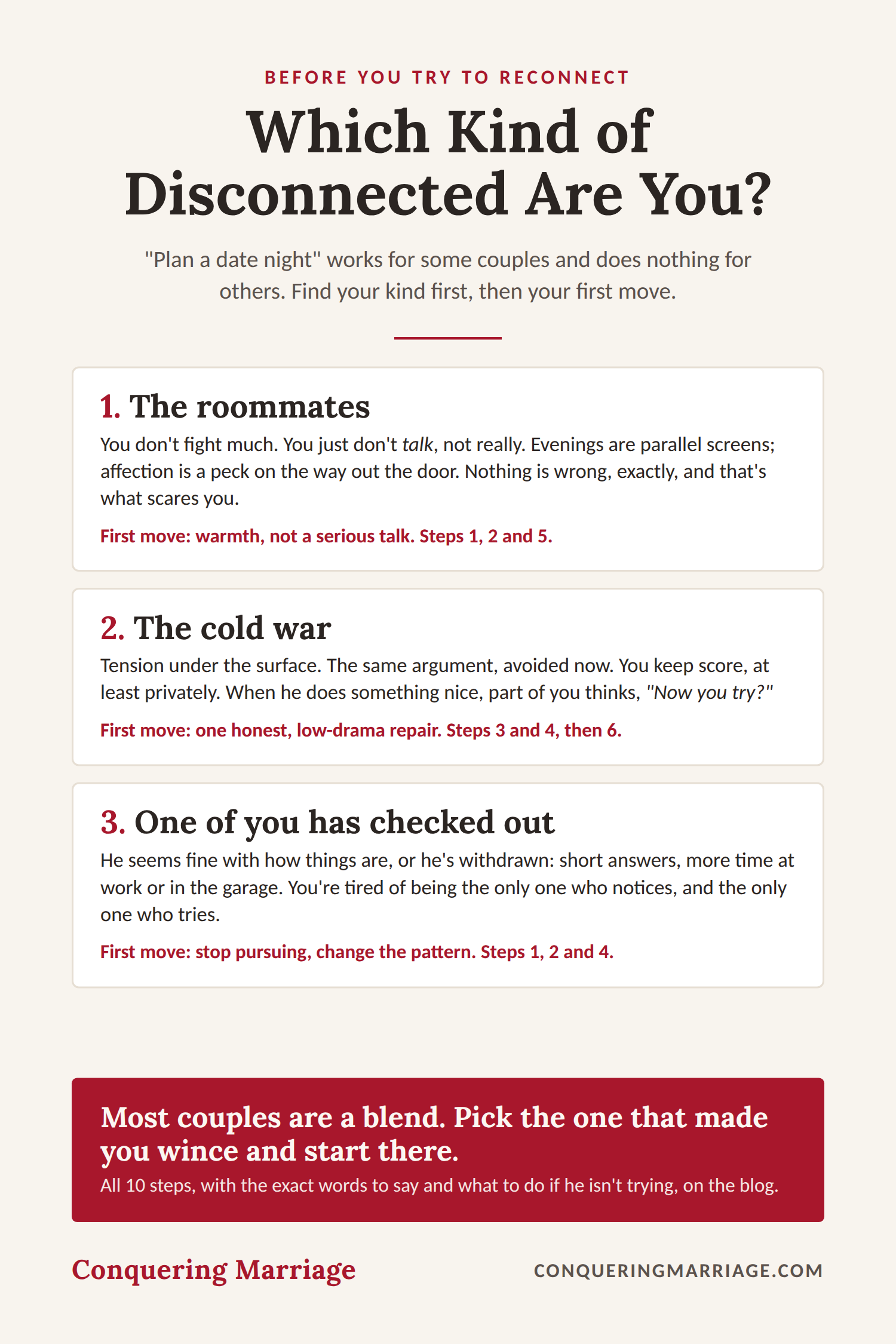
This is the step every list skips, and it’s why so much advice falls flat. “Plan a date night” is great for some couples and useless for others. Read these three descriptions and notice which one sounds like your house.
1. The roommates. You don’t fight much. You’re polite, even friendly. You just don’t talk, not really. Evenings are parallel: him on one screen, you on another. Affection has faded to a peck on the way out the door. Nothing is wrong, exactly, and that’s what scares you.
Your first move is warmth, not a serious talk. Roommates don’t need to “work on the relationship.” They need to remember they like each other. Start with steps 1, 2, and 5 below.
2. The cold war. There’s tension under the surface. You’ve had the same argument (about chores, money, his mother, your hours) enough times that you both avoid it now. You keep score, at least privately. When he does something nice, part of you thinks, “Now you try?”
Your first move is one honest, low-drama repair. The distance here is protecting old hurt, and warmth alone will feel fake until something is named. Start with steps 3 and 4, then 6 once there’s a little warmth back.
3. One of you has checked out. He seems fine with how things are. Or he’s the one who’s withdrawn: short answers, more time at work or in the garage, no interest in fixing anything. You feel like you’re the only one who’s noticed, and you’re tired of being the only one who tries.
Your first move is to stop pursuing and change the pattern. Pushing harder makes a withdrawn husband withdraw further. Start with steps 1, 2, and 4, and read the “what if he isn’t trying” section below before you do anything else.
Most couples are a blend, and that’s fine. Pick the one that made you wince and start there.
How to reconnect with your husband: 10 steps in order
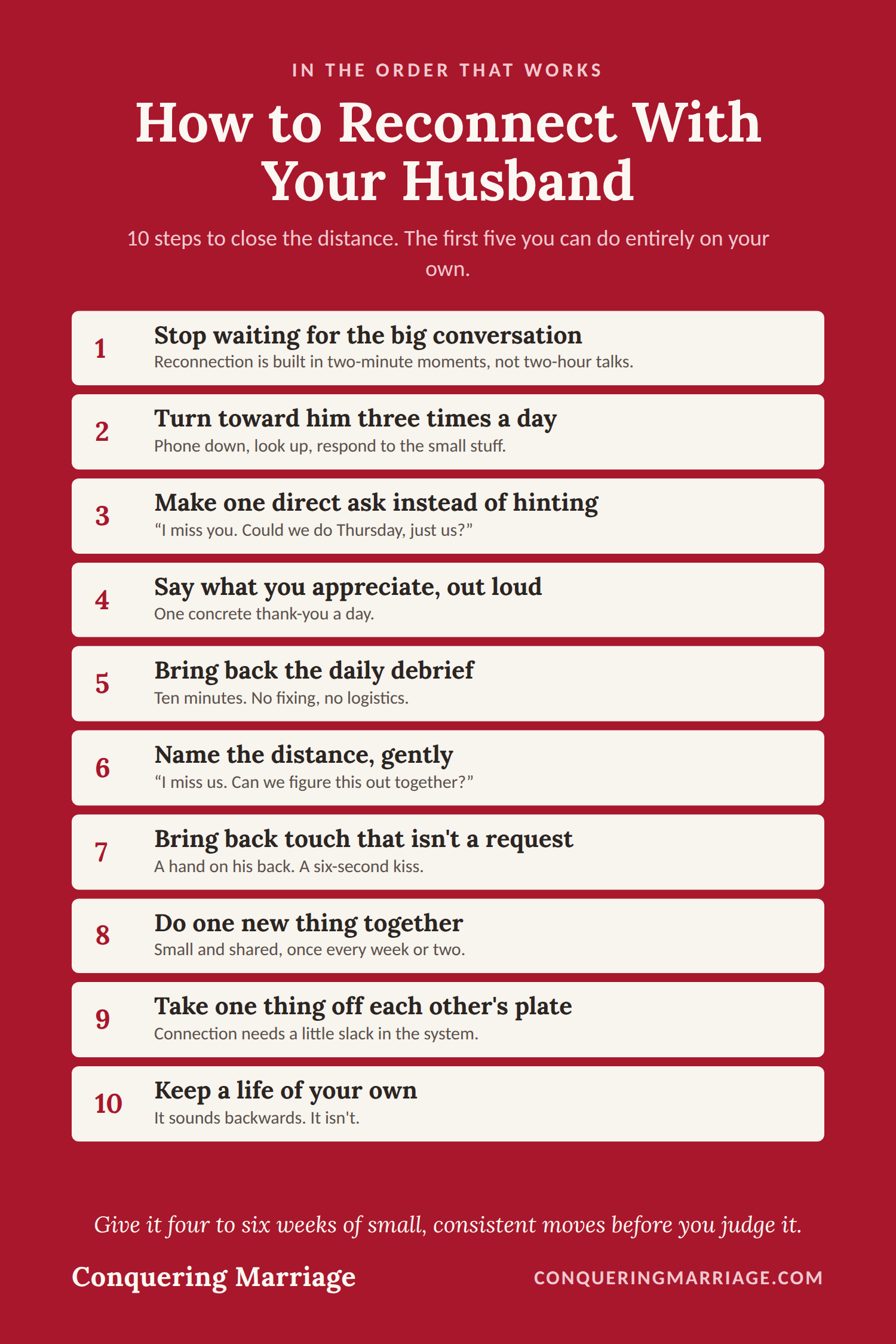
These are in the order that works. The first five you can do entirely on your own; they build the goodwill the later ones need.
1. Stop waiting for the big conversation
Many wives who feel disconnected are quietly waiting for The Talk: the evening where you sit down, lay it all out, and he finally gets it. And they hold back everyday warmth until The Talk happens, because being warm feels like letting him off the hook.
The Talk almost never goes the way it does in your head. He hears “you’ve been failing,” gets defensive, and you end the night further apart.
Skip it for now. Reconnection is built in two-minute moments, not two-hour conversations. You can have the honest talk later (step 6), from a warmer place, and it will go far better.
2. Turn toward him three times a day
This is the Gottman research in practice. When he makes any small bid for your attention (a comment about the game, a sigh, “look at this,” a hand on your shoulder), turn toward it instead of away. Put the phone down. Look up. Respond with something more than “mm-hm.”
“What happened?”
“Show me.”
“You sound wiped. Rough day?”
Three times a day, on purpose. It feels almost too small to matter. It isn’t. This is the single highest-return thing in this whole guide, and you can do it without him knowing you’re doing anything.
3. Make one direct ask instead of hinting
Disconnected couples hint. “It would be nice if we ever did anything.” “Must be nice to have time for golf.” Hints feel safer because they can’t be rejected outright, but they land as criticism, and criticism pushes him away.
Instead, ask for one specific thing, kindly, once.
“I miss you. Could we do Thursday night, just us, no phones, even if it’s just takeout on the couch?”
“I’d love it if you’d text me one thing about your day while you’re at work. It makes me feel like we’re still on the same team.”
Notice the shape: what you feel, then one clear request. No history lesson, no “you never.” If he says yes, you’ve just proven to both of you that asking works, which is the foundation for everything else.
4. Say what you appreciate, out loud, specifically
In a drifting marriage, most of what you say to each other is logistics or correction. He feels it, even if he never says so, and it’s one of the reasons husbands go quiet.
Find one thing a day and say it plainly. Not “thanks for helping.” Concrete: “I noticed you handled bedtime without me asking. That gave me a real breather. Thank you.”
If you’re in a cold war and this feels impossible, start with something small and true. “You make good coffee.” You’re not letting him off the hook. You’re changing the temperature in the room so that the harder conversations become possible.
5. Rebuild the daily debrief (ten minutes, no problem-solving)
Couples who feel close almost always have one thing in common: they know what happened in each other’s day. Couples who feel like roommates don’t.
Bring back a ten-minute end-of-day check-in. The rule that makes it work: no fixing, no logistics. This isn’t the time to sort out the dentist appointment. It’s “What was the best and worst part of your day?” and then actually listening.
If he’s not a talker, go first, keep yours short, and ask one follow-up question about his. Gottman calls this the “stress-reducing conversation,” and it’s built to be the place where you’re on each other’s side against the world, rather than against each other.
6. Name the distance, gently, without blame
Once there’s a little warmth back (give steps 1 through 5 a week or two), you can say the thing out loud. This is the honest conversation from step 1, done at the right time and in the right shape.
The shape is: us, not you.
“I’ve been feeling like we’ve drifted into being roommates, and I miss us. I don’t think it’s anyone’s fault. I just don’t want to keep going like this. Can we figure out together how to get some of it back?”
Then stop talking. Let him respond. If he says “I thought things were fine,” don’t argue. Say “I’m glad they feel fine to you. They feel a bit lonely to me, and I want to fix that with you, not at you.”
You’re not asking him to agree with your diagnosis. You’re inviting him onto your side.
7. Bring back touch that isn’t a request
Physical distance and emotional distance feed each other. When you stop touching casually, every touch starts to feel like it means something (usually “do you want sex?”), and both of you get careful.
Break the pattern with touch that clearly wants nothing: a hand on his back as you pass, sitting close on the couch, a real hug when he gets home, a six-second kiss instead of a peck (another Gottman favorite; six seconds is long enough to actually feel it). If you’ve been avoiding touch because of resentment, start smaller than feels natural. A hand on his arm while you talk.
If sex has faded and it’s weighing on you, the FAQ below covers it. The short answer is that emotional reconnection usually comes first, and it’s fine to say so.
8. Do one new thing together, however small
Novelty wakes couples up. Psychologist Arthur Aron’s research on what he calls “self-expansion” found that couples who did something new and slightly challenging together reported more satisfaction than couples who did something pleasant but familiar.
This does not require a trip. It requires something neither of you has done: a recipe, a walk somewhere you’ve never been, a class, a board game from the closet, a drive with no destination. Aim for once every week or two, and don’t turn it into a project. The point is to laugh together about something new.
9. Take one thing off his plate and one off yours
Overwhelm is one of the biggest silent causes of distance. When both of you are running on empty, there’s nothing left over for connection, and each of you privately thinks the other has it easier.
Ask him what one thing would most lighten his week. Then tell him yours. Trade if you can, or find a way to drop one of them entirely. Connection needs a little slack in the system.
10. Keep a life of your own
This one sounds backwards in a post about reconnecting, but it matters. When your whole emotional world depends on him, every quiet evening feels like a verdict, and the pressure that puts on him makes him pull back.
Keep a friend you see, something you do that’s yours, something you’re looking forward to that isn’t him. You’ll bring more to the marriage, and you’ll be a lot less anxious about the slow days, which makes the good days come sooner. (If you’ve lost your sense of yourself somewhere in the last few years, the How to Be a Better Wife post has a section on exactly that.)
What if my husband doesn’t want to reconnect?
This is the question underneath most of the others, so let’s take it seriously.
First, the honest reframe: “He seems fine with the distance” is usually not the same as “he doesn’t care.” A lot of men have been taught to handle unhappiness by going quiet, working more, or acting like nothing’s wrong. What looks like contentment is often avoidance of a conversation he thinks he’ll lose. That doesn’t excuse it, but it changes your strategy.
What tends to work:
Stop pursuing. If you’ve been the one raising it, asking, and pushing while he retreats, you’re in what therapists call a pursue-withdraw cycle, and pushing harder feeds it. Pull back from the pursuit (not from warmth). Give him room to notice the quiet.
Change one thing he can feel. Pick step 2 (turning toward) and step 4 (a real thank-you) and do them for two weeks without announcing it. Withdrawn husbands respond to a change in the weather far more than to a request to talk about the weather.
Make the invitation small and concrete. Not “we need to work on us.” Instead: “I’d like ten minutes tonight after the kids are down. Nothing heavy. I just miss talking to you.”
Say the true thing once, without a fight. “I’m not trying to start something. I just want you to know I’ve been feeling far from you, and I’d like that to change. You don’t have to answer now.” Then let it sit. Men often come back to a sentence like that days later.
Then give it real time. Four to six weeks of you doing the small things consistently. Not because you owe him that, but because it’s the only way to find out whether the distance is habit (very fixable) or something deeper.
If after that he still won’t meet you anywhere, that’s information, and you deserve to have it. It might mean a counselor (see below). It might mean the harder questions in Is My Marriage Over? and Signs of a Failing Marriage. Either way, you’ll have tried the things that actually work, and you’ll know.
How long does it take to reconnect with your husband?
Most advice skips this question, so here’s an honest range.
The first week: you’ll mostly notice your own effort. He may not respond much. That’s normal; he doesn’t know the rules have changed.
Two to three weeks: small responses. He lingers in the kitchen. He tells you something about work without being asked. He reaches for your hand once. Don’t make a big deal of it; just meet it.
If you see none of this by week three, don’t escalate. Keep going; the point is to change the weather, not to check his response every day.
Four to six weeks: if the distance was habit and overwhelm (most cases), this is where it starts to feel different. Not fixed, but warmer. This is the point to have the “I miss us” conversation from step 6 if you haven’t yet.
Two to three months: a marriage that’s been drifting for years can feel like a real partnership again. Not the honeymoon. Something better than the spark coming back: two people who know how to find their way back to each other.
If there’s an old betrayal, a long cold war, or a husband who’s fully checked out, expect longer and consider getting some help. And if things aren’t moving at all after six weeks of real, consistent effort, that isn’t a sign to try harder alone.
A 7-day starter plan
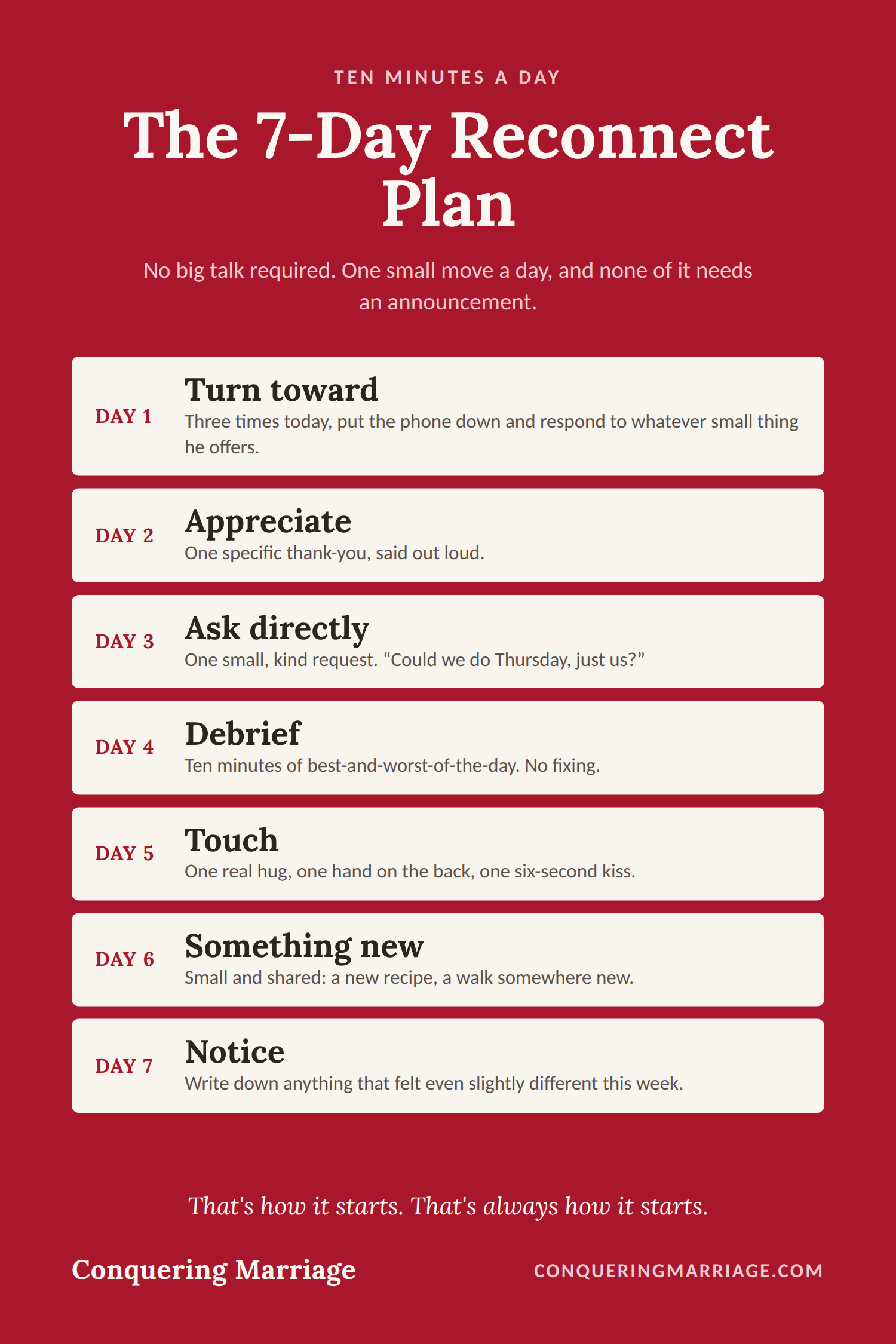
Here’s a first week built from the steps above. Ten minutes a day, and none of it needs an announcement.
- Day 1 — Turn toward. Three times today, put the phone down and respond to whatever small thing he offers.
- Day 2 — Appreciate. One specific thank-you, said out loud.
- Day 3 — Ask directly. One small, kind request. “Could we do Thursday, just us?”
- Day 4 — Debrief. Ten minutes of best-and-worst-of-the-day, no fixing.
- Day 5 — Touch. One real hug, one hand on the back, one six-second kiss.
- Day 6 — Something new. Small and shared: a new recipe, a walk somewhere new.
- Day 7 — Notice. Write down anything that felt even slightly different this week. That’s your evidence that this works.
Want the full 14 days?
The 7-day plan above is the first half of The 14-Day Reconnect Plan: one ten-minute action a day to feel like a couple again, including the honest conversations for days 8 through 14, with the exact words to say. Free for subscribers.
When reconnecting on your own isn’t enough
Two situations where I’d stop reading blog posts and get real help.
See a counselor if you’ve done the small things consistently for six weeks and nothing has shifted, if there’s an affair or a betrayal in the background, or if every attempt to talk turns into the same fight. Good couples therapy isn’t a last resort; it’s a shortcut. You don’t need him to agree to go for it to help; many wives start alone. How to Save Your Marriage covers how to find one and what to expect.
Get a different kind of help if the distance comes with contempt, control, intimidation, or fear. That isn’t distance, and no plan like this one is the answer. You’re not failing at reconnecting. You’re being asked to carry something this plan was never built for. In the U.S., call the National Domestic Violence Hotline at 1-800-799-7233, text START to 88788, or chat at thehotline.org, any time. Outside the U.S., your local domestic-abuse helpline can help you think it through.
Frequently asked questions
How do I reconnect with my husband emotionally?
Start smaller than you think. Emotional reconnection is built from daily moments of turning toward each other (step 2), specific appreciation (step 4), and a short no-fixing debrief each evening (step 5). Once there’s a little warmth back, name the distance gently using “us” language (step 6). Most couples feel a shift within four to six weeks of doing these consistently.
Why do I feel so disconnected from my husband?
Usually because the small daily moments that hold a marriage together (the debrief, casual touch, noticing each other) have been crowded out by kids, work, screens, and exhaustion, not because either of you stopped caring. Sometimes there’s unspoken resentment underneath, and that needs to be named before warmth will feel real. The “which kind of disconnected are you” section above helps you tell the difference.
We feel like roommates. Is that normal?
It’s extremely common, especially with young kids or heavy work seasons, and it’s one of the most fixable kinds of distance. Roommates don’t need a serious talk; they need to remember they like each other. Focus on warmth first: turning toward, the daily debrief, and one new thing together each week.
What if my husband seems fine with the distance?
Stop pursuing, change one or two things he can feel (turning toward, a real thank-you), keep the invitation small, and say it plainly, once. Give it four to six weeks. If he still won’t meet you, a counselor or the questions in Is My Marriage Over? come next. The full section above walks through it.
How do I reconnect with my husband after a big fight?
Repair before you rehash. A short, sincere acknowledgment of your part (“I was harsh last night, and I’m sorry”) opens the door far better than re-litigating who was right. Then rebuild warmth for a few days before you revisit the issue itself. There’s a full walkthrough in How to Heal a Relationship After a Fight.
How do we reconnect after having kids?
Protect one ten-minute window a day that belongs to the two of you (after bedtime, before screens), lower the bar for “date night” to takeout on the couch, and trade off one task each so you’re both slightly less depleted. Resentment about uneven loads is usually the real barrier; make one direct ask about it (step 3). How Not to Hate Your Husband After Kids goes deeper.
What about sex? We’ve barely touched in months.
For most wives, emotional closeness comes first and desire follows; for many husbands it’s the reverse, which is why couples get stuck. Start with touch that clearly wants nothing (step 7) so that touch stops feeling like a negotiation, and be honest, kindly: “I want that back too. I think I need to feel close to you first, and I’m working on that.” If it’s been a long time and it’s causing pain on either side, this is a good topic for a counselor.
How long should I give it before I worry?
Four to six weeks of consistent everyday effort is a fair test; most couples feel a real change by then, and a genuine partnership again in two to three months. Old betrayals or a fully checked-out husband take longer and go better with help. The timeline section above has the week-by-week picture.
Is it too late to reconnect with my husband?
Rarely, if you both still show up. Marriages that have drifted for years come back all the time once the small daily habits return. It’s harder when one person has already decided to leave, or when there’s contempt or fear in the house. If you’re not sure which you’re dealing with, What to Do When You’re Not Happy in Your Marriage helps you sort it out.
One last thing
You found this page because you noticed the distance and decided to do something about it. That instinct is worth more than any tip on this list. Keep it, and keep a little of yourself, too. Marriages don’t come apart from one bad season; they come apart when nobody turns toward the other person for long enough that it starts to feel normal.
So pick one step. Tonight. Put the phone face down, look up when he walks in, and say something small and true. That’s how it starts. That’s always how it starts.
Free: The 14-Day Reconnect Plan
One ten-minute action a day, from the first small moments to the honest conversations. Every day is something you can start on your own.