
If you’re reading this, you’ve probably already said the sentence to yourself, maybe for the first time, maybe for the hundredth: I’m not happy in my marriage. You may not have said it to anyone else. You may not even be sure it’s true, only that something has been flat, or heavy, or lonely for longer than you’d like to admit.
I’m not going to tell you to plan a date night. You’ve read that article. I’m going to help you work out which kind of unhappy this is (because there are several, and they need different first moves), then walk you through what to do, in order, including the exact words for telling your husband.
The short version: first work out whether you’re unhappy with a season, the marriage, one specific thing, or your life; each needs a different first move. Then stop what makes it worse, put warmth back, and tell him while it’s still a request, not a verdict. Give it a fixed season.
If you’re not just unhappy but frightened, controlled, or hurt, skip everything else and go to when it’s more than unhappy.
Table of Contents
First: which kind of unhappy is this?
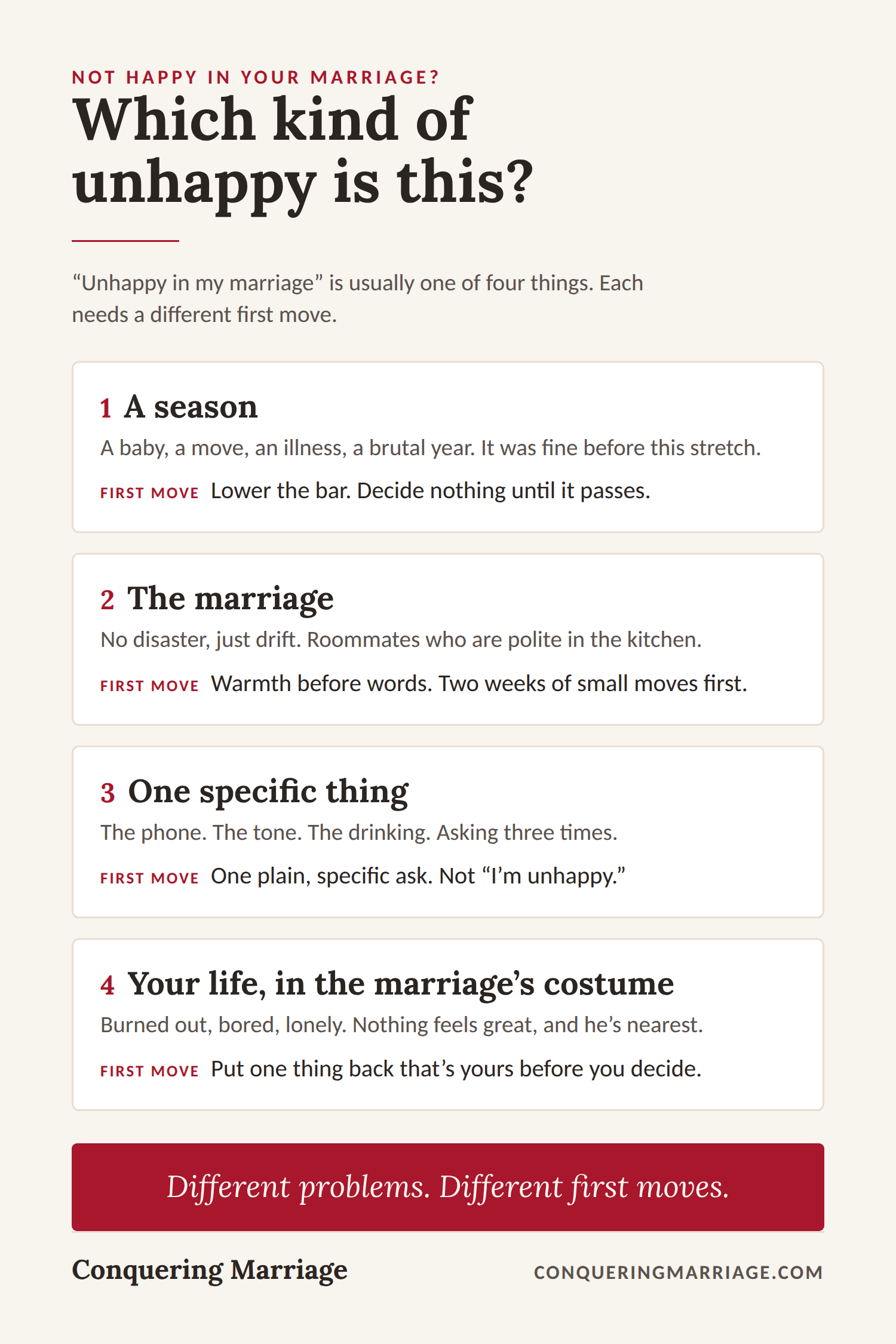
“Unhappy in my marriage” feels like one thing. It’s usually one of four, and the first move is different for each. Read all four and pick the one that made your stomach drop.
1. You’re unhappy with a season. A baby, a move, a job that eats him alive, an illness, a death in the family, a year where you never once had a full night’s sleep. The marriage was fine before this stretch and it’s mostly the stretch that’s hard. First move: lower the bar, name the season out loud to each other, and don’t make any decisions about the marriage while you’re in it. Step 3 and step 4 below matter most for you.
2. You’re unhappy with the marriage. No single disaster, just drift. You’ve become roommates, or logistics partners, or two people who are polite in the kitchen. You don’t fight much; you don’t feel much. This is probably the most common kind, and the most fixable, because nothing is broken; it’s just been left alone. First move: warmth before words (step 4). If this is you, how to reconnect with your husband when you feel like strangers is the companion to this post.
3. You’re unhappy with one specific thing. He drinks more than you’re comfortable with. He’s on his phone through every evening. He won’t help without being asked. He talks to you in a tone he’d never use on a coworker. The rest of the marriage might be okay, but this one thing is taking up all the room. First move: a plain ask (step 6) rather than leading with a general “I’m unhappy” conversation, which he’s likely to hear as “everything about you is wrong.”
4. You’re unhappy with your life, and the marriage is wearing the costume. You’re burned out, bored, lonely, grieving, or you’ve lost the parts of yourself that weren’t “wife” and “mom.” The marriage isn’t great, but honestly, nothing is. This one is easy to misdiagnose, because he’s the nearest target. First move: step 7. Put back one thing that’s yours before you decide the marriage is the problem.
Two more things. If you read those four and thought “it’s all four,” that’s normal, and you should start with the one you can change fastest, which is usually 3 or 7. And if you read them and thought “none of these; it’s that I feel relief when he leaves and dread when he comes back,” that’s a heavier question than this post, and Is my marriage over? How to tell a hard season from the end has a scored self-check that will serve you better than anything here.
The mistake unhappy wives make most often
Here’s the pattern therapists see over and over, and it’s worth understanding before you do anything else, because it decides whether the rest of this post works.
In the early years, she asks for more: more time, more talk, more help. He doesn’t hear it as urgent. Over the years, the asks turn into complaints, the complaints turn into bitterness, and the bitterness turns into contempt. Then, at some point, she stops. Not because things are better, but because she’s tired of asking. From the outside, the marriage gets quieter. He reads the quiet as “we’re fine.” She’s quietly planning. When she finally says she’s done, he’s blindsided and suddenly willing to do everything she asked for ten years ago.
Marriage therapist Michele Weiner-Davis named this the “walkaway wife” pattern (and, as she says, it runs both ways: his retreat feeds it too). If you’ve been searching this question at night, some part of it may sound familiar.
The point isn’t that you’ve done something wrong. The point is that there’s a window, and you may still be in it: the window where your unhappiness is still a request and hasn’t become a verdict. Everything below is built to keep you in that window, and to use it. The single most useful thing you can do this month is say it to him while it’s still a request. Not in anger, not as an ultimatum, not after a fight. Step 5 has the words.
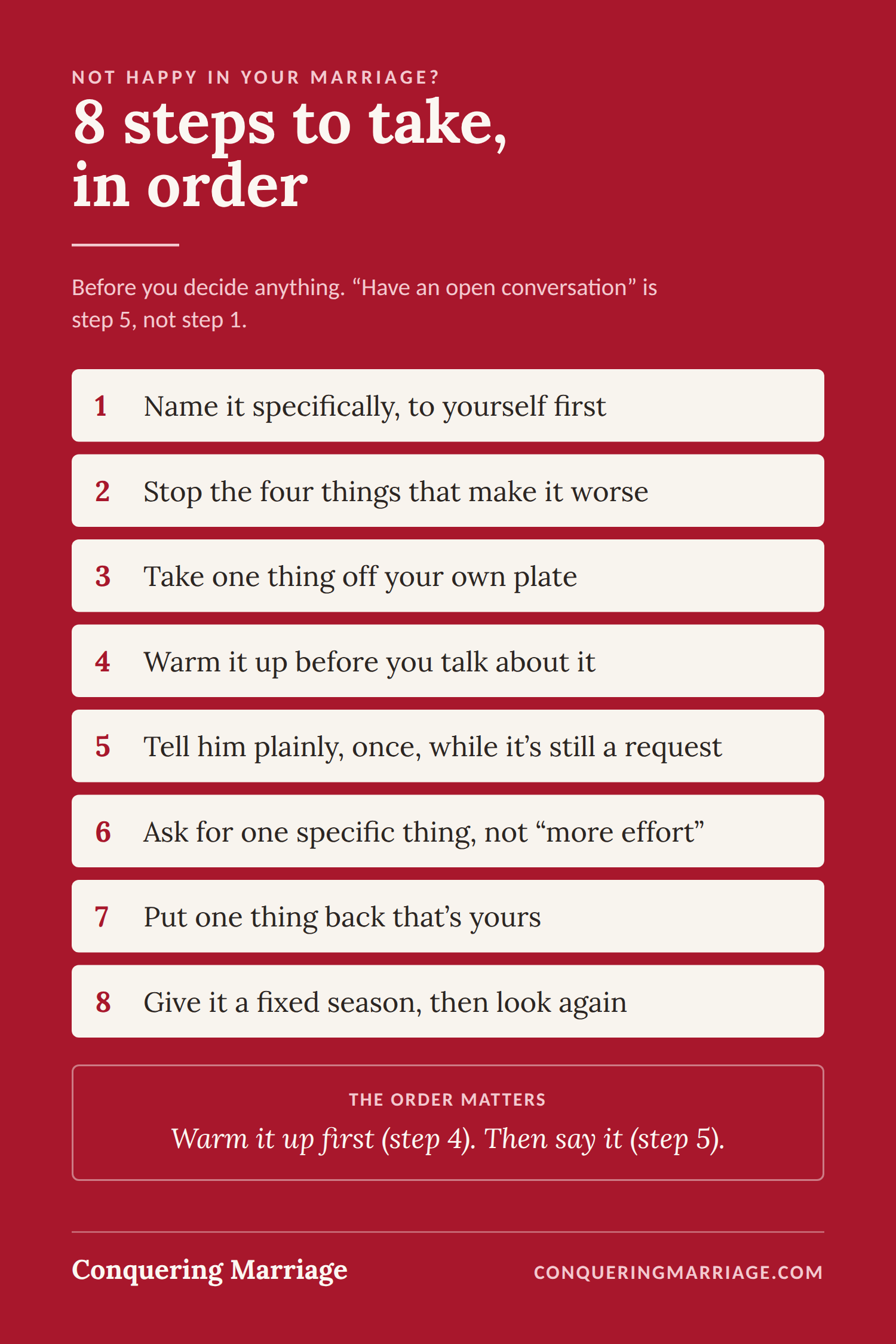
What to do when you are not happy in your marriage: 8 steps, in order
The order matters. Most unhappy-marriage advice starts with “have an open conversation.” That’s step 5, not step 1, and there are reasons it comes after the others.
1. Name it specifically, to yourself first
“I’m not happy” is true, but it’s not usable. He can’t act on it and neither can you. So before anything else, get a notebook or your phone and finish these three sentences honestly. Nobody sees this.
- The thing I miss most is… (being touched without it leading anywhere · having someone ask about my day and wait for the answer · laughing together · feeling like he’d choose me again)
- The thing that wears me down most is… (asking three times · being the default parent · his phone · the tone · the drinking · feeling invisible)
- If one thing were different two months from now, I’d want it to be…
That third sentence is the one you’ll use later. If you can’t answer it, that’s information too: it usually means kind 4 (your life, not just the marriage), and step 7 matters more than anything.
2. Stop the four things that make it worse
Unhappiness in a marriage has a way of feeding itself. These four habits are how. You don’t have to fix the marriage this week, but you can stop watering the weeds.
Venting to the friend who already hates him. Every retelling to someone who’s decided he’s the villain hardens the story a little more. Talk to the friend who likes you both, or to a counselor, or write it down.
Keeping score. The mental ledger of everything you do versus everything he doesn’t. It’s usually accurate, and it’s still poison, because it turns every small kindness he does manage into “well, finally.”
The comparison scroll. Other people’s anniversaries, other husbands’ flowers. You’re comparing your Tuesday to their highlight reel.
Silent tests. “If he really loved me he’d notice I’ve been quiet.” He won’t notice, or he’ll notice and not know what to do, and you’ll add it to the ledger. Silent tests are how a request becomes a verdict without him ever hearing the request.
3. Take one thing off your own plate
Maybe you’re the one who carries the mental load: the appointments, the birthdays, the sunscreen, the knowing where everything is. If so, some of what feels like “I’m unhappy with my marriage” is “I’m running on empty, and he’s the person standing nearest.” Before you can be honest about the marriage, you need a little slack.
So this week, drop one thing entirely (the thing nobody will die without), and hand one thing over completely: deadline, consequences (“you own the dentist; I’m not going to remind you”), and the freedom to do it worse than you would. If resentment about the load is the main thing you feel, see how not to hate your husband after kids, which walks through handing over whole jobs, not tasks.
4. Warm it up before you talk about it
This is the step everyone skips, and it’s why “we talked about it and nothing changed” is such a common story. A serious conversation about the marriage, landed on a cold marriage, gets heard as an attack, and he gets defensive or goes quiet. The same conversation, after two weeks of small warmth, gets heard as an invitation.
So for the next two weeks, before the conversation, do small things that need nothing from him: a hand on his back as you pass, one real question about his day and then actually listening, a “thank you” for something ordinary, ten minutes on the couch with no screen. Not because he’s earned it. Because you’re building the ground the conversation has to stand on.
If you want that done for you, in order, with the words, that’s precisely what the free 14-Day Reconnect Plan is: two weeks of one ten-minute action a day, warmth first, the honest conversations in week two. Every day is something you can start on your own. He doesn’t have to know you’re doing it.
Not happy, but not ready to have The Talk? Start with two weeks of small steps. Free: The 14-Day Reconnect Plan. One ten-minute action a day, with the exact words to say. Every day is something you can start on your own.
5. Tell him plainly, once, while it’s still a request
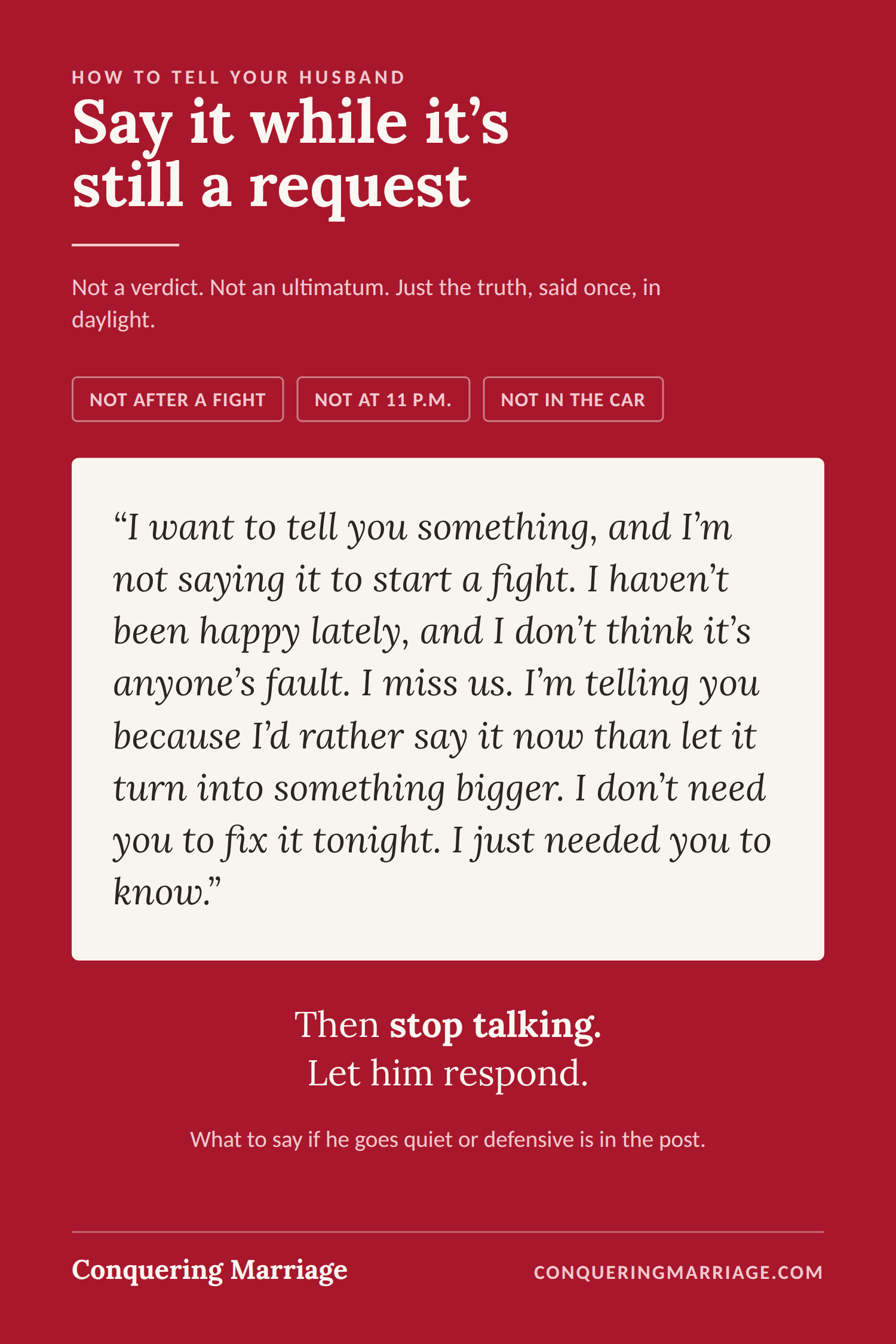
Not after a fight. Not at 11 p.m. Not in the car with the kids in the back. Pick a calm, ordinary evening, sit near him, and say something close to this:
“I want to tell you something, and I’m not saying it to start a fight. I haven’t been happy lately, and I don’t think it’s anyone’s fault. I miss us. I’m telling you because I’d rather say it now than let it turn into something bigger. I don’t need you to fix it tonight. I just needed you to know.”
Then stop talking. Let him respond. He may go quiet, or get defensive, or say “I thought we were fine.” All three are normal. Your only job in that moment is not to escalate: “I know. That’s why I’m telling you now, while it’s just this.”
What you’re doing here matters more than it looks. You’re moving your unhappiness from your own head, where it has been quietly hardening, into the space between you, while it’s still soft enough to do something with. Most husbands who get blindsided by “I’m done” were never told “I’m not happy” in a way they could hear.
6. Ask for one specific thing, not “more effort”
(If the sorter sent you straight here, one specific thing, this can be your first conversation. Open with one calm sentence of step 5’s framing, then make the ask.)
A few days after the first conversation, once he’s had time to sit with it, come back with the sentence from step 1, the “one thing different two months from now.” One thing. Specific. Doable this month.
Not: “I need you to be more present.” (He’ll nod, and nothing will change, because nothing was asked.)
But: “I’d like us to have twenty minutes after the kids are down, no phones, three nights a week. Could we try that for a month?”
Not: “I need more help around here.”
But: “Could you own bedtime on Tuesdays and Thursdays, start to finish, so I get two evenings back?”
If the specific thing is bigger (the drinking, the tone, the phone), same rule, plainer words: “When you talk to me like that, something in me closes. I need it to stop. Can you work on it?” One ask, clearly made, is worth twenty rounds of hinting.
One limit: if the drinking is addiction he won’t look at, or the tone frightens you rather than just wears you down, a specific ask isn’t the right tool. See when it’s more than unhappy.
7. Put one thing back that’s yours
If you found kind 4 in the sorter (unhappy with your life, and the marriage is the nearest target), this is your most important step, and it’s the one most “fix your marriage” articles never mention. A marriage can’t be the only source of your happiness. It was never built to be.
So this month, put one thing back that was yours before it all got absorbed: the friend you haven’t seen since the baby came, the class, the run, the book club, the thing you used to be good at. Not to get away from him. To come back to him as someone with a life of her own, who is, not coincidentally, the person he fell for. Unhappy wives who do this often find the marriage looks different from a slightly fuller life, and even when it doesn’t, they have more of themselves to decide with.
8. Give it a fixed season, then look again
Decide, now, on a date: eight weeks from today. Between now and then, do steps 2 through 7 in good faith, and don’t re-decide the marriage every night. Deciding and un-deciding at midnight isn’t deciding; it’s spinning, and it’s exhausting. Close the question until the date.
On the date, ask yourself three things: Did anything move? Did he try, even clumsily? Do I feel more like myself than I did eight weeks ago? If the answers are mostly yes, you’re in a hard season, not a dead marriage, and the thing to do is keep going. If they’re mostly no, Is my marriage over? How to tell a hard season from the end has a scored self-check and a longer six-week honest test that will help you look at the harder question with clear eyes.
If he doesn’t respond, or you’re the only one trying
This is the question underneath everything above, and I want to answer it straight.
First: one person changing the pattern does change the marriage. Not always enough, but never nothing. When you stop scorekeeping, stop the silent tests, put warmth back, and ask for what you need, you change what he’s responding to, and many husbands respond to that within a few weeks, even if they’d never have started it. The old version of this post said the fix “is up to you two.” That’s true at the end. It’s not true at the start. The start can be you.
Second: give it long enough to be a fair test, then say so. If, after your fixed season, you’ve done your side and he’s done nothing (not “not enough,” but nothing), then say that too, plainly:
“I’ve been trying for the last two months, and I’ve told you what I need. I don’t feel like you’re meeting me. I’m not threatening anything. I’m telling you I can’t keep doing this by myself, and I need to know if you’re in.”
That’s not an ultimatum. It’s the truth, said once, in daylight. What he does with it will tell you something the self-checks can’t.
Third: you can get help without him. A counselor of your own isn’t “going behind his back”; it’s getting a second pair of eyes on a pattern you’re too close to see. If he’ll come, couples counseling; if one of you isn’t sure you even want the marriage fixed, ask for a discernment counselor specifically, who works with exactly that.
If you’re unhappy but you can’t leave, or don’t want to
Some of you aren’t asking how to fix it or whether to leave; you’re asking how to be happy in an unhappy marriage, or at least okay in one. You’ve already run the numbers, or the faith question, or the kids question, or you simply know in your bones that you’re staying. You’re not looking for an exit; you’re looking for a way to be okay inside a marriage that isn’t what you hoped. That deserves a straight answer too, and here it is.
You can be more content in a marriage that stays imperfect, and it’s not the same as giving up. It looks like this: grieve the marriage you thought you’d have, on purpose, once, instead of a little every day. Stop arguing with reality about who he is; the fifth time you’re disappointed by the same thing, the disappointment is optional. Contain the rumination to a window (twenty minutes and a notebook, then you’re done for the day, because the nightly replay makes everything feel worse than it is). Build a life with people in it who aren’t him. And keep the low-cost warmth going, because a warm-enough marriage that’s not a great one is a real thing, and a lot of long marriages live there.
Two honest limits. This only works for a marriage that is unhappy but safe and respectful: if he’s cruel, controlling, or in an addiction he won’t look at, “acceptance” is the wrong tool, and the exceptions below apply. And “staying well” still needs step 5 and step 6. Staying quietly, without ever having said it, is how the walkaway-wife story starts; you can stay and still be honest.
Should I stay in an unhappy marriage for the kids?
You’ll find people who’ll tell you flatly to stay and people who’ll tell you flatly to go, and both are answering a different question from the one you’re asking. Here’s the honest version.
Children generally do well in a calm two-parent home. They also generally do well after a divorce that’s handled with respect. What they don’t do well in is a home full of contempt, cold silence, or shouting: a home where they can feel that the two most important people in their lives can’t stand each other. So “stay for the kids” is only protective if the marriage you’re staying in is one they can feel okay inside.
That reframes the question. It isn’t “stay or go, for the kids.” It’s “which version of me can be a calm, present parent, and what would it take to be her?” For many unhappy wives, the answer is “this marriage, repaired,” and the eight steps above are how you find out. For some, it’s “this marriage, imperfect but warm enough,” and the section above that one is for you. For a few, it’s “not this marriage as it is,” and if that’s where the fixed season leaves you, Is my marriage over? will help you take the next question seriously without rushing it.
One more thing, said gently: kids are better at reading a home than we think. Staying “for them” in a marriage soaked in resentment doesn’t hide the resentment. It teaches them that this is what marriage is.
What the research says about staying
I’m careful with statistics in these posts, because most of the ones quoted at unhappy wives are either made up or missing half the story. So here’s one, with the whole story.
In the early 2000s, a team of family researchers went back to a large national survey and looked at adults who had rated their marriage unhappy, to see where they were five years later. Among those who stayed married,