
You’re here because you want to know how to save your marriage, or whether it can be saved at all, and every page you’ve opened has handed you a list. Twenty tips. Thirty-three ways. Thirty-seven essentials. You don’t have the energy for thirty-seven anything. You want to know what to do first, what to stop doing tonight, and what to say to him. And if you’re honest, there’s a harder question under all of it: what if you’re the only one trying?
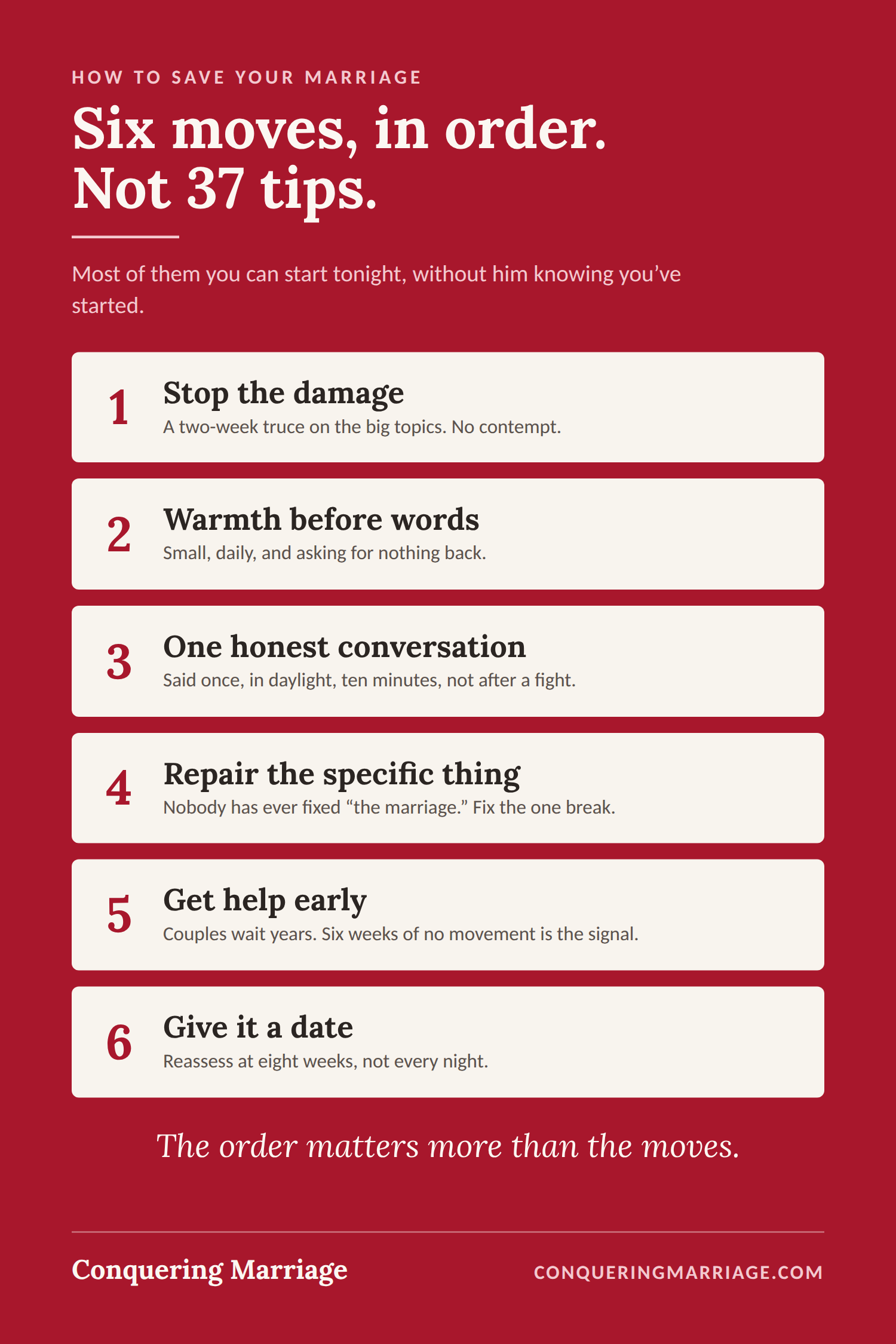
So here’s the whole thing up front. Saving a marriage is not thirty-seven things; it’s six moves, done in order, and the order matters more than the moves. Most of them can be started by one person, and this article tells you how, including the exact words.
The short version: stop making it worse tonight (the 11 p.m. talks, the audit, the ultimatum). Put warmth back for a week or two before any big conversation. Then say once, plainly, that you want this and what you’re asking for. Fix the specific break. Get help early. Reassess on a date.
If fear is part of what you’re feeling (you manage his moods, you’re careful what you say, he’s hurt you or threatened to), saving the marriage is not the first job. The same goes if there’s an affair or an addiction in the picture. Go to when saving it isn’t the first job before anything else here. And if you already know he’s stopped trying, there’s a whole section for you; read it before the six moves, because it changes how you do them.
Table of Contents
First: what “saving your marriage” actually means
Most of the advice out there talks as if a marriage is saved the day you both agree to work on it. That’s the beginning, not the end. A marriage is saved when the two of you can have a hard conversation and come out the other side still on the same team. It also needs enough warmth in an ordinary Tuesday that the hard conversations don’t come around every week. That’s the target: not a marriage with no problems, but a marriage that can take a problem.
It helps to know what “saved” is not. It isn’t quiet. Plenty of marriages go quiet because one person gave up, and from the outside that looks like peace. It isn’t the honeymoon, either. You’re not trying to get back to year one; you’re trying to get to something you’ve never had: the two of you handling life together, with years’ worth of knowledge about each other. And it isn’t you doing all the work forever. A marriage where one person carries it indefinitely is not saved; it’s postponed. There’s more on that below.
Which kind of broken is it? Four kinds, four first moves
“Save my marriage” covers four very different situations, and the first move is different for each. Find yours before you start.
1. You’ve drifted: roommates, not enemies
There’s no big fight. There’s no fight at all. You run a household well and a marriage badly, and you can’t remember the last conversation that wasn’t about logistics. This is the most common kind and the most fixable, and it’s usually fixed by warmth, not by talking about the distance. First move: Move 2 (warmth) before anything else. Don’t open with a big conversation about how far apart you’ve grown; to a man who hasn’t noticed, that sounds like an accusation, and to a man who has, it sounds like a verdict. If this is you, how to reconnect with your husband walks through it in detail.
2. You’re stuck in a fight cycle
Same argument, different day. It starts about the dishwasher and it’s about everything by minute four. You both know the lines. Neither of you feels heard, and the fights are getting closer together. First move: Move 1 (stop the damage) with a two-week truce on the big topics, then Move 3, one conversation, done properly. Fight cycles are loud, which makes them feel worse than the roommate kind, but loud is two people still trying to be heard. That’s workable.
3. Something specific broke
An affair, a lie about money, a betrayal about the kids or his family, a thing he said that you can’t unhear. There’s a before and an after. First move: if it’s an affair or an addiction, read when saving it isn’t the first job first, because the sequence is different. For the other breaks, Move 4 (repair the specific thing) comes before warmth. You can’t put warmth on top of an unrepaired break; it slides off.
4. He’s already halfway out
He’s said “I don’t know if I want this anymore,” or he’s sleeping in the other room. Or he’s simply stopped: no fights, no effort, no eye contact, and a sense that he’s made a decision he hasn’t told you about. This is the frightening one, and it’s the one where most of the advice you’ll find makes it worse, because the instinct is to chase. First move: the only one trying section, then Move 1, then, and this will feel wrong, Move 2 in a very specific form. If there’s any fear in the mix, that comes first.
What to stop doing tonight
Before the six moves, this. Most of what makes a struggling marriage worse isn’t cruelty. It’s love and fear doing things that feel like trying. If you recognize yourself in these, you’re not a bad wife; you’re a scared one, and these are what scared people do.
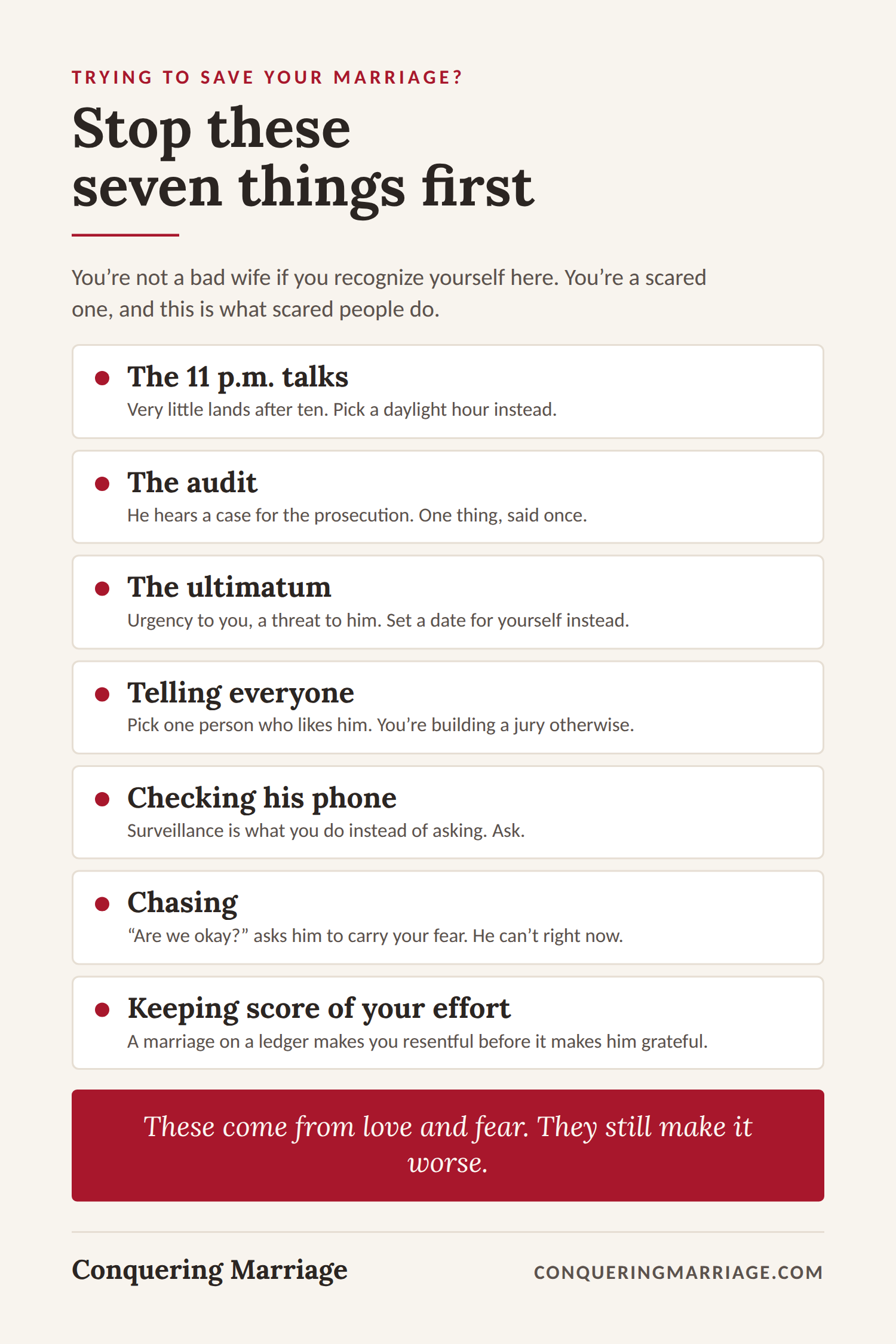
The 11 p.m. talks. The big conversation that starts when you’re both exhausted, in the dark, after the kids are down, because that’s the only time there is. Very little said after ten at night in a struggling marriage helps. He’s braced for it the moment you say “can we talk,” and you’re too tired to say it the way you mean it. Stop having them. Move 3 tells you when and how instead.
The audit. Going through everything that’s wrong, in order, with examples. You’ve been holding it for months and it comes out as a list. He hears a case for the prosecution, and a man who feels prosecuted defends, and now you’re in the fight cycle. One thing at a time, said once.
The ultimatum. “If this doesn’t change by Christmas, I’m done.” You mean it as urgency. He hears a threat, and people rarely reconnect under threat; they comply or they leave. There is a place for a date (Move 6), but it’s a date you set for yourself, not a deadline you hand him.
Telling everyone. Your sister, your two closest friends, your mother, the group chat. It’s how women survive, and I’d never tell you to have no one. But pick one person, choose someone who likes him, and keep the rest for later. If you spend six months telling five people what’s wrong with him, you’ve built a jury, and even if the marriage recovers, they haven’t. (If you’re afraid of him, this one doesn’t apply. Tell whoever you need to, and start with the hotline below.)
Checking his phone. If there’s a real reason to, that’s a different situation, and it’s below. If there isn’t, surveillance is what you do instead of asking, and it makes you into someone you don’t like. Ask instead. Move 3 has the words.
Chasing. Texting to check where things stand. Asking “are we okay?” at the end of every good evening. Re-raising the conversation you already had because his answer wasn’t reassuring enough. Every one of these asks him to carry your fear, and a man who is already unsure of the marriage usually can’t carry it. This is the hardest one to stop and the one that matters most in kind 4.
Keeping score of your own effort. “I’ve done all of this and he’s done nothing.” You may be right. But a marriage kept on a ledger is already in trouble, and the ledger makes you resentful before it makes him grateful. There’s a proper way to handle being the only one trying, and it isn’t the ledger; it’s the section on trying alone.
The six moves, in order
Move 1: Stop the damage (this week)
You can’t save a marriage while it’s still being wounded, and in most struggling marriages, the wounding is happening in the arguments. So the first move isn’t to fix anything. It’s to stop the bleeding for two weeks.
Concretely: a two-week truce on the big topics. Not silence, and not pretending; a truce. The money conversation, the in-laws, the sex conversation, the “you never” conversation: parked, on purpose, for fourteen days. If one starts, you say, “I want to talk about this properly, and I don’t want to do it like this. Can we leave it for now?” and you leave it, even if he keeps going.
Second, the Four Horsemen: four communication patterns that, in the Gottman Institute’s research, can predict the end of a relationship. They are criticism (attacking his character rather than naming a behavior), contempt (the eye-roll, the mockery, the sigh that says you’re pathetic), defensiveness, and stonewalling. You can’t control his. You can stop yours, and contempt is the one to watch: the Institute calls it the single greatest predictor of divorce, and it’s the easiest to slip into when you’ve been hurt. For two weeks, no eye-rolls, no sarcasm, no “obviously.” Not because he’s earned it. Because you’re trying to save something, and contempt does the most damage.
If that sounds like letting him off, it isn’t. It’s clearing the ground so that when you do speak, he can hear you.
Move 2: Warmth before words (the first week or two)
This is the move everyone skips, and it’s why the big conversation so often fails. A hard conversation lands on whatever’s underneath it. If what’s underneath is a week or two of small warmth, it lands as she still wants this. If what’s underneath is two months of cold, it lands as here it comes.
So for a week or two, before you say a single important thing, you put warmth back. Small, daily, and (this is the part that matters) without asking for anything in return. A hand on his back as you pass. Making his coffee the way he takes it. One text in the day that isn’t logistics. Sitting on the same couch. Thanking him for the one ordinary thing he did do. He doesn’t need to know you’ve started.
You’ll want to stop after four days because he hasn’t noticed, or has noticed and hasn’t responded. Keep going. Warmth works on a delay; two to three weeks is usually when you’ll see the first softening, four to six for a real shift. If you’d like this done for you, one day at a time, with the words, try the free 14-Day Reconnect Plan. Week one is warmth, and week two brings the honest conversations. Every day is something you can start on your own.
One exception for kind 4. If he’s halfway out, warmth in the usual form reads as pressure. Do the low-key version: no big gestures and no ask. Be pleasant, be steady, be someone whose company is easy, and make no move toward him that requires a response. You’re not winning him back; you’re becoming, again, a person it’s good to be around. That’s usually the only kind of warmth a man halfway out the door can take in.
Want the warmth part done for you, one day at a time? Free: The 14-Day Reconnect Plan. One ten-minute action a day, with the exact words to say. Every day is something you can start on your own.
Move 3: One honest conversation, once
After a week or two of Moves 1 and 2, you’re ready for one conversation. One. Not the audit, not the 11 p.m. talk. This is the conversation where you tell him plainly that you want to save the marriage and what you’re asking for. It’s the most important thing in this article, so here’s how.
When: a weekend morning or an early evening, not after a fight, not in the car, not in bed. Both of you fed and sober. Kids elsewhere or asleep, and at least an hour before you need to be anywhere.
How long: short. Ten minutes is plenty. The goal is not to resolve the marriage; it’s to say the true thing once and let him respond.
What to say: three parts. What you see, that you’re still in it, and one thing you’re asking for.
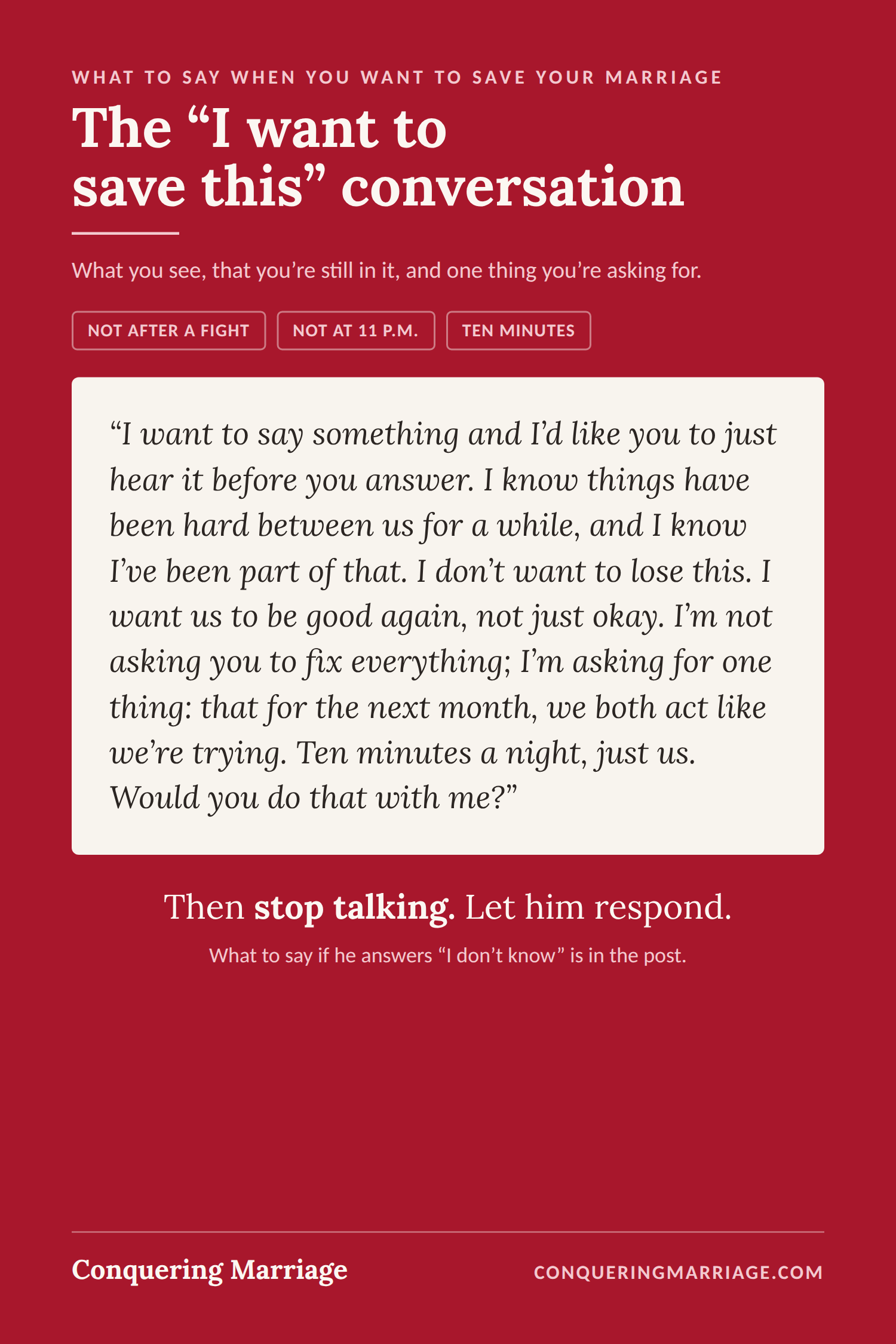
“I want to say something and I’d like you to just hear it before you answer. I know things have been hard between us for a while, and I know I’ve been part of that. I don’t want to lose this. I want us to be good again, not just okay. I’m not asking you to fix everything; I’m asking for one thing: that for the next month, we both act like we’re trying. Ten minutes a night, just us. Would you do that with me?”
(If what broke was something he did, leave out “I know I’ve been part of that.” You don’t owe that sentence.)
Then stop talking. Let him respond, and let the silence sit if it sits. The urge to fill it with more explanation is the urge to chase; don’t.
If he says yes, don’t negotiate the details on the spot. Say thank you, suggest starting tonight, and go do something ordinary together.
If he says “I don’t know” (or “I don’t know if I want to,” which is what a husband who’s halfway out often says), this is the answer you’ve been afraid of. How you take it matters more than anything you said before it. Don’t argue with it and don’t collapse. Say: “Okay. That’s honest, and I’d rather have honest. I’m going to keep doing my part for the next couple of months either way, because I want to, not to make you feel guilty. You don’t have to decide anything tonight.” Then leave it, and mean it. He’ll be watching for whether you meant it. See if you’re the only one trying.
If he says “we’re fine,” he may believe it. Say: “I hope so. But I don’t feel fine, and I’d rather tell you than pretend. I’m not asking you to agree with me. I’m asking you to notice with me for a month.”
If he uses it to open the audit on you, don’t defend. “You might be right, and I want to hear it, but not tonight. I’d rather we start from what we both want than from what we’ve both done.”
Move 4: Repair the specific thing that broke
“Working on the marriage” is too big to do. Nobody has ever fixed “the marriage.” What people fix is the money lie, or the way Sunday mornings go, or the thing he said at his mother’s, or the fact that you haven’t had sex since spring. So after the conversation, pick the one specific thing, and repair that.
If it’s a fight cycle: learn the one exit. Most recurring fights have a moment where it could stop and doesn’t. Find yours (it’s usually a specific phrase) and agree on a word, any word, that either of you can say to stop the fight for twenty minutes without conceding it. It sounds childish. It often works, because it puts the fight on the outside of both of you. And how to heal a relationship after a fight walks through the 48 hours after one, step by step.
If it’s something you did: the apology that lands has four parts and no “but.” Name what you did, name what it cost him, say you’re sorry without explaining, and say what you’ll do differently. “I said that about your mother in front of the kids. That was humiliating for you and it wasn’t fair. I’m sorry. I’m not going to do that again, and if I’m angry about her I’ll tell you privately.” No “but you,” no “I only said it because.” An apology with a “but” is a second argument.
If it’s something he did: you don’t have to forgive it this month. Forgiveness is not a decision you make; it’s something that becomes possible once the thing is repaired and time passes. What you can do this month is say what repair would look like. “I don’t know how to be over it yet. What would help is knowing you understand what it did, not just that you’re sorry. Can you tell me what you think it was like for me?” If he can do that, honestly, it’s the beginning. If he can’t, and it’s an affair or a lie that keeps going, read this.
If it’s the roommate drift: the specific thing is usually time. Not “more time together,” which is unfixable; one protected slot. Thursday night, phones in the kitchen, the same forty minutes every week, no matter how tired. Guard it like an appointment with a doctor. If you’d like a ready-made first week to go with it, how to be a better wife has a simple seven-day plan.
If it’s the kids: if the marriage went wrong somewhere around a new baby, the specific thing is usually the division of the invisible work. The fix is handing over whole jobs rather than tasks. How not to hate your husband after kids is the whole method.
Move 5: Get help earlier than feels necessary
Here’s a number worth knowing. In the first large study to measure it (2021, 270 people), the average wait between serious problems starting and the first couples-therapy session was 2.68 years, though most couples went within two. Even two years is a long time to live with the same fight, or the same silence. If Moves 1 to 4 haven’t moved anything in six weeks, that’s the signal. Not that the marriage is over; that the two of you need a third person in the room.
Two things about asking. First, don’t call it “therapy” if that word makes him bolt; call it what it is, a few sessions with someone who does this all day. Second, ask once, plainly, and offer to do the finding. “I want us to see someone, a few sessions, someone who does this all day. I’ll find them and book it. Will you come?” If he won’t, go alone. That is not a consolation prize. One person in the room, changing her half of every pattern, can change the pattern. And some husbands who won’t go to “couples counseling” will come to one of her sessions because she asked.
If cost is the barrier: many therapists offer sliding-scale fees, and university training clinics see couples for very little. The signs of a failing marriage article has another version of the counseling ask if this one doesn’t fit.
Move 6: Give it a date, not a verdict every night
The most exhausting thing about trying to save a marriage is deciding, every single night, whether it’s working. Don’t. Pick a date about eight weeks from the day you started Move 1 (roughly six weeks after the conversation) and write it down somewhere private. Until then you’re not deciding anything; you’re doing the moves. On the date, you look honestly at three things: has the warmth come back at all, did the one specific repair hold, and is he trying, in his own way, even a little.
If yes to two of three, you’re saving it. Keep going, and set another date. If no to all three, that’s real information. The next step is is my marriage over. You’ve already run the equivalent of its six-week honest test, so go straight to its scored self-check. If you’re the only one trying and he’s shown you nothing in eight weeks, the section on trying alone is where that goes.
How to save a marriage when only one is trying
You’ll read in plenty of places (this site included, until this rewrite) that your effort is wasted if you’re the only one committed. I want to say plainly that this is wrong, and it’s the kind of wrong that can send a wife to a divorce lawyer before she needs one.
Here’s what’s true. One person cannot guarantee a marriage. One person can absolutely change it, because a marriage is a pattern between two people, and if one of you changes her half of the pattern, the pattern has to change. He doesn’t get to keep having the same fight if you’ve stopped fighting it. He doesn’t get to keep living in the same cold house if you’ve stopped being cold. That’s not a trick and it’s not a guarantee. It’s just how patterns work.
So here is how to try alone without losing yourself.
Do the moves anyway, and tell him you’re doing them. Not “I’m doing all this for us” (that’s the ledger); just, once, “I’m going to work on my part of this for the next couple of months, because I want to. I’m not asking you to match it.” Then do it. Moves 1, 2, 4, and 5 can all be done by one person. Move 3 you’ve done. Move 6 you do alone.
Stop measuring his response daily. This is the discipline that makes it possible. You’re not doing it