
You searched “how to fix a broken marriage,” not “how to improve my marriage,” and the word matters. Broken means something gave way. Maybe it was trust: an affair, a lie that ran for years, money he hid. Or maybe nothing dramatic happened at all, and the two of you have just been cold for so long that neither of you expects warmth anymore. Either way, the usual advice (plan a date night, list his good qualities) can feel like being asked to repaint a house with a cracked foundation.
So this page is only about the broken kind, and it starts by sorting which one you’re in, because the first step is different for each.
The short version: after a betrayal, the break stops and the truth comes out before warmth, and the one who broke it does most of the repairing. After a long cold war, call a truce, put small warmth back, then have one honest conversation. Don’t decide your marriage’s future in the first week.
If fear is part of this (you manage his moods, you’re careful what you say, he’s hurt you or threatened to), fixing the marriage is not the first job. Go to when fixing it is not the first job before anything else here.
Table of Contents
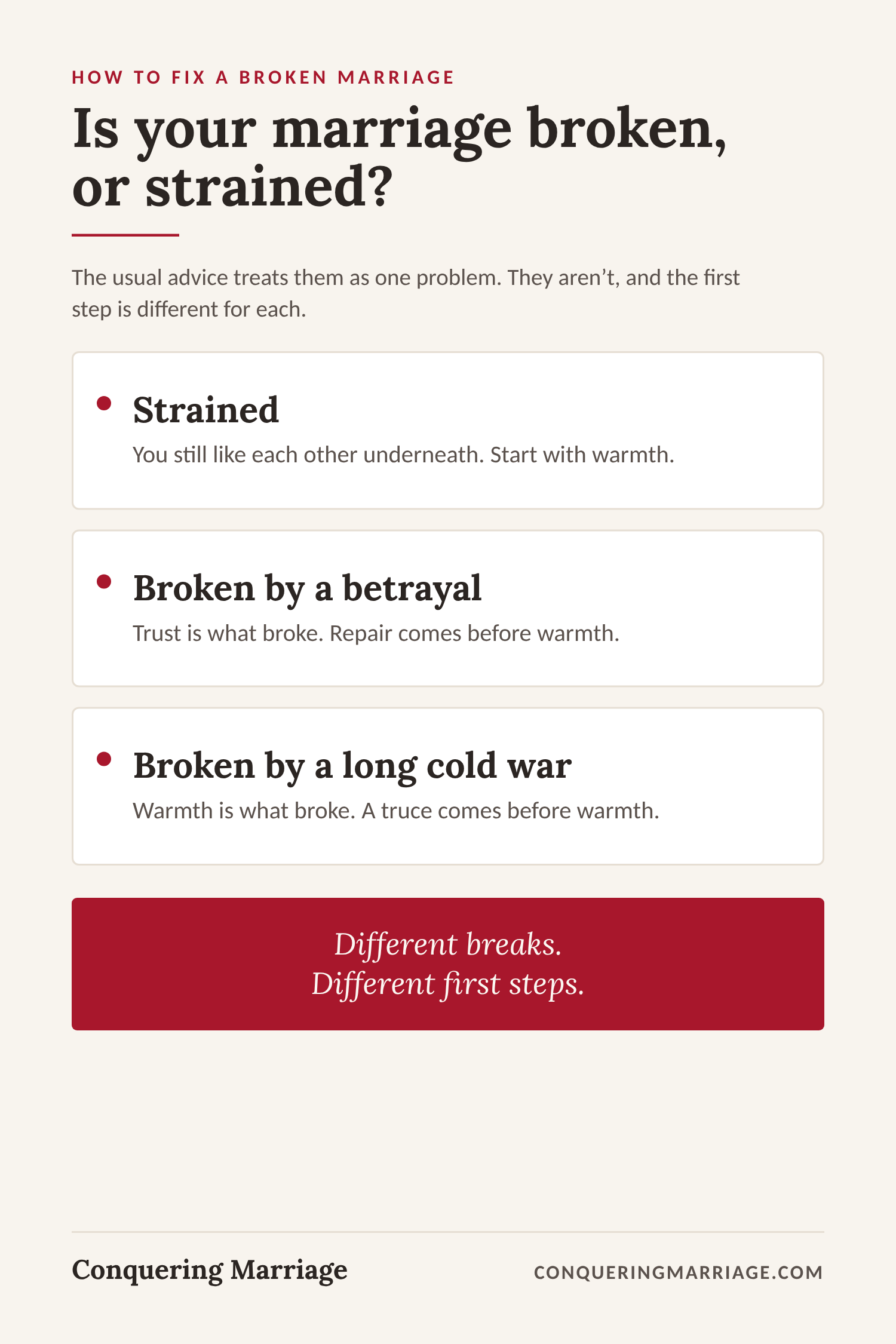
Strained or broken?
Strained is when you still like each other underneath, and it’s mostly distance, busyness, or the same fight on repeat. If that sounds like you, how to save your marriage has the full sequence, six moves in order, and you’ll get more from it than from this page.
Broken usually looks like one of two things.
1. Broken by a betrayal
An affair (physical or emotional), a secret debt, a long lie. The thing that’s damaged is trust: you can’t take what he says at face value, and every kind gesture comes with “but what else don’t I know?” (If the secret was an addiction, such as drinking, gambling, pills, or porn he can’t stop, read the addiction paragraph first. The order there is different.) Go to how to fix a broken marriage after a betrayal.
2. Broken by a long cold war
No single event, just years of it. You’ve had the same arguments so many times that you both stopped having them, and the resentment went underground. You keep score, at least privately. When he does something kind, part of you thinks, “Now you try?” Neither of you would call it a fight, because nobody fights anymore. What’s damaged is warmth, and the harder part is that you’ve both stopped expecting it back. (If it’s distance without the resentment, two people who drifted into running a household, that’s strained, and how to save your marriage is the better page.) Go to how to fix a marriage after years of resentment.
Some marriages are both: a betrayal on top of a cold war, or a cold war that started with one. If that’s you, start with the betrayal section. A cold war can’t thaw while trust is still in question.
How to fix a broken marriage after a betrayal
Most advice tells you to forgive and reconnect. That comes last, not first. When trust breaks, the order is:
1. It stops, completely. The affair ends with no contact; the secret spending stops; the lying stops. Nothing else works while it’s still going, and warmth from you won’t make it stop.
2. The truth comes out, once and fully. Not in pieces over months, where each new detail restarts the injury. Whoever broke it tells the whole of it, ideally with a counselor in the room. You’re allowed to ask questions, and to ask the same ones more than once.
3. He does most of the repairing, and it’s on your clock. The person who broke trust carries the weight of rebuilding it: being open before he’s asked, answering without getting defensive, and understanding what it did to you, not just saying sorry. The Gottman Institute describes affair recovery in three phases: atone, attune, attach. It starts with atonement, and only then rebuilding closeness. Their own write-up says “there is no specific time frame,” and that’s worth holding onto when someone tells you to be over it by now.
4. Then warmth, slowly. Small, ordinary kindness comes back after the repair has started, not instead of it. If you feel pressure to “act normal” before you’re ready, that’s the order going wrong, not you failing.
In the first days, you don’t owe anyone a decision about the marriage. Something like this is enough:
“I’m not deciding anything about us yet. I need you to end it completely, tell me the whole truth, and answer my questions without getting angry, even when I ask the same thing twice. I’ll tell you when I’m ready to talk about the rest.”
If you were the one who broke it, the order is the same with the roles reversed. End it, and tell the whole truth before you’re found out a second time. Expect his questions for longer than feels fair. An apology that lands names what you did and what it cost him, without “but.” Something like:
“I did this, and it wasn’t your fault. I know I broke something you trusted me with. I’m not asking you to forgive me on a schedule. Ask me anything, as many times as you need, and I’ll answer honestly.”
A counselor who specializes in affair recovery is worth finding early here, for either of you. If he won’t end it or won’t be open about it, that isn’t your failure, and there’s nothing more you can repair from your side until he does. Signs of a failing marriage has more on the first month after an affair comes out.
How to fix a marriage after years of resentment (a long cold war)
A cold war doesn’t end with a grand gesture; he’d distrust it, and so would you. It ends the way real wars do: someone calls a truce, the temperature comes up a little, and then the two of you say plainly what happened.
1. Call a truce, privately, starting today. No sarcasm, no sighs, no score-keeping out loud. You don’t announce it. You just stop firing. This is the part you can start entirely on your own, today, and it often changes the temperature faster than you’d expect.
2. Then small warmth, before any big talk. Not a weekend away and not a declaration. Something small and true, for a week or two: “You make good coffee.” A real “how was your day.” A thank-you for something he always does. You’re not letting him off the hook. You’re changing the temperature so the conversation in step 4 has somewhere to land. The 14-Day Reconnect Plan lays those days out for you, with the words: warmth first, the honest talk in week two, and a smaller cold-war version where one helps. Its day 8 is a good moment for the thaw conversation.
3. Pick one resentment, not the list. After years, there are dozens, and bringing them all to one conversation is how the last ten talks went wrong. Choose the one that matters most, the one that, if it changed, would make the others easier to carry. You can say to yourself: “I’m putting the rest down for now. Not forgetting. Putting down.”
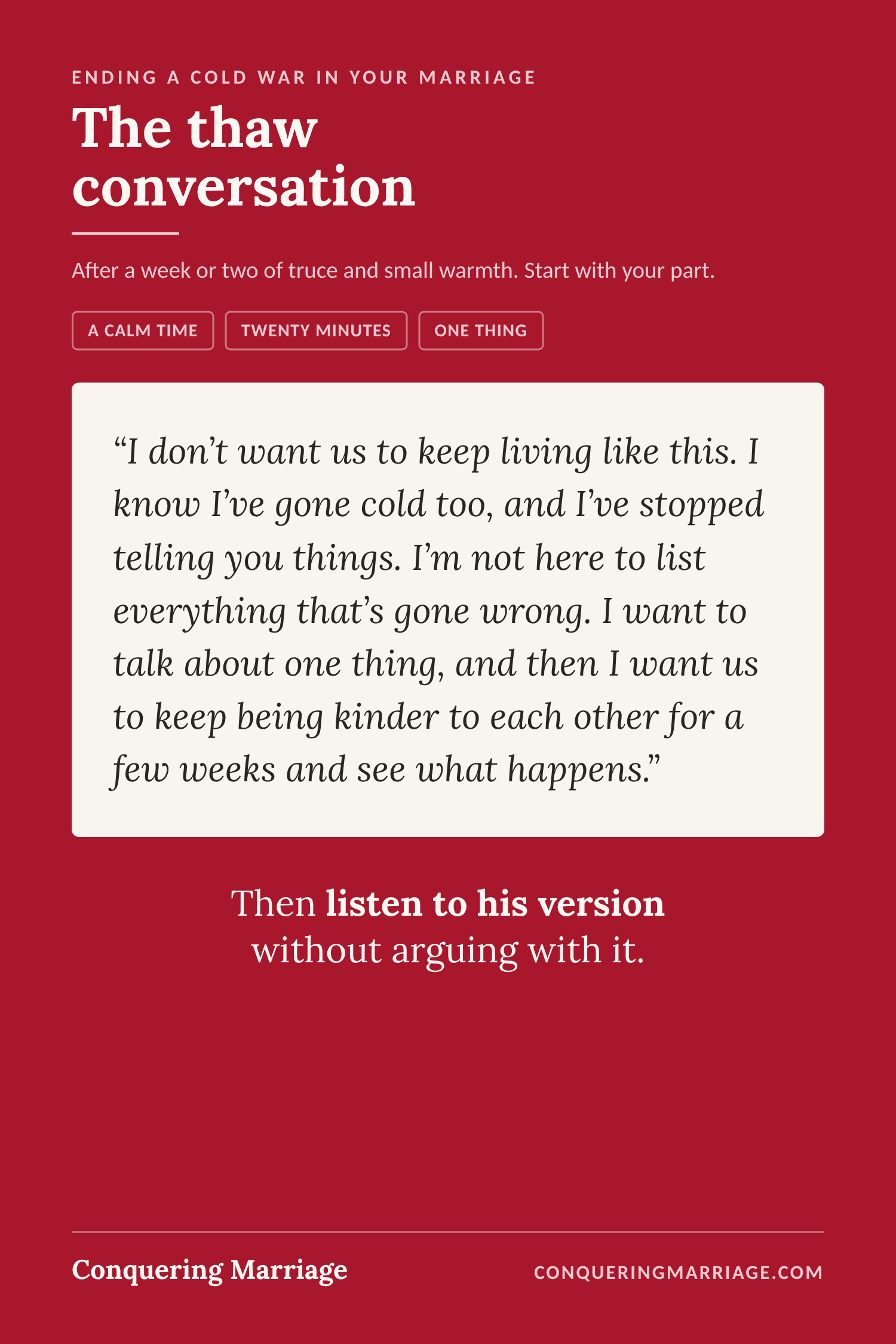
4. Have one thaw conversation. After a week or two of the truce and the small warmth, not before. Not at 11 p.m., not after a fight, not by text. Ask for twenty minutes at a calm time, and start with your part, because in a cold war both people chose the cold, even if not equally. (If the cold is how he punishes you, or you went quiet because speaking up wasn’t safe, that isn’t a cold war you both chose. Read when fixing it is not the first job first.)
“I don’t want us to keep living like this. I know I’ve gone cold too, and I’ve stopped telling you things. I’m not here to list everything that’s gone wrong. I want to talk about one thing, and then I want us to keep being kinder to each other for a few weeks and see what happens.”
Then name your one thing, as what it’s been like for you, not what he did wrong. And then listen to his version without arguing with it. Focus on the Family’s “find the termites” exercise fits here if he’s willing: each of you names one concern at a time, describing what you saw rather than what you think it meant.
How to reconnect with your husband has more on the cold-war marriage. If the cold war is really a fight that never ended, start with how to heal a relationship after a fight.
Want the warmth part done for you, one day at a time? Free: The 14-Day Reconnect Plan. One ten-minute action a day, with the exact words to say. Every day is something you can start on your own.
What not to do when your marriage is broken
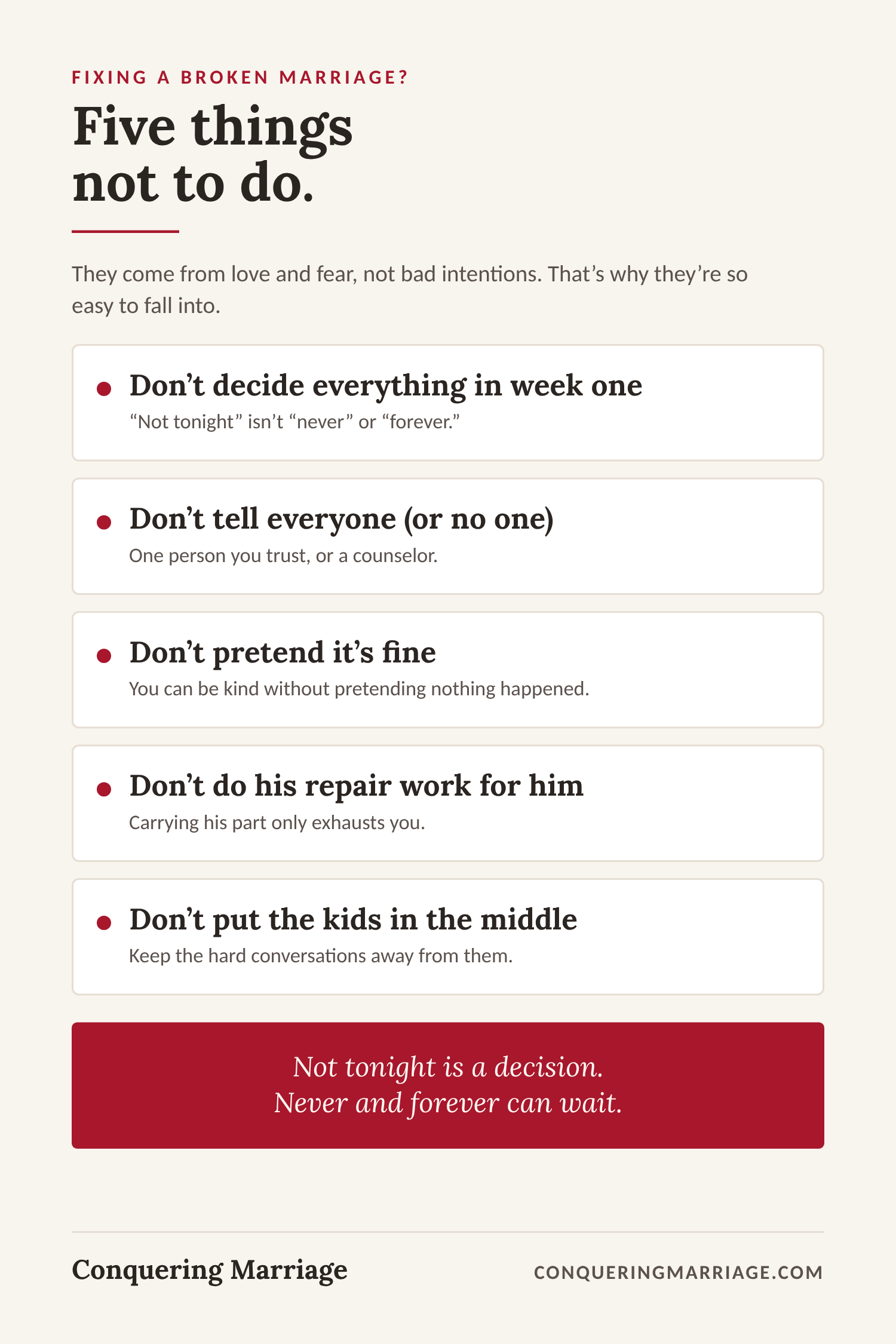
These come from love and fear, not bad intentions, which is why they’re so easy to fall into.
Don’t decide everything in the first week. Right after a betrayal or a blow-up, your nervous system is not a good judge of a whole marriage. You can decide “not tonight” without deciding “never” or “forever.” Getting yourself somewhere safe isn’t deciding the marriage.
Don’t tell everyone, and don’t tell no one. The old version of this article said keep it private, and it’s half right: a chorus of opinions makes repair harder. But tell one person you trust, or a counselor. And never keep fear private; that’s a different situation.
Don’t pretend it’s fine. Acting normal to keep the peace is how cold wars start. You can be kind without pretending nothing happened. (If acting normal is how you stay safe, that isn’t pretending, and the fear paragraph comes first.)
Don’t do the repair work for him. If he broke trust, you can’t apologize, explain, and rebuild on his behalf. Carrying his part is how a broken marriage becomes an exhausted wife.
Don’t use the kids as messengers or witnesses. Keep the hard conversations away from them, and keep them out of the middle.
How to fix a broken marriage alone (when you’re the only one trying)
For a lot of women reading this, this is the real question: can it be fixed if he isn’t trying? The honest answer: one person can change the pattern, and often does. A truce, warmth, and one honest conversation from one side change what the other person is reacting to. One person cannot guarantee the outcome, and one person can’t carry it forever.
There’s a whole section on this in how to save a marriage when only one is trying. The same page’s Move 3 has what to say if he tells you “I don’t know if I want to.” And when you need to know whether it’s still worth it, the scored self-check on is my marriage over is the place for that question. Your 2 a.m. thoughts aren’t.
When fixing it is not the first job
Everything above assumes the marriage is hurt, not dangerous.
If it’s fear. If you manage his moods, if you’re careful what you say, or if he’s hurt you or threatened to, then “fix the marriage” is not the question yet. The same goes if he controls the money, your phone, or where you go. Your safety is the question. Please don’t use any of the scripts on this page. You don’t have to decide anything about the marriage to talk to someone who does this every day. The National Domestic Violence Hotline is free and confidential: call 1-800-799-7233, text START to 88788, or chat at thehotline.org. They’ll help you think it through without telling you what to do. Please reach out even if you’re not sure it “counts.” You’re not failing at your marriage. You’re being asked to handle something no marriage advice was built for. If you’re having thoughts of harming yourself, call or text 988. If anyone is in immediate danger, call 911.
If it’s an addiction. Drinking, gambling, pills, porn he can’t stop: an addiction he won’t look at isn’t something marriage work can fix, and you didn’t cause it. If the drinking or using ever comes with anger that frightens you, the fear paragraph above comes first. The SAMHSA National Helpline (1-800-662-4357) is free, confidential, and open to family members, and Al-Anon exists for exactly the wife in this paragraph. For gambling, the National Problem Gambling Helpline (1-800-MY-RESET, or 1-800-697-3738; call, text, or chat, 24/7) is open to family members too. Then decide what you’re willing to live alongside while he does or doesn’t get help. That’s a “should I stay?” question, not a “how do I fix it?” one, and a counselor of your own is the right place to work through it.
If the betrayal is still going on. If the affair hasn’t ended, or the lying hasn’t stopped, there’s nothing to repair yet. That’s not a failure of effort on your part. It’s a decision he hasn’t made. If it’s yours, the same is true the other way round: nothing he does can repair it until you end it.
How long does it take to fix a broken marriage?
Longer than a strained one, and that’s normal, not a bad sign. Very roughly, after a cold war: the truce changes the temperature in days. The small warmth and the thaw conversation take weeks, and feeling like a team again takes months, sometimes a year or more. After a betrayal, rebuilding trust often takes a year or more, and it moves in waves; a hard week in month five doesn’t mean you’re back at the start.
What helps is a date rather than a daily verdict. Give the work a set stretch, say eight weeks, and then look honestly at what’s changed: is he doing his part, is the cold lifting, are you less alone in it? If the answer keeps being no, that’s real information, and is my marriage over will help you weigh it.
Frequently asked questions
Can a broken marriage be fixed?
Often, yes, but “broken” covers a lot. A marriage broken by years of cold distance can warm up again when both people decide to stop the cold war. A marriage broken by a betrayal can recover when the betrayal stops completely and the person who broke trust does the work of rebuilding it. What can’t be fixed is a break one person keeps making, like an affair that hasn’t ended. A marriage with fear in it has a different first job, and it’s here.
Can you fix a broken marriage without counseling?
A cold war sometimes thaws without it, if you’re both willing. After a betrayal, a counselor makes recovery easier and much less lonely, ideally one who specializes in affair recovery. For an addiction, start with support for yourself; the addiction paragraph has where. If he won’t go, going on your own still helps you decide what you need.
Can one person fix a broken marriage?
One person can change the pattern, but can’t guarantee the outcome or carry it forever. More in how to save a marriage when only one is trying.
Is it too late to fix my marriage?
It’s rarely too late while both of you are still willing to try, even after years. It may be too late when one of you has decided, clearly and over time, not to. If you’re not sure which is true, the self-check on is my marriage over is a calmer way to find out than guessing.
Does space help a broken marriage?
Sometimes. A short, agreed break after a blow-up or a discovery can help both of you think. A long, open-ended separation with no plan tends to become distance, not repair. If you need space because you don’t feel safe, that’s different, and this section comes first.
How do I fix my marriage after I cheated?
End it completely, tell the whole truth, and let him set the pace. The betrayal section has the words.
One last thing
If you’ve read this far, part of you still wants this to work, and that’s not naive. Broken marriages get fixed in a particular order. After a betrayal, the break is stopped and told in full before anything else. After a cold war, the firing stops first. Warmth and one honest conversation come after that, a little at a time.
If yours is the long-cold kind, the free 14-Day Reconnect Plan is the warmth step done for you: one ten-minute action a day, with the words to say.
Ready to put the warmth back? Start with the next fourteen days. Free: The 14-Day Reconnect Plan. One ten-minute action a day, with the exact words to say. Every day is something you can start on your own.