
He said it. Maybe in the middle of a fight, maybe calmly over the kitchen counter on a Tuesday, maybe through an envelope a stranger handed you at the door. However it arrived, you’re here because he wants a divorce and you don’t, and you want to know if there’s anything you can do.
Often, there is. Here’s how to stop a divorce, and it probably isn’t what your panic is telling you right now, which is to talk him out of it tonight.
The short version: you can’t legally make him stay married, so stopping a divorce means changing his mind, and pressure won’t do it. Answer calmly once, ask for a pause with a discernment counselor, and change your half of the marriage. If papers are filed, respond on time and see a family-law attorney; that isn’t giving up.
If fear is part of this (you manage his moods, you’re careful what you say, he’s hurt you or threatened to), stopping the divorce is not the first job. Go to when stopping the divorce is not the first job before anything else here.
Table of Contents
First, an honest word about what’s possible
Every US state lets a person get divorced even if their spouse doesn’t agree. As one legal guide puts it, “no state will force someone to stay married against their will.” So there’s no form, phrase, or lawyer’s trick that stops a divorce he truly wants.
That sounds like bad news, but read it again. It means the divorce isn’t really a legal problem yet. It’s a decision in one person’s head, and decisions in people’s heads change all the time. A large study of divorcing parents (people already in the court process) found that about one in four believed the marriage could still be saved. In about one in three couples, one partner was open to help reconciling. “I want a divorce” is often less settled than it sounds, even after papers are filed.
What changes his mind is almost never the argument you win. It’s the marriage he’d be leaving starting to look different. That’s slower, and it’s the part you have some control over.
My husband wants a divorce and I don’t: four situations, four first moves
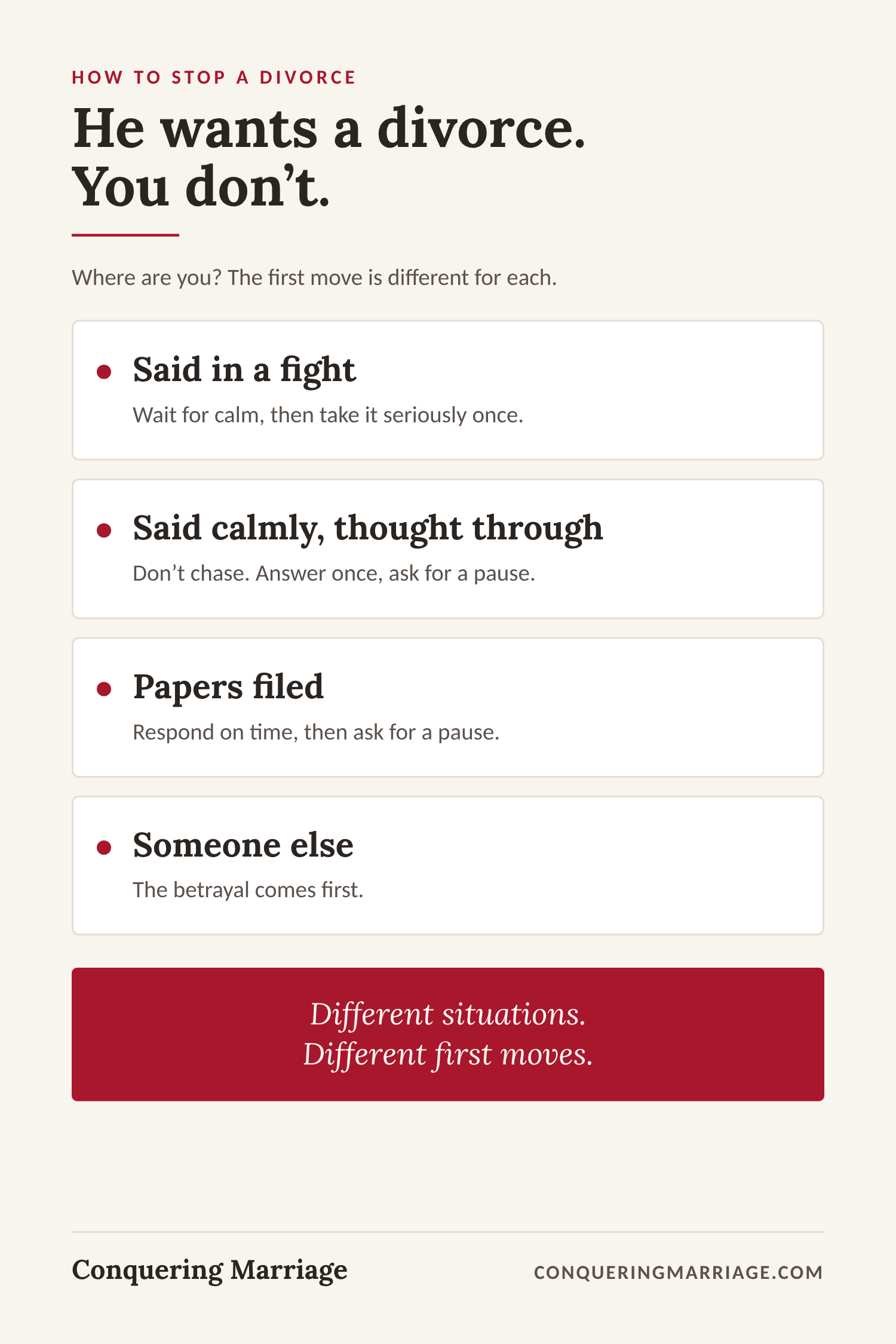
1. He said it in a fight, or at a low point
It came out hot: after a blow-up, a bad month, a week of no sleep. He may half-regret it already. This is often less a decision than a cry of “I can’t keep living like this.” First move: don’t treat it as final and don’t treat it as nothing. Wait until things are calm, then take it seriously once (the script is below) and ask for a pause.
2. He said it calmly, and he’s clearly thought about it
No fight. He’s measured, maybe kind, maybe distant, and you get the feeling he’s been deciding this for a long time. This is the harder one, and it’s where chasing does the most damage. First move: the calm answer below, then the pause, and then the long, quiet work of changing your half. Expect this to take weeks, not days.
3. The papers have been filed or served
Now there’s a legal process running alongside the emotional one, and you have to look after both. First move: don’t ignore the papers, and don’t sign anything in a hurry. Read the papers section, then ask for the pause. He can still withdraw it.
4. There’s someone else
He’s having an affair, or you think he is, and he wants out. Stopping the divorce isn’t the first question here; the betrayal is. Nothing you change on your side can compete with an affair that’s still going on. First move: read how to fix a broken marriage after a betrayal, and if anything about this frightens you, this section comes first. If the affair was yours and that’s why he wants out, the order is reversed: end it completely and tell the whole truth. If you were the one who broke it has the words.
What not to do this week
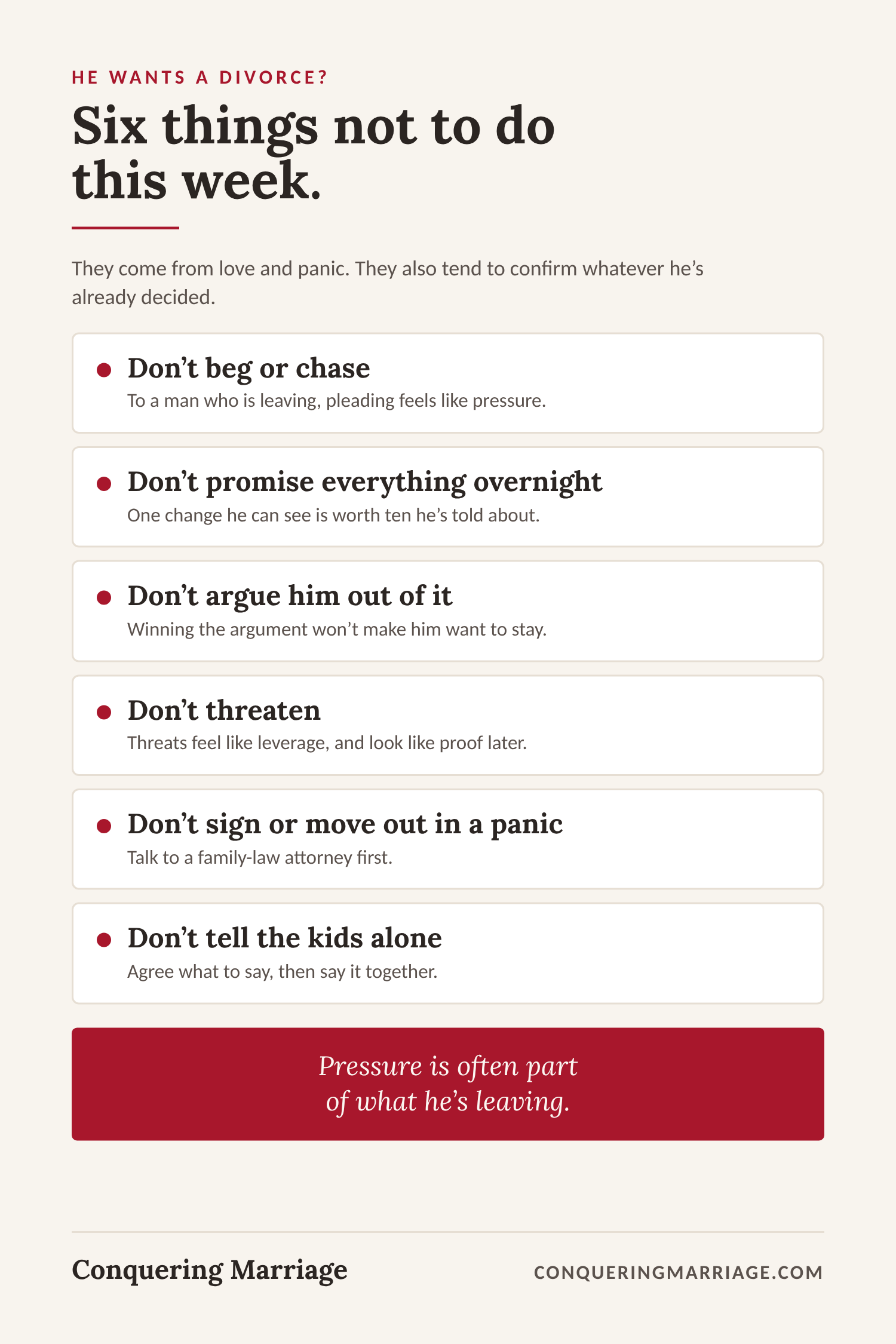
These come from love and panic, which is why they’re so hard to resist. They also tend to confirm whatever he’s already decided.
Don’t beg, chase, or plead. The calls, the texts at 2 a.m., the “please, just tell me what you need.” To a man who is leaving, pleading feels like pressure, and pressure is often part of what he’s leaving.
Don’t promise to change everything overnight. “I’ll do anything” is sincere and he won’t believe it, because he may have heard versions before. One change he can see is worth ten he’s told about.
Don’t argue him out of it. You may have every reason on your side. Winning the argument still won’t make him want to stay; it often makes him dig in, because now he’s defending his decision instead of reconsidering it.
Don’t threaten. Not with the kids, the money, the house, or telling his mother. Threats feel like leverage in the moment and look like proof later, to him and possibly to a court.
Don’t sign, move out, or empty an account in a panic. These have legal consequences that are hard to undo. Talk to a family-law attorney first; one consultation is enough to know where you stand. (If you need to leave to be safe, that isn’t panic, and the fear paragraph comes first.)
Don’t tell the kids until the two of you have agreed what to say. And then say it together, if you can.
What to say when your husband says he wants a divorce
You’ll probably get one real moment to respond well, and it usually isn’t the first second. If he says it in a fight, you can simply say, “I heard you. I don’t want to answer that while we’re both this angry,” and leave the room. Come back to it within a day or two, at a calm time.
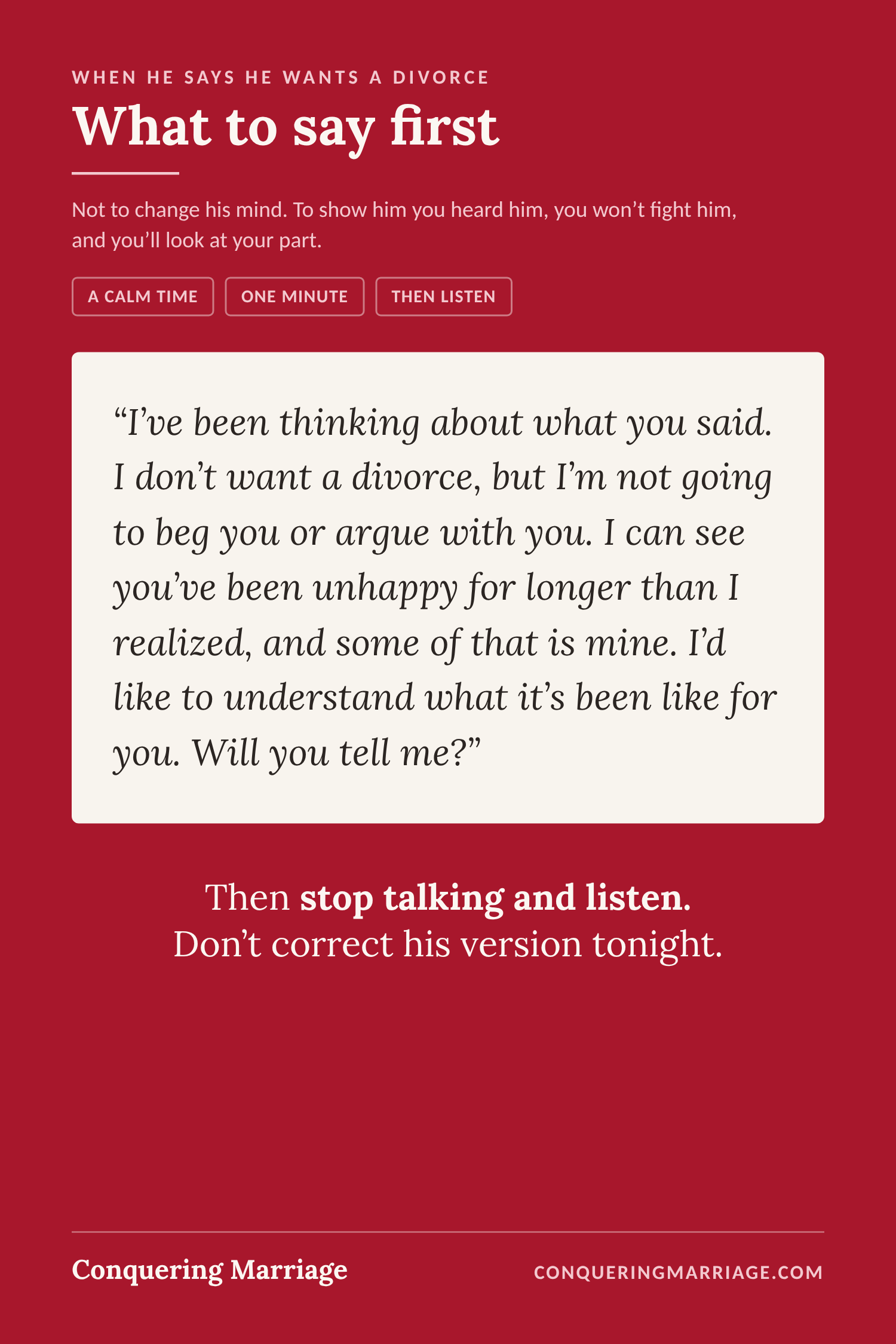
When you do answer, the goal isn’t to change his mind. It’s to show him, in about a minute, that you heard him, that you’re not going to fight him, and that you’re willing to look at your part. Something like:
“I’ve been thinking about what you said. I don’t want a divorce, but I’m not going to beg you or argue with you. I can see you’ve been unhappy for longer than I realized, and some of that is mine. I’d like to understand what it’s been like for you. Will you tell me?”
(If he’s been unfaithful, leave out “and some of that is mine.” You don’t owe that sentence.)
Then stop talking and listen, even if what he says is unfair, and even if it hurts. Don’t correct his version tonight. You can disagree later; right now, understanding him is the most persuasive thing you can do.
Own your half, once. If there are things you’ve done that made it worse (the criticism, the coldness, the score-keeping), say so plainly and specifically, one time: “I’ve been critical a lot, and I’ve stopped asking about your day. That’s on me.” No speeches, no list, no repeating it every evening. (This is about your half of a strained marriage. You don’t own his affair, and you don’t own his anger if it frightens you; that’s a different situation.)
Ask for one thing: a pause
You can’t ask him not to divorce you. You can ask him not to decide yet. That’s a much smaller request, and a fair one after years of marriage.
Make it specific. A set period, before anyone files or before anyone takes the next legal step, during which you both talk to a counselor. Two to three months is reasonable to ask for; a month is the minimum worth asking for.
The best kind of counseling for this moment has a name: discernment counseling. It was developed by family therapist Bill Doherty for exactly your situation: one spouse leaning out, the other leaning in. Ordinary couples counseling tends to stall there, because one person isn’t sure he wants the marriage fixed. It’s short: one to five sessions, mostly one-on-one with the counselor, and it doesn’t try to save the marriage. It helps you both choose between three paths: stay as you are, move toward divorce, or commit to “a six-month all-out effort in couples therapy.” For a husband who’s leaning out, that’s an easier thing to say yes to, because nobody’s asking him to promise anything. The University of Minnesota keeps a directory of trained discernment counselors, including a list outside Minnesota. (If you’re afraid of him, joint counseling of any kind isn’t the right first step; read this first.)
Here’s one way to ask:
“I know you want a divorce, and I’m not asking you to change your mind today. I’m asking for two months before either of us does anything final. I’d like us to see a discernment counselor. It’s short, and it’s built for couples where one person wants out. If you still want the divorce at the end of it, I’ll know I tried, and I won’t fight you on the decision.”
Only say the last sentence if you mean it. It’s what makes the request believable, and it doesn’t commit you to anything about how the divorce itself is handled.
If he says no, don’t argue the point. Say, “Okay. I’d still like you to think about it. The offer stands,” and drop it. Then do the next section anyway, on your own. You can see a counselor by yourself, and it’s worth doing whatever he decides.
What to do during the pause (or without one)
If a divorce gets stopped, this is usually where: quietly, over weeks. Your job isn’t to persuade him. It’s to change your half of the marriage he wants to leave, without asking him to notice.
Call a private truce. No sarcasm, no sighs, no reopening the divorce conversation every few days. You don’t announce it. You just stop firing.
Put small warmth back, without an agenda. A real “how was your day,” a thank-you for something he always does, a little ease in the house. Not grand gestures; he’ll read those as a campaign. The free 14-Day Reconnect Plan can help here: one ten-minute action a day. If he’s halfway out the door, follow its page 3 advice for a husband who’s checked out: repeat the first week’s easiest days before going further, and skip any step that asks him for something.
Keep your own life full. Friends, work, your Saturdays. A wife who has put her whole life on hold to stop the divorce is carrying all of it, and he can feel that weight. A wife who is steady and busy is easier to come back toward, and she’s looking after herself whatever he decides.
Stop checking every day whether it’s working. You’re doing this for a set time, then you’ll look honestly. Daily checking turns warmth into a test, and he’ll feel tested.
All of this is covered in more depth in how to save a marriage when only one is trying, and it’s worth reading in full. One person can’t guarantee a marriage. One person can change the pattern, and sometimes that’s what changes his mind.
Not sure what to do tomorrow, let alone this month? Free: The 14-Day Reconnect Plan. One ten-minute action a day, with the exact words to say. Every day is something you can start on your own.
Can you stop a divorce after papers are filed?
This is general information, not legal advice. Divorce law is set by each state, and the details really do differ. One consultation with a family-law attorney where you live is worth it, even if you’re hoping it never goes further.
If he filed: you generally can’t stop his case yourself, but you can take part in it, and he can withdraw it. In most states the person who filed can ask the court to dismiss the case. Some states make it simple: in California, for example, the filer submits a Request for Dismissal, and once the other spouse has filed a response, both have to agree to it. A dismissal ends the case rather than pausing it; if either of you files again later, it starts over. So a pause that leads somewhere can still end with the case withdrawn.
Don’t ignore the papers. They’ll give you a deadline to respond, and missing it can let the case go ahead without you. Responding is not the same as agreeing to the divorce. It just means your voice is in the process. Talking to a lawyer is not a betrayal of the marriage. It’s looking after yourself while you try.
Ask the attorney about slowing things down. Courts and states differ on whether a case can be paused while a couple tries counseling, and many have waiting periods before a divorce can be finalized anyway. Your lawyer can tell you what’s possible where you live.
If you filed and you’ve changed your mind: you can usually withdraw it. It’s often a short form, and you generally don’t have to explain why. If he’s already responded, you may need his agreement, and in some states he can keep the case going himself. (If you filed because you were afraid of him, talk to your lawyer or the hotline before you withdraw anything.) Tell him first, in person: “I filed because I didn’t know what else to do. I don’t want a divorce. I want to try, properly, with help. I’ll withdraw it if you’re willing to try too.”
If the divorce is already final: legally, it’s over, and a couple who reconcile after a final divorce generally remarry. Everything in the sections above still applies; it just isn’t about stopping a divorce anymore.
When stopping the divorce is not the first job
Everything above assumes the marriage is hurt, not dangerous. Three situations don’t fit, and the order is different for each.
If it’s fear. If you manage his moods, if you’re careful what you say, or if he’s hurt you or threatened to, then “stop the divorce” is not the question yet. The same goes if he controls the money, your phone, or where you go. Your safety is the question. Please don’t use any of the scripts on this page. You don’t have to decide anything about the marriage to talk to someone who does this every day. The National Domestic Violence Hotline is free and confidential: call 1-800-799-7233, text START to 88788, or chat at thehotline.org. They’ll help you think it through without telling you what to do. Please reach out even if you’re not sure it “counts.” You’re not failing at your marriage. You’re being asked to handle something no marriage advice was built for. If you’re having thoughts of harming yourself, call or text 988. If anyone is in immediate danger, call 911.
A divorce can be the safer path, and wanting to stop it can be fear talking. The hotline can help you think through that too, including what leaving safely would look like.
If it’s an addiction. Drinking, gambling, pills, porn he can’t stop: an addiction he won’t look at isn’t something marriage work can fix, and you didn’t cause it. If the drinking or using ever comes with anger that frightens you, the fear paragraph above comes first. The SAMHSA National Helpline (1-800-662-4357) is free, confidential, and open to family members, and Al-Anon exists for exactly the wife in this paragraph. For gambling, the National Problem Gambling Helpline (1-800-MY-RESET, or 1-800-697-3738; call, text, or chat, 24/7) is open to family members too. Then decide what you’re willing to live alongside while he does or doesn’t get help. That’s a “should I stay?” question, not a “how do I stop the divorce?” one, and a counselor of your own is the right place to work through it.
If the affair is still going on. There’s nothing to repair yet, and nothing you change on your side can compete with it. That’s not a failure of effort on your part. It’s a decision he hasn’t made. If it’s yours, the same is true the other way round: nothing he does can repair it until you end it.
When you can’t stop it
Sometimes you do everything right, and he still goes. If that happens, it won’t be because you didn’t love him enough or didn’t find the right words. A divorce one person truly wants is one the other person can’t prevent, however good she is.
If you get there, the things that helped you try will help you now. Keep your dignity; you’ll be glad of it later. Get your own lawyer and your own counselor. Keep the kids out of the middle. And give yourself time before deciding what any of it means about you.
If you’re not sure yet whether to keep trying, the scored self-check on is my marriage over is a calmer way to think it through than 2 a.m. is.
How long does it take to stop a divorce?
Longer than you want, and that’s normal. The first calm conversation can change the temperature within days, especially if he said it in a fight. Changing a decision he made quietly, over a long time, usually takes weeks of the truce and the warmth before he softens at all, and months before you’re both properly back in it. A discernment counselor takes one to five sessions to help you choose a path; a committed repair effort after that is typically measured in months.
What helps is a date rather than a daily verdict. Ask for the pause, give your part of it a set stretch, say eight weeks, and then look honestly at what’s changed.
Frequently asked questions
Can you stop a divorce once it’s filed?
Often, yes, if the person who filed decides to withdraw it. A filed case can usually be dismissed, sometimes with a short form, and if the other spouse has already responded, both may need to agree. What you can’t do is stop a case he filed and still wants. The details depend on your state; the papers section has more, and a family-law attorney can tell you exactly. If you’re afraid of him, the first job is different, and it’s here.
Can I stop my husband from divorcing me?
Not legally; no state makes someone stay married. You can sometimes change his mind, which is a different thing and the more hopeful one. Don’t beg or argue. Answer calmly once, ask for a pause with a discernment counselor, and change your half of the marriage while you wait. If you’re afraid of him, start here instead.
Can I refuse to sign divorce papers?
You can refuse, but in most states it won’t stop the divorce. The case usually continues without your agreement, and if you don’t respond at all, it may go ahead without you. Respond by the deadline, and get legal advice about what to sign. More in the papers section.
What do you say when your husband says he wants a divorce?
Not much, at first. If it’s in a fight: “I heard you. I don’t want to answer that while we’re both this angry.” Later, at a calm time: that you don’t want a divorce, that you won’t beg or argue, that you can see he’s been unhappy, and that you want to understand. Then listen. If you’re afraid of him, don’t use a script; start here.
Does marriage counseling work if one person wants a divorce?
Ordinary couples counseling often stalls, because it assumes you both want to fix the marriage. That’s why discernment counseling exists: it’s short, built for one spouse leaning out and one leaning in, and it helps you decide together whether to try. More in ask for one thing: a pause.
Should I just let him go?
Sometimes that’s the right answer, and only you can know. If you’re afraid of him, it may be the safer one; read this first. If you’re unsure whether you even want the marriage he’s leaving, is my marriage over can help you sort out what you’re grieving.
What are the three words that stop a divorce?
You’ll see “I will change” suggested, and the instinct behind it is right: he needs to see something different. But words alone rarely stop a divorce, because he may have heard promises before. One change he can see, kept for weeks without asking for credit, says it better than any three words.
One last thing
If you’re reading this with your heart pounding, here’s what to hold onto: a divorce he’s announced is not a divorce that’s happened. The wives who give a marriage its best chance at this point are usually the ones who stop fighting the decision and start changing the marriage. They’re calm when he expects a fight and warm when he expects coldness, and they’re patient in a way that has nothing to do with being a doormat.
You don’t have to do it perfectly. You just have to stop doing the things that confirm his decision, and start, a little at a time, doing the things that question it.
Want somewhere to start tomorrow morning? Free: The 14-Day Reconnect Plan. One ten-minute action a day, with the exact words to say. Every day is something you can start on your own.