
You’re here because something in your marriage has changed and you can’t tell how serious it is. Maybe the fights are worse, or there aren’t any fights anymore and that’s what worries you. Maybe you’ve caught yourself imagining a life on your own and felt relief instead of sadness, and then felt guilty for the relief. You typed “signs of a failing marriage” because you want an honest answer, not a pep talk and not a list that ends with a phone number for a lawyer.
So here’s the answer up front: the signs most lists lead with are usually signs of a strained marriage, not a failing one, and strain is fixable, often by one person starting. Other signs mean a pattern has set in that won’t fix itself. And three signs change everything and need their own next step. This article sorts all fourteen into those three levels, then tells you what to do about each, including the exact words to say to him.
The short version: count your signs by level, not by number. Strain (fights that spread, logistics-only talk, keeping score) is common and reversible. A pattern (silence, contempt, not caring) means the marriage is failing if nothing changes, and it can still change. An affair, an addiction, or fear comes first.
If fear is part of what you’re feeling (you manage his moods, you’re careful what you say, he’s hurt you or threatened to), skip everything else and go straight to what to do if it’s fear.
Table of Contents
First: what “failing” actually means
A marriage doesn’t fail on a date. It fails by pattern: something goes wrong, doesn’t get repaired, and the next thing lands on top of it. One old observation still holds: it’s usually gradual, and it’s usually noticed by one person long before the other. If you’re the one noticing, you are not imagining it and you are not overreacting. You’re early, and early is the best place to be.
The other thing to know is that the signs don’t all weigh the same. A marriage where you fight about everything is in worse shape than one that’s truly calm. But a marriage that has gone quiet because you’ve stopped caring is in worse shape than both. That’s why the list below is sorted by level, not counted.
The 14 signs of a failing marriage, sorted by how serious they are
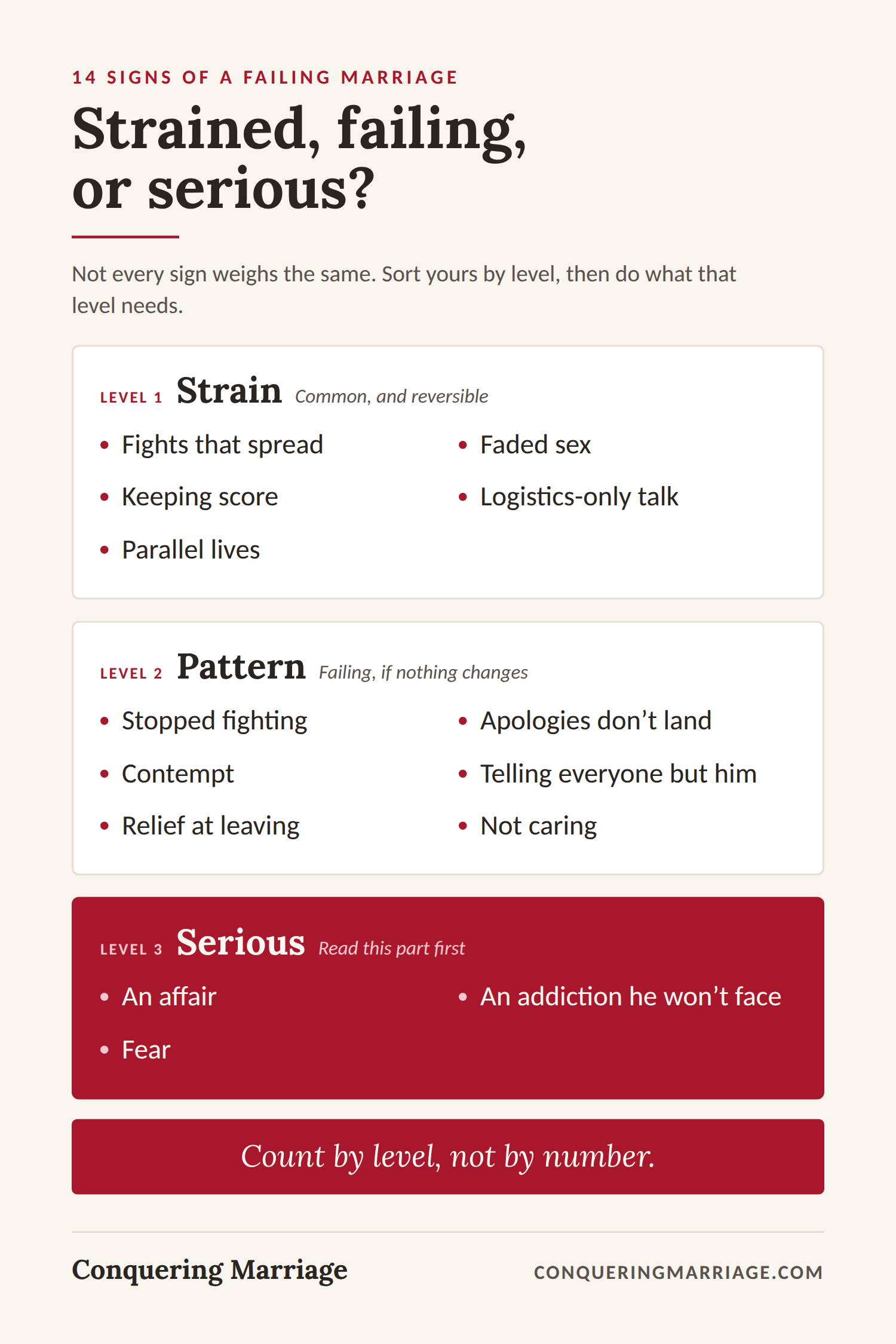
Level 1: signs of strain (common, and reversible)
These are the signs that show up in most long marriages at some point. On their own they mean the marriage is under load, not that it’s failing.
1. Every disagreement turns into a fight about everything. You start on the dishwasher and end up on his mother, the money, and the thing he said three Christmases ago. When small conflicts keep spreading, it usually means there’s a backlog of unresolved things underneath, and the dishwasher is just where it leaks out.
2. Sex has faded, and it faded through excuses. Not “we’re in a busy season,” but months of “I’m tired” and “maybe this weekend” from one or both of you, and neither of you naming it. Faded desire is normal; faded desire nobody will talk about is a sign.
3. You keep score. You notice what he didn’t do more than what he did. He does the same. Compliments have been replaced by an inventory, and forgiveness by a ledger. This one is the earliest form of contempt (number 8), the sign the research worries about most, so it’s worth catching now.
4. You only talk logistics. Who’s picking up the kids, did you pay the water bill, what time is your mother coming. Real conversation, the kind where one of you says something true about how you’re feeling, has quietly stopped. If you feel like roommates more than a couple, how to reconnect with your husband was written for exactly this.
5. You have separate lives under one roof. Different interests, different friends, different evenings, and you can’t remember the last thing you did together on purpose. Parallel lives aren’t a crisis by themselves; a lot of good marriages go through a season of them. They become a sign when they stop being a season and start being the arrangement.
What Level 1 means: the marriage is strained. If these are your only signs, you don’t need a diagnosis; you need warmth back in the system before the next hard conversation. Skip to what to do at Level 1 below.
Level 2: signs of a pattern (failing, if nothing changes)
These are different in kind. They’re the signs that the strain has stopped being an event and become the weather.
6. You’ve stopped fighting, and it isn’t peace. This is the sign most lists get backwards. Couples who fight are still trying to be understood. When the fighting stops because one of you decided it isn’t worth the energy, the marriage has lost its argument for itself. Silence that feels like relief is a warning, not a win.
7. Apologies don’t land anymore. He says sorry and you feel nothing. You say sorry and he shrugs. Attempts to repair, the small “hey, I didn’t mean that” moments that every couple runs on, are being ignored or refused. When repair stops working, every conflict stays open, and they stack.
8. Contempt has crept in. Eye-rolling. “Typical.” Sarcasm that isn’t affectionate. Mocking him to the kids or to your friends. Feeling, underneath it, that you’re better than him. The Gottman Institute, after decades of watching couples, names four communication patterns that can predict the end of a relationship (criticism, contempt, defensiveness, and stonewalling) and calls contempt the single greatest predictor of divorce. It’s the strongest sign on this list that isn’t structural, and it’s still reversible, but not by ignoring it.
9. You talk about the marriage with everyone except him. Your sister knows. Your best friend knows. The group chat knows. He doesn’t, or he knows only that you’re “fine.” This isn’t a character flaw; it’s what happens when talking to him stopped feeling safe or useful. But it means the marriage is being processed everywhere except inside it.
10. You imagine being single, and what you feel is relief. Everyone married has the passing thought. The sign is the feeling that comes with it. Sadness or guilt means you’re still attached. Relief, or a small private plan (the apartment you looked at, the savings you’ve started keeping separate), means part of you has already left, and the rest of you should know that. (If you’re setting money aside because you’re afraid of him, that’s not this sign. It’s a safety step, and a smart one; see sign 14.)
11. You’ve stopped caring whether it works. Not angry anymore. Not sad. Just done arguing about it, done trying, done hoping. Of all the pattern signs, this is the hardest to come back from, because a marriage that no one is fighting for doesn’t need to fail loudly. It just stops.
What Level 2 means: here’s a rough rule of thumb. If three or more of these have been true for six months or longer, those are signs your marriage is failing, in the plain sense of the word. It is not over. But it won’t turn around on its own, and the next move is a conversation, not another month of waiting. Skip to what to do at Level 2.
Level 3: the three signs that change everything
12. An affair, emotional or physical. Including the one you’re having, or thinking about having.
13. An addiction he won’t look at. Drinking, gambling, porn, pills. The sign isn’t the habit itself; it’s the refusal to look at it.
14. Fear. You manage his moods. You’re careful what you say. He’s hurt you, or threatened to, or controls the money, the car keys, or who you see.
These three don’t go on the same scale as the others because they aren’t about how the marriage is going; they’re about whether the ordinary rules apply at all. Each has its own next step below. If one of them is yours, read that section first, before anything else on this page.
The loud signs and the quiet ones
Here’s the thing most lists miss, and it changes which of your signs you should worry about.
The loud signs are the ones that feel like emergencies: the shouting, the door-slamming, the fight in the car with the kids in the back. They’re miserable, and they’re also the signs of two people who still want something from each other. A couple that fights is a couple that hasn’t given up on being heard. That’s true of fights that are loud, not fights that are frightening. If the shouting or the door-slamming ever makes you afraid of him, that’s sign 14, not a loud sign, and it has its own section.
The quiet signs are the dangerous ones, and they’re the real signs of a dying marriage. The fight that doesn’t happen because you’ve stopped bothering. The apology you don’t make because it wouldn’t change anything. The evening you spend in separate rooms and neither of you notices. Quiet signs don’t feel like emergencies. They feel like calm. That’s why so many marriages end on them: nobody calls a counselor because things have gotten peaceful.
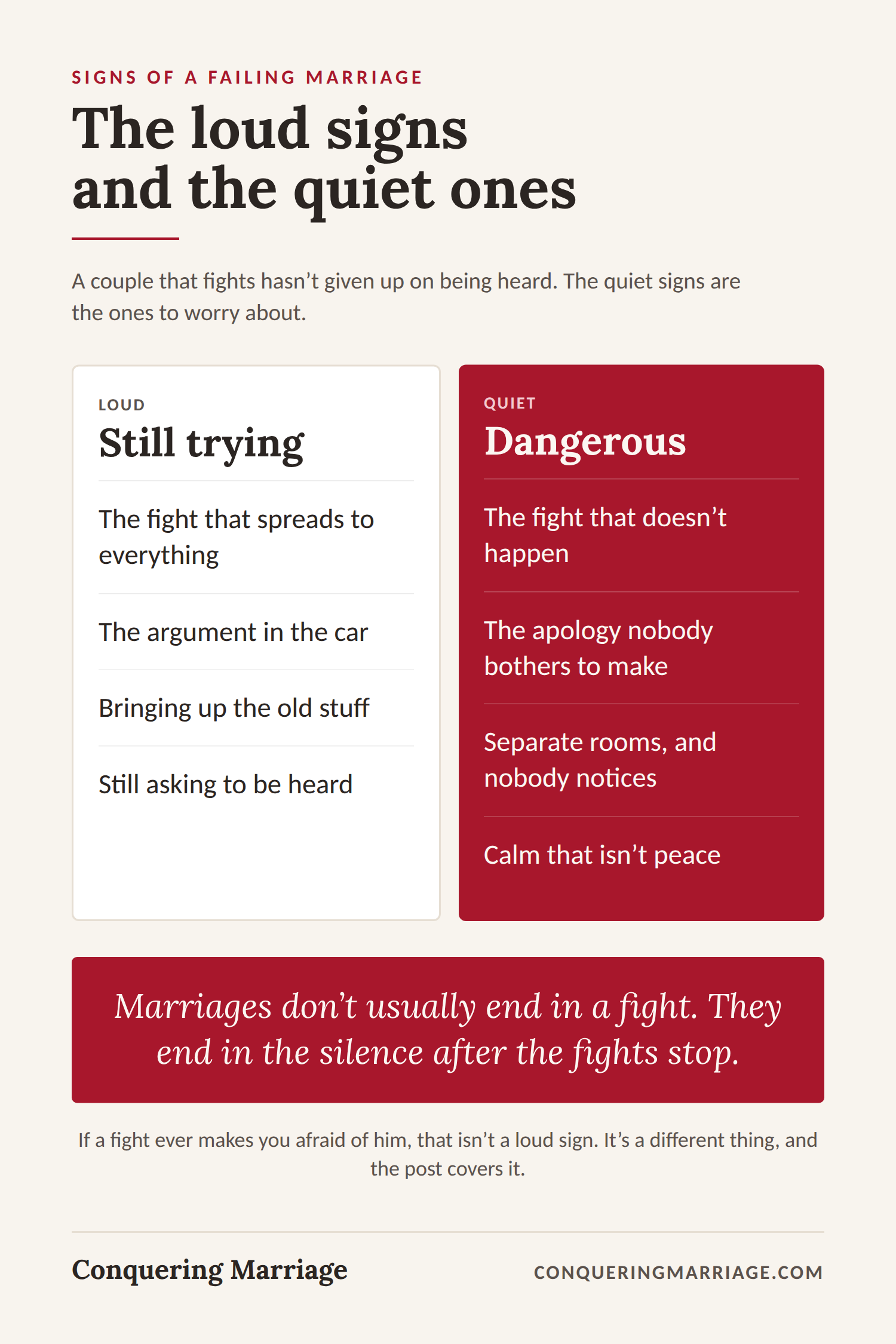
So if your list is mostly loud, take heart: you have something to work with. If your list is mostly quiet, take it seriously, and sooner rather than later.
Is my marriage failing? A quick self-check (three questions, not a score)
I’m not going to give you a score. Scores are for the “is it over?” question, and that question has its own page with a proper scored self-check. This page is about catching it earlier than that. So, three questions:
Which level are most of your signs on? Mostly Level 1: strained. One or two at Level 2: act on those now, before they’re three. Three or more at Level 2: failing. Any of Level 3: go to that section now.
How long have they been true? Under six months usually means a season (a baby, a job, a loss, an illness). Six months or more, and it’s becoming a pattern. If a hard season is what started it and you’re not sure it’s only a season anymore, what to do when you’re not happy in your marriage sorts that out in detail.
Does he see it too? If yes, you can skip straight to the conversation below. If no, you’re far from alone, and there’s a section for it.
Seeing the signs, and want to act before it gets worse? Start with two weeks of small steps. Free: The 14-Day Reconnect Plan. One ten-minute action a day, with the exact words to say. Every day is something you can start on your own.
What to do about it, by level
What to do at Level 1: put warmth back before the next hard talk
Strain is fixable, and the fix is less dramatic than it feels like it should be. Two moves.
Stop the spreading. Pick one rule and keep it for a month: one fight, one topic. When the dishwasher argument reaches for his mother, say, out loud, “That’s a different thing. Can we stay on this one?” It won’t feel like much. It’s one of the best things you can do to stop Level 1 sliding into Level 2, because it keeps conflicts small enough to repair.
Put ten minutes of warmth back, every day, before you try to talk about anything. Not a date night. Ten minutes: a real question at dinner, a hand on his back on the way past, a word about one thing he did that you noticed. Strained marriages don’t need a summit; they need the temperature raised a few degrees so that the next real conversation lands on warm ground instead of cold. That’s what the free 14-Day Reconnect Plan is built to do, one small action a day, with the words, so you don’t have to invent it at the end of a long day.
If keeping score is your loudest sign, the “too tired and too resentful” section of how to be a better wife deals with the resentment the ledger is usually made of. And if the strain started with kids and hasn’t lifted, how not to hate your husband after kids is the version of this page for that.
What to do at Level 2: say it once, plainly, then get help
Level 2 doesn’t respond to warmth alone, because the problem isn’t temperature anymore; it’s a pattern, and patterns need naming. Here’s the order.
Have the conversation. Once, calmly, at a time that isn’t after a fight, isn’t 11 p.m., and isn’t in the car. Say what you see, say you’re still in it, and ask for one thing. Something like:
“I need to say something and I need you to just hear it first. I think we’re in trouble. Not ‘we had a bad week’ trouble. We don’t fight anymore and I don’t think that’s because things are good. I miss you, and I’m scared we’re turning into two people who live in the same house. I’m not saying this to blame you. I’m saying it because I still want this, and I’d rather say it now than in a year. Would you be willing to work on it with me?”
If silence isn’t your sign, swap “We don’t fight anymore and I don’t think that’s because things are good” for the one that’s truest for you, said plainly: “We only talk about logistics,” or “We don’t laugh anymore.”
Then stop talking. Let him respond. Whatever he says first (defensive, quiet, surprised, dismissive) is his first reaction, not his answer.
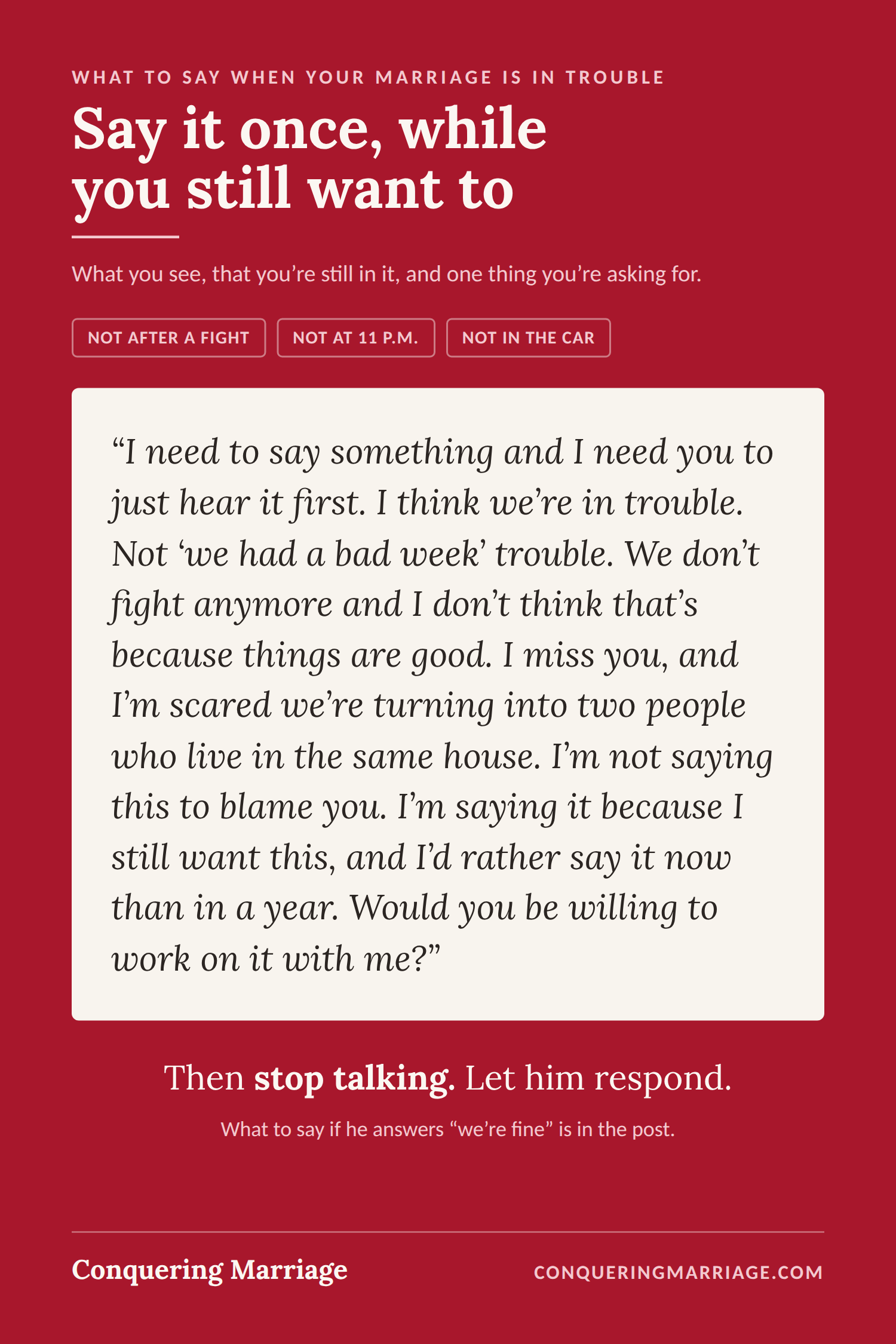
If he says “we’re fine.” He may mean it; men are often the last to notice quiet signs because quiet doesn’t feel like a problem to the person who isn’t lonely in it. Don’t argue the point. Say: “I hear that it feels fine to you. It doesn’t to me, and I’ve been carrying that on my own for a while. I’m not asking you to agree it’s bad. I’m asking you to take it seriously because I do.” That’s a request he can agree to without admitting anything, which is often what it takes.
Get help, and get it sooner than feels necessary. Level 2 patterns, especially contempt and refused repair, are what couples counselors are actually for, and they’re more fixable earlier. Ask like this: “I’d like us to see someone. Not because we’re broken. Because I don’t want to wait until we are. Would you come to one session with me? If you hate it, we’ll talk about what else to do.” One session is an easier yes than “therapy.” If he won’t, go alone; a good counselor can help you change your half of the pattern, and your half is half.
What to do at Level 3: fear, an affair, or an addiction
Fear. Start here if this one is yours: you manage his moods, you’re careful what you say, he’s hurt you or threatened to, or he controls the money, the car keys, or who you see. That’s more than a marriage in trouble, and nothing else on this page applies. Please don’t use any of the scripts here. The National Domestic Violence Hotline is free and confidential: call 1-800-799-7233, text START to 88788, or chat at thehotline.org. They’ll help you think it through without telling you what to do. Please reach out even if you’re not sure it “counts.” You’re not failing at your marriage. You’re being asked to handle something no list of signs was built for. If you’re having thoughts of harming yourself, call or text 988. If anyone is in immediate danger, call 911.
An affair. If he’s having one, or you are, the first thing to know is that it doesn’t automatically mean the marriage is over, and it doesn’t automatically mean it isn’t. Plenty of couples come back from one. What usually ends a marriage isn’t the affair itself but a break that never gets dealt with: the truth that stays half-hidden, the affair that doesn’t fully end, the questions nobody answers. If he’s the one having it, it isn’t a verdict on you. Two things this week: don’t make a permanent decision in the first month, and don’t try to handle it alone. This is a situation where a counselor who specializes in affair recovery is worth finding before anything else. If you’re the one being tempted, the honest question is not “should I?” but “which sign on this list am I trying to get away from?” That sign is the real conversation to have with him.
An addiction he won’t look at. Everything else on this page assumes two people who could, in principle, meet each other halfway. Addiction removes that in a specific way: he isn’t refusing you; he’s protecting the thing, and until he can see that, no amount of warmth or scripting will get through. If the drinking or using ever comes with anger that frightens you, the fear paragraph at the top of this section comes first. Otherwise, your job isn’t to fix the drinking (or the gambling, the porn, the pills). It’s two things. First, say it once, without the ledger: “I’m not asking you to quit tonight, and I’m not going to list the times. I’m telling you I’m scared, and I can’t keep pretending it isn’t a problem. I want you to talk to someone about it. If you won’t, I’m going to talk to someone myself, because I need help with how to live with this.”
Second, do exactly that. The SAMHSA National Helpline (1-800-662-4357, free, confidential, 24/7, in English and Spanish) is for families as well as the person using, and Al-Anon exists specifically for the people who love someone who drinks. For gambling, the National Problem Gambling Helpline (1-800-MY-RESET, or 1-800-697-3738; call, text, or chat, 24/7) is open to family members too. None of them will tell you to leave. All of them will help you stop carrying this alone, which makes it much easier to think clearly about what comes next.
For an affair or an addiction, when you’re ready for the “is it over?” question, is my marriage over? has a scored self-check that takes these into account. It also has a six-week honest test for when you’re torn.
If you see the signs and he doesn’t
This is one of the most common situations there is, and few articles on this topic cover it. You’ve read the list and recognized nine things. He’d read the same list and recognize two, and think you were being dramatic about those.
Usually it isn’t that he doesn’t care. It’s that the quiet signs are quiet for him. He isn’t the one lying awake. The logistics-only conversations feel efficient to him, not lonely. The lack of fighting feels like things have calmed down. So when you say “we’re in trouble,” you’re describing weather he hasn’t felt.
Three things help.
Describe, don’t diagnose. “You’ve checked out of this marriage” is a verdict, and he’ll defend against it. “We haven’t had a real conversation in about a month and I miss you” is something he can check against his own memory and find true.
Give him one concrete thing, not the whole list. Nine signs is an indictment. One is a request. Pick the one that would change your week most (often number 4 or 5: a real conversation, or one evening together on purpose) and ask for that.
Start without him. This is the part that feels unfair, and it is a little unfair, and it often works. Everything in Level 1 can be started by one person (and at Level 2, so can seeing a counselor on your own). When the temperature rises, he usually notices; when he notices, the conversation gets easier. Two weeks of that (the 14-Day Plan is the scripted version) is a fair first test of whether he’ll meet you.
If you do all three and, after a couple of months, he still won’t see it and won’t come, that’s information, and it belongs on the is my marriage over? page, not this one.
How long do you have?
You’ve probably seen the line that couples wait six years before getting help. It’s repeated on a lot of the pages you’ll find on this topic. When researchers actually measured it, in a 2021 study of 270 people in couples therapy, the average was under three years, and most had started within two. So the picture is a little less bleak than the internet suggests.
But the point underneath the myth is right: there’s a window, and it closes quietly. Level 1 signs left for a year become Level 2 signs. The other Level 2 signs, left for a few years, become sign 11, the not caring, and by then one of you has often quietly decided. There’s a well-known version of this where the wife spends years asking, stops asking, and then leaves a husband who never saw it coming. What to do when you’re not happy in your marriage covers that window in detail.
There’s no date. There’s just this: whatever level you’re on, you’re earlier today than you’ll be in six months, and most of what’s on this page works better early.
Frequently asked questions
What are the first signs of a failing marriage?
The earliest signs ar