
If you’ve typed “is my marriage over” into a search bar, you’re probably not looking for a definition. You’re lying awake, or sitting in the car in the driveway, and you want someone to tell you whether the flat, tired, faraway feeling you’ve had for months means what you’re afraid it means.
I can’t answer that for you. Nobody on the internet can, and be wary of anyone who claims to. But I can do something more useful than a list of scary signs. I can help you tell a hard season from an ending, give you a way to check where your marriage falls, and show you what to do next if the honest answer is “I don’t know.”
The short version: most of what feels like the end (constant fighting, feeling like roommates, no interest in sex) is a hard season, not a verdict. The signs that matter are quieter: contempt, silence, relief when he’s gone, and a fair attempt to fix things that changed nothing.
If you’re torn, don’t decide tonight. Run the six-week test below, with a fixed end date, and decide then. And if you’re being hurt, skip everything else and go straight to when it’s not a hard season.
Table of Contents
First, the thing nobody tells you: being unsure is normal
Here is what most “signs your marriage is over” articles leave out. A lot of people who end up divorced were never certain. When researchers at the University of Minnesota surveyed about 2,500 parents who were already going through a divorce, roughly one in four said they believed their marriage could still be saved. About three in ten said they might be open to help reconciling. These were people already in the legal process. If they weren’t sure, you’re allowed to not be sure either.
Family therapist Bill Doherty calls these “mixed-agenda” couples: one person leaning out, one leaning in, or one person leaning both ways at once, depending on the day. He built an entire form of counseling (discernment counseling, more on it below) because ordinary marriage counseling doesn’t work when one of you isn’t sure you want the marriage fixed.
So if you feel like you’re two different women, the one who wants out on Tuesday and the one who can’t imagine it on Saturday, that’s not a character flaw. It’s a very common place to be when you’re searching this question. The goal of this article isn’t to push you to either side. It’s to help you stop deciding and un-deciding every night, and get to an answer you can live with.
5 things that feel like the end but usually aren’t
Before we get to the signs that matter, let’s clear out the ones that scare people for no good reason. If these are the main things you’re seeing, you’re most likely in a hard season, and hard seasons have a way out.
You fight all the time. Fighting is unpleasant, but fighting means you both still care enough to argue. Couples who are truly done tend to go quiet. The question isn’t how often you fight; it’s whether the fights ever get repaired (an apology, a joke, a hand on the back of the neck an hour later). If they do, even badly, there’s still something alive there.
You feel like roommates. This is one of the most common things wives describe, and it is almost never the end. It’s what happens when kids, work, and logistics eat every ounce of attention for a few years. It responds well to small, specific changes. That’s the whole subject of how to reconnect with your husband when you feel like strangers, and if roommates is your main symptom, that post will do more for you than this one.
You have no interest in sex. Especially after babies, during a stressful stretch, or when you’re the one carrying the mental load, low desire is a symptom of exhaustion and resentment, not a sign the marriage is dead. Desire usually comes back when the resentment is dealt with, not the other way around.
You sometimes imagine life without him. Most people married more than a few years have pictured the apartment, the quiet, the not-having-to-ask. A passing fantasy is your mind trying on an option. It becomes a sign (see below) when it turns into planning.
You feel nothing for him this month. Numbness during a brutal season (a new baby, a death, a job loss, a health scare) is your nervous system protecting itself, not a verdict on your marriage. Give it a season before you read anything into it.
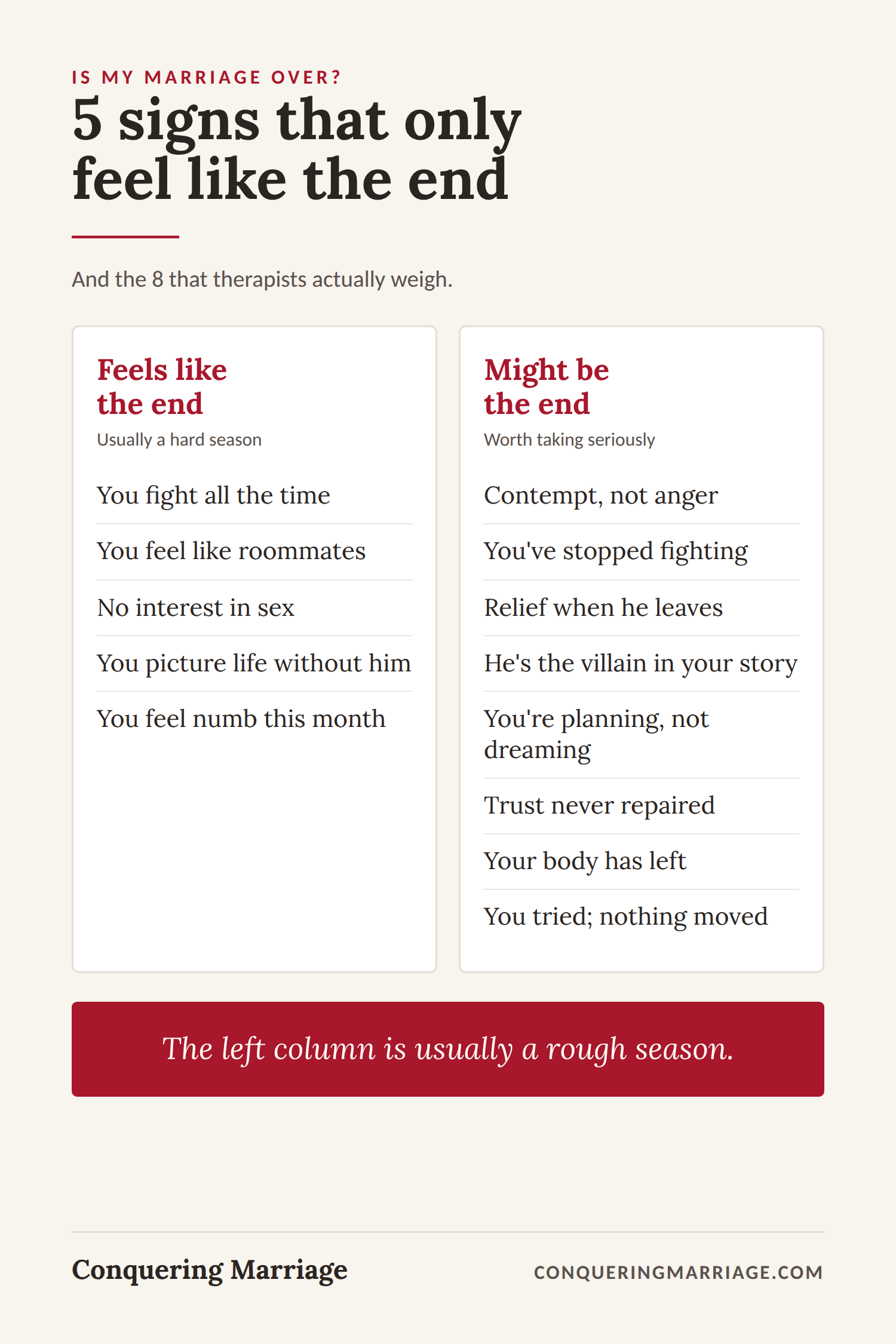
8 signs your marriage may be over
These are the markers therapists pay attention to when a marriage may be past saving. One (contempt) comes straight from decades of research; the rest are patterns clinicians describe again and again. None of them alone is a verdict. Several of them together, for a long time, are worth taking seriously.
1. Contempt has replaced anger
Anger says “I’m hurt and I want you to fix it.” Contempt says “I’m better than you.” It shows up as eye-rolling, mockery, sarcasm about his character, the tone of voice you’d use on someone you’ve written off. Relationship researcher John Gottman calls contempt the single greatest predictor of divorce. If you feel it toward him most of the time, or feel it coming from him, pay attention.
2. You’ve stopped fighting, and stopped caring that you’ve stopped
This one hides in plain sight because it looks like peace. If the fights stopped because you worked something out, wonderful. If they stopped because you decided it wasn’t worth the energy (you already know how it goes, and you can’t be bothered), that’s not peace. That’s resignation, and it’s one of the quietest ways a marriage ends.
3. You feel relief when he leaves and dread when he comes back
Not “it’s nice to have an evening to myself” (most people feel that). More like: your shoulders drop when his car pulls out, and something in your chest tightens when it pulls back in. The absence of any longing for him, over months, is something clinicians take seriously.
4. He’s the villain in your story, and you’ve stopped being curious
Listen to how you describe him in your head, or to a friend. Is it “he’s been distant and I don’t know why” or “he’s selfish, that’s just who he is”? When the story has hardened into a character verdict, when you can no longer imagine a reason for what he does that isn’t a flaw in him, the part of you that could still turn toward him has gone quiet. Curiosity is one of the last things to leave a living marriage.
5. You’re planning, not fantasizing
There’s a difference between picturing a quiet apartment and looking up rentals. Between “I wonder what it would be like” and a separate savings account he doesn’t know about, a folder of documents, a mental list of who gets what. Concrete, secret exit-planning means part of you has already decided, even if the rest of you hasn’t caught up.
One exception: if you’re setting money or papers aside because you’re afraid of him, that isn’t a sign your marriage is over. It’s a safety step, and a smart one. See when it’s not a hard season.
6. Trust was broken, and it was never actually repaired
An affair, a hidden debt, a lie that unraveled: these don’t automatically end a marriage. Plenty of couples come back from them. What ends a marriage is when the break was never really dealt with, when you “moved on” because you had to, and now every small thing lands on that old bruise. If you can’t remember a moment of real repair (his genuine remorse, a change you could see, your forgiveness that actually took), the trust is still broken, however long ago it happened.
7. Your body has already left
Sometimes the mind is still deciding while the body has gone. You flinch a little at his touch. You sit at the far end of the couch without deciding to. You find yourself holding your breath when he walks into the kitchen. Your body keeps a record of how safe you feel with someone, and it is often more honest than the story you’re telling yourself.
If what your body is telling you is that you’re afraid of him, that’s not a sign your marriage is over. It’s a sign to skip to the exceptions below.
8. You’ve genuinely tried, and nothing has moved
This is the one that matters most, and the one people fudge the most. “Genuinely tried” doesn’t mean you’ve hinted, sulked, or hoped. It means you told him plainly what was wrong and what you needed, more than once, in a calm moment. It means you changed what you could on your own side (that’s what the better wife post is really about). It means you gave it a real stretch of time, and maybe sat in front of a counselor together. If you’ve done all of that and nothing has shifted, that’s real information. If you haven’t, then you don’t yet know whether your marriage is over. You only know that it’s unhappy, which is a different thing.
The question that decides more than any list of signs
If you only take one thing from this article, take this. Underneath every list of signs, one question does most of the work:
Are you grieving the distance between you, or are you grieving the marriage itself?
Grieving the distance sounds like: “I miss us. I miss how he used to look at me. I hate that we’ve become this.” There’s pain in it, and pain, strangely, is a good sign. It means the attachment is still live. You don’t grieve the distance from someone you’ve stopped wanting.
Grieving the marriage sounds like: “I’ve already mourned it. I’m sad about the years, about the kids, about what it was supposed to be. But I don’t miss him.” That’s a different kind of sadness. It’s quieter, and it has usually already made up its mind.
Notice which sentence makes your throat tighten. You’ll probably know, and it’s the last question in the self-check below.
Is my marriage over? A 12-question self-check
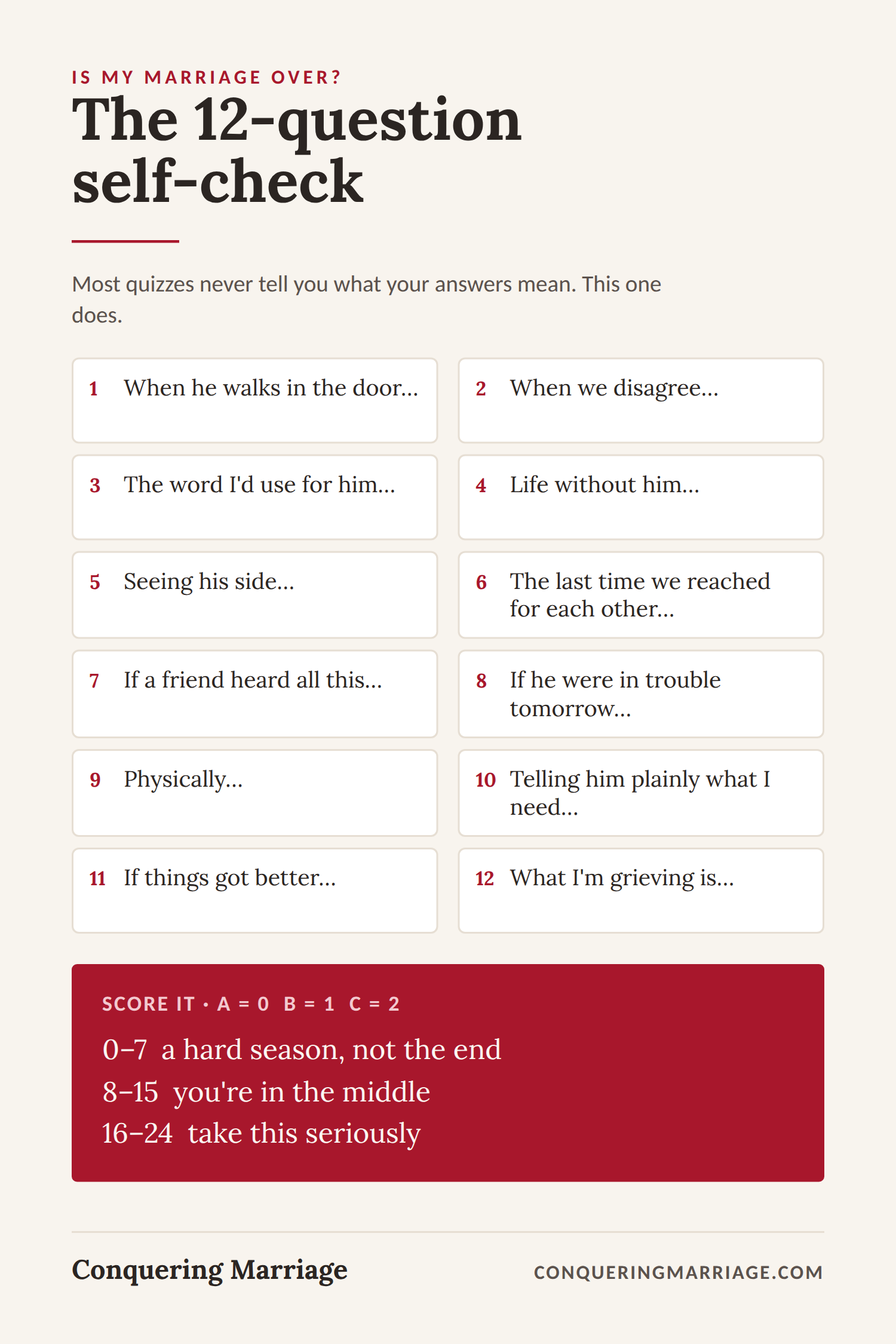
Many “is my marriage over” quizzes give you a long list of questions and no answer. This one gives you 12 and tells you what your answers mean. Answer about the last three months, not the worst week and not the best one. Be honest. Nobody’s reading over your shoulder.
For each question, pick A, B, or C.
- When he walks in the door, I mostly feel… A) glad, or at least neutral · B) tired, wary, on guard · C) dread, or nothing at all
- When we disagree… A) it gets heated, but we usually find our way back · B) we go quiet and it never really gets resolved · C) I don’t bother anymore; I already know how it ends
- When I picture him, the word that comes to mind is closest to… A) frustrating, distant, stressed · B) someone I’ve stopped expecting much from · C) contemptible, pathetic, the enemy
- Life without him… A) crosses my mind now and then · B) is something I daydream about regularly · C) is something I’ve started planning for in practical ways
- When I try to see things from his side… A) I can, even when I don’t want to · B) it takes real effort · C) I can’t, and I’ve stopped trying
- The last time one of us reached for the other (a hug, a joke, a “how was your day”)… A) was this week · B) was a while ago, I’d have to think · C) I can’t remember
- If a friend described my marriage to me, I’d say… A) “sounds like a rough patch” · B) “sounds like you need help” · C) “sounds like it’s over”
- If he were hurt or in trouble tomorrow… A) I’d be there without thinking · B) I’d be there, but out of duty · C) I’m not sure I’d feel much
- Physically… A) I still want closeness with him, even if I’m too tired for it · B) I tolerate it · C) I avoid his touch, or flinch a little
- Telling him plainly and calmly what’s wrong and what I need… A) I haven’t really done it yet, or it shifted something, even a little · B) he heard it, but nothing lasted · C) I’ve done it many times and nothing changed, or I’ve stopped because it wouldn’t matter
- If I imagine things getting better between us… A) I feel hopeful, even a little · B) I feel skeptical · C) I feel exhausted, or nothing
- What I’m grieving right now is… A) the distance between us · B) hard to say · C) the marriage itself
What your answers mean
Score each answer: A = 0, B = 1, C = 2. Add them up.
0–7: a hard season, not the end. Your marriage is unhappy and probably neglected, but the connection is still there under the tiredness. This is very fixable, and often without him having to do much at first. Start with how to reconnect with your husband and the free 14-Day Reconnect Plan. Give it six weeks of real effort before you revisit this page.
8–15: you’re in the middle, and that’s the hardest place to be. You’re not done, but you’re worn down, and you don’t trust that trying will work. Don’t decide from here. Read the “if you’re not sure” section below and run the six-week test. That’s what it’s for.
16–24: take this seriously. Something in you has left, or is leaving. That doesn’t mean divorce is the only option, and it doesn’t mean you have to decide today. It does mean the next step isn’t a date night. It’s a proper conversation, probably with a discernment counselor, and it’s honesty with yourself about whether you’re grieving the distance or the marriage. Give that question a day or two before you act on it.
Whatever your total, if you answered C on three or more of questions 3, 4, 8, 10, 11, and 12, read the “take this seriously” band too.
One override: if any of your C answers come from being afraid of him, not just tired of him, go to when it’s not a hard season. That changes everything.
Scored 0–15? Start with two weeks of small steps. Free: The 14-Day Reconnect Plan. One ten-minute action a day, with the exact words to say. Every day is something you can start on your own.
If you’re not sure: the six-week honest test
Here’s the problem with being in the middle. You end up re-deciding every night, usually at 11 p.m., usually after something small, and every decision gets overturned by the next good day or bad one. That’s exhausting, and it’s not deciding. It’s spinning.
The way out is to stop deciding for a fixed period, and to do something instead, so that at the end you have real information rather than the same feelings on a loop. Doherty’s discernment counseling asks couples to choose between three paths: stay as things are, move toward divorce, or commit to an all-in reconciliation effort for a set time with divorce off the table during it. You can borrow that structure on your own.
The rules
Pick a date six weeks out and write it down. Until then, the question “is my marriage over” is closed. Not answered; closed. You will not decide, and you won’t relitigate. When the 11 p.m. spiral starts, you say to yourself, “not until the 23rd” (or whatever date you wrote down), and go to sleep.
For those six weeks, you go all in, on your own side, whether or not he does. Not because it’s your job to save the marriage single-handed, but because you can’t know whether your marriage is worth saving until you’ve seen what happens when one person actually tries. If he responds, you’ll know. If he doesn’t, you’ll know that too, and it will be much easier to leave a marriage you’ve given a fair test than one you slipped out of while still wondering.
What “all in” looks like
- Tell him where you are, once, in week one. Not in a fight, not at bedtime. Keep it short and calm. Script below.
- Do the small things daily. Turn toward him when he speaks. Say one appreciation out loud each day. Ask for one specific thing instead of hinting. The reconnect post walks through all of this, and the free 14-Day Reconnect Plan makes a good first two weeks.
- Save the deeper “I miss us” conversation until you’ve had at least a week or two of warmth: week three or four if you’re doing this on your own, or day 8 if you’re following the 14-Day Plan, whose first week is built to get you there. Script below.
- Get help if you can. If he’ll come, see a counselor together. If one of you isn’t sure you even want to fix the marriage, ask for a discernment counselor by name. It’s short (one to five sessions) and built for exactly this, and it needs both of you there. If he won’t come at all, go alone: a good individual therapist can help you see your own marriage more clearly than any article.
- Keep a tiny log. One line a night: what happened, how you felt. Feelings lie in the moment; six weeks of lines don’t.
What to say to him (four scripts)
The “where I am” conversation, week one:
“I need to tell you something, and I need you to just hear it before you respond. I’ve been really unhappy for a while, and I’ve started to wonder whether we’re going to make it. I’m not saying I want out. I’m saying I’m scared, and I don’t want to keep pretending I’m fine. For the next six weeks I’m going to really try, and I’d love it if you would too.”
The “I miss us” conversation, once there’s some warmth (day 8 of the Plan):
“I’ve been feeling like we’ve drifted into being roommates, and I miss us. I don’t think it’s anyone’s fault. I just don’t want to keep going like this. Can we figure out together how to get some of it back?”
Then stop talking. Let him respond.
Asking him to counseling:
“I don’t want to keep having the same fight or the same silence. I’d like us to talk to someone together, not because I think we’re broken, but because I think we’re stuck and I can’t get us unstuck on my own. Would you come to one session with me? Just one, and then we’ll see.”
If he says he doesn’t think anything’s wrong:
“I hear that it feels okay to you, and I’m glad it does. It doesn’t to me. I’m not asking you to agree that it’s bad. I’m asking you to take it seriously that I’m telling you it is.”
At the end of six weeks
Sit down with your log and ask three questions. Did anything move, even a little? Did he try, in his way, once he knew? And, the big one: when things warmed up, did I want more of it, or did I feel relief when nothing changed? You’ll have an answer that’s built on six weeks of evidence instead of one bad night. That’s a decision you can live with, whichever way it goes.