
You love him. You’d even say you’re a good team. He does the bottles at night, you know which cream to use on which rash, and between you the house more or less runs. But somewhere in the last few months you stopped being two people who are into each other and became two people who hand a baby back and forth. You talk about naps, diapers, and who’s picking up what. You can’t remember the last conversation that wasn’t about the baby. And when he reaches for you at night, part of you wants to want it and part of you wants to be left alone.
If you feel disconnected from your husband since the baby, you’re not doing marriage wrong, and it doesn’t mean you’ve fallen out of love. A baby changes nearly everything a marriage runs on: sleep, time, touch, and attention. The closeness doesn’t usually come back by itself when things calm down, because with small children things don’t calm down for a while. It comes back when you put small pieces of it back on purpose, in sizes that fit a house with a baby in it.
The short version: feeling disconnected after a baby can mean five different things, so find yours first. Usually the fix isn’t a big date night. It’s two minutes a day that aren’t about the baby, touch that doesn’t ask for anything, and twenty minutes a week that are yours. The seven steps give the order. If you feel low, anxious, or afraid, start here instead.
Table of Contents
Why you feel disconnected from your husband after baby (it isn’t just you)
You’re both running on empty. Broken sleep makes everyone shorter-tempered, less patient, and less interested in anything that isn’t urgent. Connection is never urgent, so it’s the first thing to go.
Every conversation became logistics. When you do get a minute together, there’s always something that has to be decided: who’s up at 3 a.m., whether that cough needs the doctor, what’s for dinner. Those conversations are necessary. They’re also the conversations of two co-workers, and if they’re the only ones you have, you start to feel like co-workers.
Your touch budget is spent. If you’re feeding a baby and holding a baby and being climbed on all day, by evening you may not want anyone else touching you, even someone you love. Many new mothers call this being “touched out.” It’s real, and it isn’t about him. But if neither of you says that out loud, he can read it as rejection, and you can start avoiding all touch so it doesn’t lead anywhere.
You’re living different days. If one of you is home with the baby and the other goes to work, you each reach the evening with a different kind of tired. Each of you can feel the other has no idea what your day was like. Even if you both work, one of you usually carries more of the thinking about the baby, and that gap makes it easy to feel alone in the same room.
You’ve both changed. Becoming a parent changes how you see yourself, what you worry about, and what you have energy for. Part of what you’re doing now is getting to know each other again.
The research is reassuring, if you read all of it. In a well-known study that followed newlywed couples for several years, Alyson Shapiro, John Gottman, and colleagues found that about two-thirds of the wives who became mothers saw their satisfaction with the marriage drop, and about one-third didn’t. The part people leave out is what set that third apart. Their husbands kept expressing fondness for them and stayed aware of what was going on in their wives’ lives and in the marriage, and the wives stayed aware of their husbands too. The dip is common, not inevitable, and what protected those couples was mostly small, daily attention, which is exactly what the steps below rebuild.
Sometimes, though, the distance isn’t the marriage at all. If you feel low most days, can’t stop worrying, feel numb, or have thoughts that frighten you, that can be a postpartum mood or anxiety disorder, and it’s worth treating first. It’s common and treatable. Read the exceptions before anything else.
Which kind of disconnected is it?
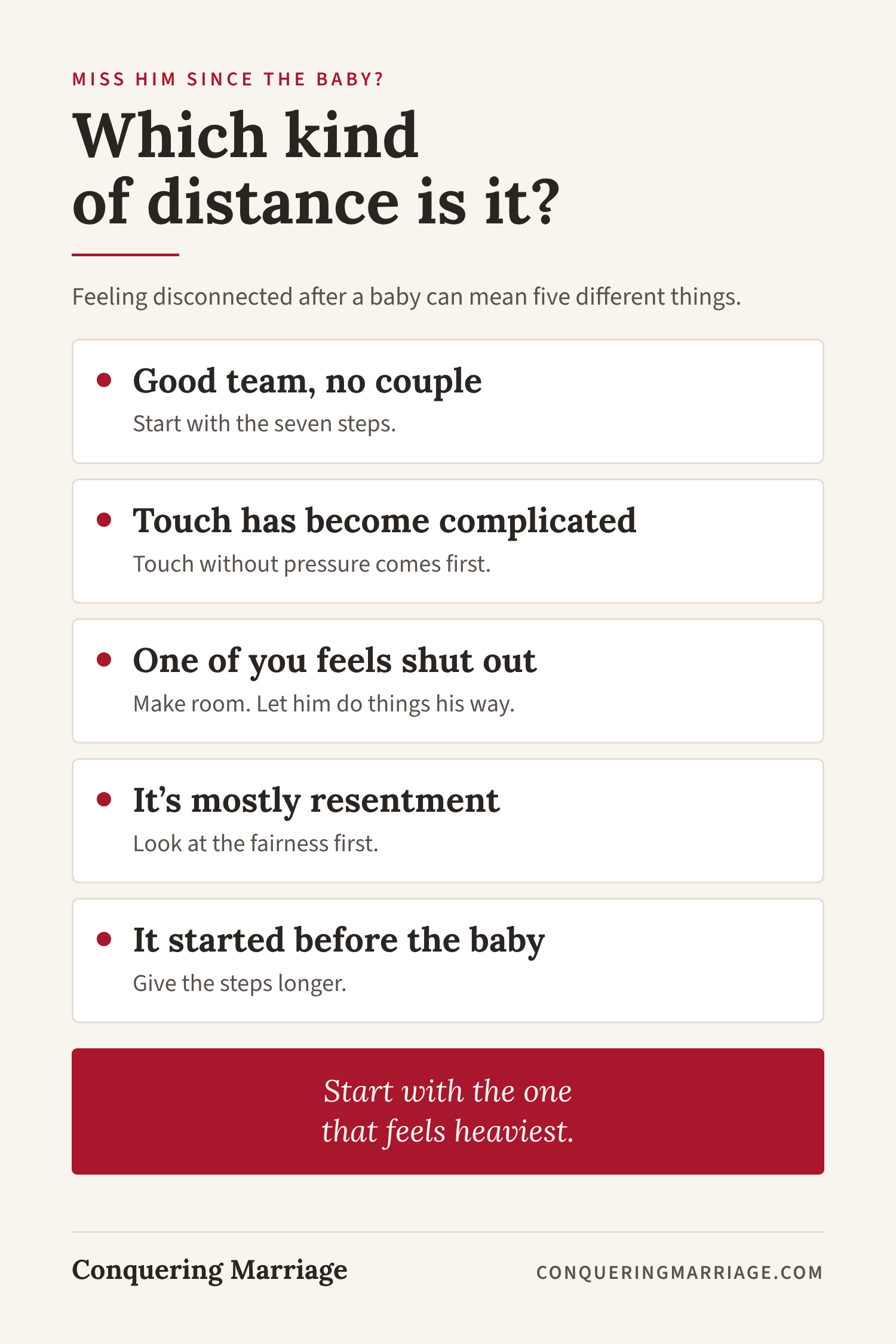
Read these and notice which one makes you nod. You may recognize more than one; start with the one that feels heaviest.
1. Good team, no couple. You work well together, you’re kind enough to each other, and you rarely fight. But every conversation is about the baby or the house, and you can’t remember the last time you laughed together or talked about anything else. Start with the seven steps. This one is common, and very fixable.
2. Touch has become complicated. You don’t want to be touched by the end of the day, or sex hasn’t come back, or it has but it doesn’t feel like yours. He’s reaching, you’re pulling away, and now every hug feels like a question. Start with the seven steps, steps 5 and 7. Touch without pressure comes before the sex conversation, on purpose. With a newborn, step 5 is enough for now.
3. One of you feels shut out. Maybe he seems to have stepped back, lets you handle everything baby-related, and you feel alone with it. Or maybe he says he feels like an outsider in his own family, that the baby gets all of you. Often it’s both at once. Start with the seven steps, then read if he feels shut out.
4. It’s mostly resentment. You’re not just missing him. You’re angry: about who does what, who gets to sleep, who gets to leave the house. If the main feeling is a tally running in your head, closeness can’t land until the fairness gets looked at. Start with how not to hate your husband after kids, which walks through sleep, the fairness talk, and handing over whole jobs, then come back here for the closeness.
5. It started before the baby. If you were already drifting before you got pregnant, the baby may have made it more obvious rather than causing it. Start with feel like roommates with your husband?, which is built for a distance that has been there for a while. The steps here will still help, but give them longer.
None of these, and you just feel flat, anxious, or not like yourself? Please read the exceptions first.
What not to do first
Don’t wait for it to get easier. “Once she sleeps through the night” turns into “once she’s in daycare,” then “once the next one is a bit older.” Small connection now is worth more than big connection someday.
Don’t save it all for date night. A date every few weeks is lovely if you can get one. It can’t carry a whole relationship on its own, and if it’s the only time you try, it comes with too much pressure. The daily minutes matter more.
Don’t make him an assistant parent. If you’re the one who knows how everything is done, it’s easy to hand him tasks and then correct how he does them. He learns to wait for instructions and you feel alone with the thinking. Let him do things his way, unless it’s genuinely unsafe.
Don’t say yes to sex you don’t want to keep the peace. It tends to make the next time harder, not easier. And don’t avoid all touch so that nothing “leads anywhere.” Both are understandable. Both make the distance worse. Steps 5 and 7 are the way through.
Don’t start with the big conversation. “We need to talk about us” lands very differently on two exhausted people than “come sit with me for a minute.” Warmth first, the talk later.
How to reconnect with your husband after baby: seven steps, in order
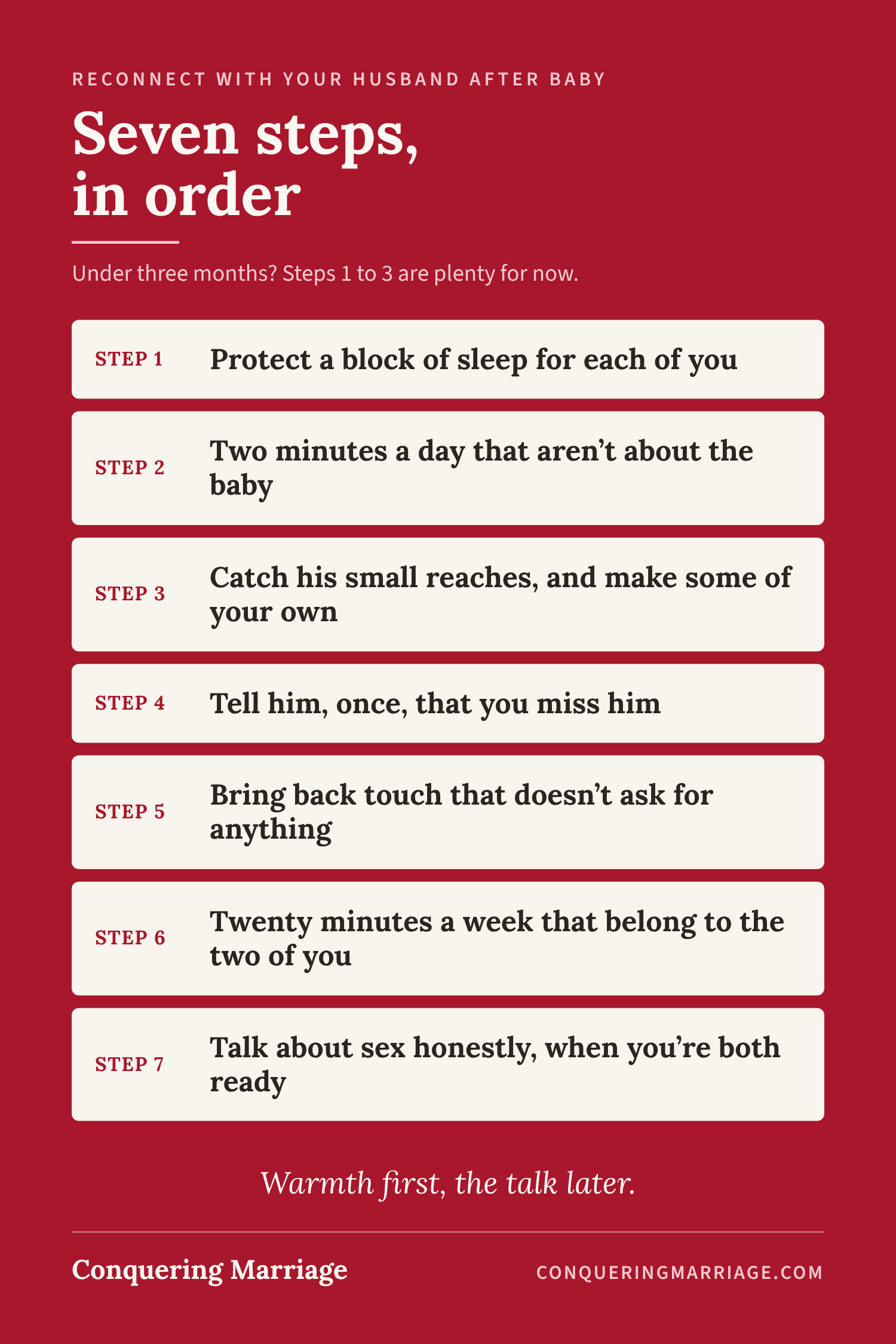
These are in order for a reason: sleep makes everything else possible, warmth makes the talking possible, and touch without pressure makes the sex conversation possible. Each step is sized for a house with a baby in it. Do one, keep it going, then add the next. If your baby is under about three months, steps 1 to 3 are plenty for now. Add the rest as things settle.
Step 1: protect a block of sleep for each of you
Nothing about your marriage can be judged fairly from four hours of broken sleep. If you can, give each of you one protected stretch a few times a week: he takes the first night shift on Tuesday, you take it Wednesday, the person off duty sleeps somewhere they won’t hear the baby. If you’re breastfeeding, he can still take the bring-the-baby-to-you, burp, change, and settle part, so you’re awake for twenty minutes and not an hour. How not to hate your husband after kids has more on sorting the nights fairly. This isn’t about being a better wife. It’s so you both feel like people again.
Step 2: two minutes a day that aren’t about the baby
Once a day, ask one question that has nothing to do with the baby, the house, or the schedule, and listen to the answer. It can be while the baby is feeding, in the car, or on the couch after bedtime. Two minutes counts.
“Okay, no baby talk for two minutes. What’s one thing from your day I don’t know about?”
Other questions that work: “What’s been on your mind this week that isn’t us or the baby?” “What are you looking forward to?” “What’s something you miss doing?” You’re not trying to have a deep conversation. You’re reminding each other that there are two people here, not just two parents.
Step 3: catch his small reaches, and make some of your own
The researcher John Gottman studied everyday “bids”: a comment, a question, a hand on the shoulder, a “look at this.” In his research, couples still together six years later turned toward each other’s bids about 86 percent of the time. Couples who later divorced did it about 33 percent of the time. With a baby, bids get missed constantly, because you’re both busy and tired and the baby always comes first.
This week, catch his. When he shows you something on his phone, look up and say something back. When he says “long day,” ask what happened. Then make a few of your own: a text in the middle of the day that’s about him, not about diapers. A thank-you for something specific he did. A hand on his back when you pass him in the kitchen. If you’ve been feeling that he’s stepped back, catching his bids is also the fastest way to find out whether he’s feeling shut out rather than not caring.
Step 4: tell him, once, that you miss him
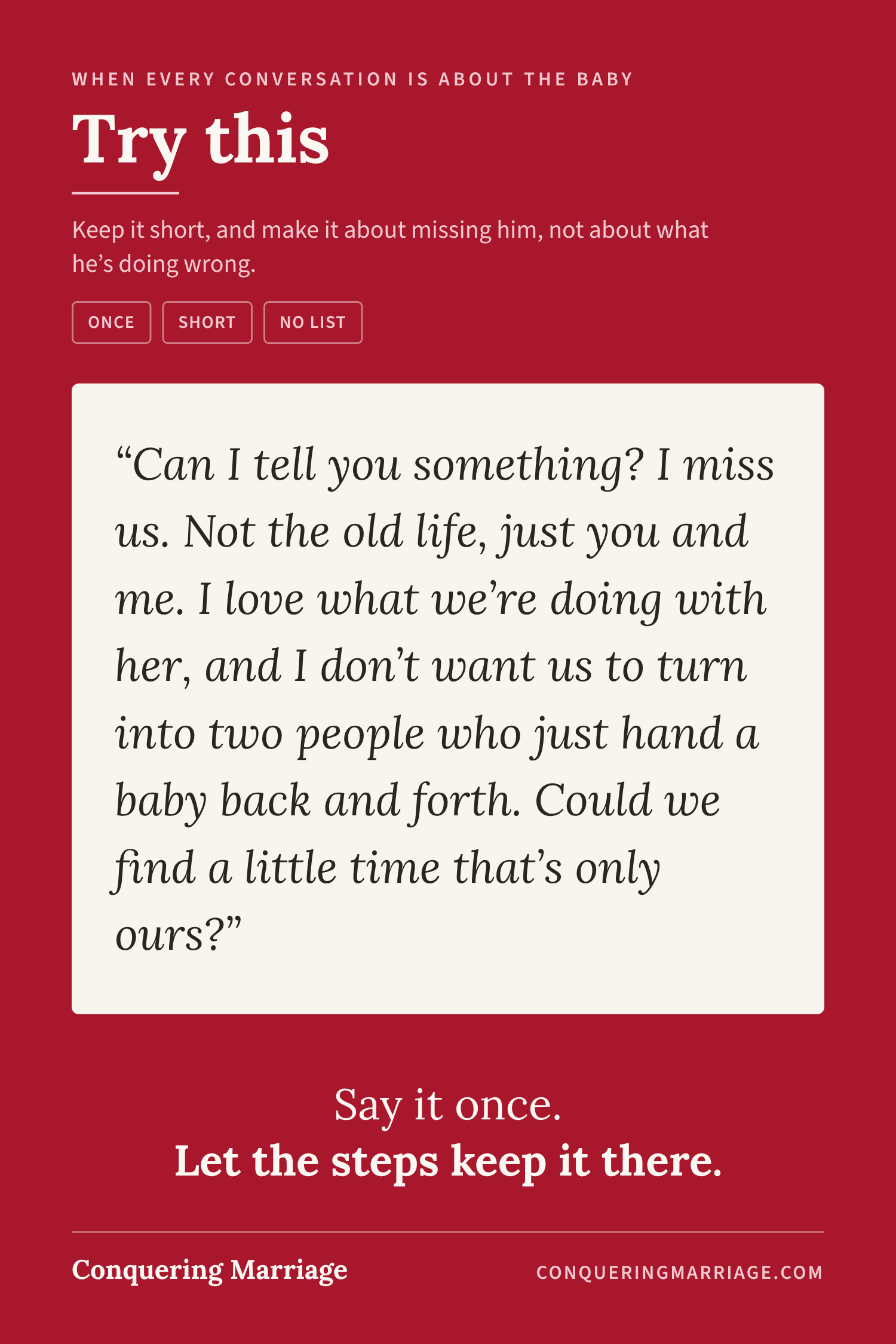
After a week or so of steps 2 and 3, say it out loud, once. Choose a calm moment, not right after an argument, not when one of you is holding a screaming baby. Keep it short, and make it about missing him, not about what he’s doing wrong.
“Can I tell you something? I miss us. Not the old life, just you and me. I love what we’re doing with her, and I don’t want us to turn into two people who just hand a baby back and forth. Could we find a little time that’s only ours?”
That’s it. Don’t follow it with a list. If he says “I miss us too,” that’s the start of a conversation. If he looks surprised or says “we’re fine,” that’s okay too. You’ve put it on the table without blame, and the rest of the steps keep it there.
Want the small steps written out? Free: The 14-Day Reconnect Plan. One ten-minute action a day, with the exact words to say, to bring the warmth back before the hard conversations. Every day is something you can start on your own, even on a day with a baby in your arms.
Step 5: bring back touch that doesn’t ask for anything
If touch has become a negotiation, the way back is touch that’s clearly not a request. A long hug in the kitchen. Holding hands on the couch. Your feet in his lap while you watch something. A kiss that’s longer than a peck and isn’t the start of anything.
For it to work, he needs to know it isn’t a step toward sex, and you need to trust that he knows. So say it:
“I want to be close to you, and right now my body is so touched out by the end of the day that I pull away even when I don’t want to. Could we have some time where we hold each other and it doesn’t have to lead anywhere? Not forever, just while I get my body back.”
Some husbands are relieved to hear this. Yours may have been reading your pulling away as rejection. If he hears it as “no sex ever,” it’s fine to add: “This is how I get back to wanting you, not a way of avoiding it.” If he pressures you or won’t take no for an answer, that isn’t a touch problem; please read the exceptions.
Step 6: twenty minutes a week that belong to the two of you
Once a week, protect twenty minutes after the baby is asleep that are only yours. Phones in another room. No baby talk, no household decisions. It doesn’t need a babysitter. Some ideas: eat dinner together at the table instead of in shifts. Play a card game. Sit outside with a cup of tea. Look at old photos from before. Take turns picking a show you used to watch together. Plan one thing you’d like to do together when the baby’s older, even if it’s a year away.
If you can get a real date once in a while, wonderful. But the weekly twenty minutes is what keeps you feeling like a couple between dates, and it’s much easier to protect.
Step 7: talk about sex honestly, when you’re both ready
Sex after a baby often comes back slower than either of you expected, and often in a different shape. That’s common. The longer it isn’t talked about, the more it gets filled in with guesses: he guesses you don’t find him attractive; you guess he only wants one thing.
A few things are worth knowing first. Your doctor or midwife’s all-clear means your body has healed enough, not that you have to be ready. If sex hurts, or keeps hurting, please tell your doctor; pain after birth is common and very often treatable, sometimes with pelvic floor physical therapy. Breastfeeding and sleep loss can lower desire for a while. And if desire doesn’t come back at all, even after the rest of your life feels better, that’s worth raising with your doctor too, because it can have a medical cause, including a postpartum mood disorder.
When you’ve had a few weeks of steps 2 to 6, have the conversation, outside the bedroom and not at 11 p.m.:
“I want to talk about us and sex, because I don’t want either of us guessing. I do want you. My body and my energy are different right now, and I’d rather go slowly than avoid it. What would feel good to you? I’ll tell you what feels good to me right now, too.”
Then listen. He may be carrying something too: worry about hurting you, feeling rejected, or feeling like he can’t bring it up. You don’t have to agree on everything in one conversation. You do have to stop guessing.
Then give it six weeks
Give the whole thing a fixed season: about six weeks from when you start step 4, keeping steps 1 to 6 going, with step 7 when you’re both ready. At six weeks, look back honestly. Do you have at least a few minutes most days that aren’t about the baby? Has touch become easier, even a little? Do you feel like he’s on your side? If yes, keep going. If it’s still no on every count, read if he isn’t trying below, and consider talking to a counselor.
If he feels shut out (or you feel alone with the baby)
These two often go together. You feel alone with the baby because he seems to have stepped back. He feels like an outsider in his own family because you and the baby seem to have a closed circle, and every time he tries, he’s corrected. Neither of you meant it. It just happened, because one of you was home more, or learned faster, or felt more pressure to get it right.
If he’s said anything like “you don’t need me” or “it’s all about the baby now,” try not to hear it as a criticism. It’s usually a bid. The answer isn’t to take care of his feelings for him. It’s to make room:
“I don’t want you to feel like an outsider. Honestly, I feel alone with a lot of it too. Could you take bath time, all of it, your way? I’ll stay out of the room. And can we have our twenty minutes on Thursday?”
Then stay out of the room. If he does it differently from you, let him, unless it’s actually unsafe. The more he does things on his own, the more he becomes a parent and not a helper, and the less alone you’ll feel.
New fathers can get depressed too. If he’s withdrawn from everything, not just from you, seems flat or irritable for weeks, or is drinking more, it’s worth gently suggesting he talk to his doctor. The exceptions below apply to him as well.
What reconnecting looks like at each stage
The first three months. Survival mode. The goal isn’t romance; it’s staying on the same side. Steps 1 to 3 are plenty: sleep where you can, two minutes a day that aren’t about the baby, catch each other’s bids. A kind word at 3 a.m. counts as connection.
Three months to a year. Things settle a little, routines form, and this is usually when the distance becomes noticeable, because there’s room to feel it. This is the stage for steps 4 to 6: say “I miss us,” bring back touch without pressure, protect the weekly twenty minutes. Step 7 when you’re both ready, and not before.
The toddler years. Often a second wave of distance, especially if you’re thinking about another baby or juggling work and childcare. The same steps still work. This is also when “we’ll reconnect once things calm down” can quietly turn into years, so if the distance is still there, put a date on the six-week check.
If you’re years past the baby and still disconnected, what you have may now be a roommate marriage, not a baby-stage dip. Feel like roommates with your husband? is built for that.
If he isn’t trying
Sometimes you do all of this and he doesn’t seem to notice, or he says he’s fine and doesn’t change anything. First, check that the distance isn’t really resentment about the load: if it is, if he won’t step up has the next move. Second, make sure he knows it matters to you. He may assume the distance is just what having a baby is like, and that you feel it the same way. Saying “I miss us” once (step 4) and then asking for one specific thing usually does more than hinting.
If you’ve done both and nothing moves, you can still keep the parts that are yours: the warmth, the bids, the time for yourself. You can’t reconnect a marriage on your own, but you can keep the door open and look after yourself while you do. How to save your marriage has a section on trying alone without losing yourself. A counselor can help too, on your own first if he won’t come:
“I’ve been feeling far away from you since the baby, and I don’t want us to drift. Would you come to a few sessions with me? If you’d rather not, I’m going to go on my own, because I want to understand what’s happening with me too.”
And if it feels like more than distance, read the exceptions below.