
Maybe you’ve typed “I hate my husband after baby” into a search bar at 11 p.m. with a baby monitor glowing beside you, or with a toddler finally asleep and a sink full of bottles nobody else is going to wash. If so, I want to say the first thing plainly: you are not a bad wife, you are not a bad mother, and you are not the only one. You’re a woman who loves her children, is running on almost nothing, and has started to feel something toward the man she married that frightens her a little.
I’m not going to tell you to drink more water or book a date night. You’ve read that article. I’m going to help you take the feeling apart (because “hate” after kids is nearly always several things stacked on top of each other, and each has a different fix), then walk you through what to do, in order, including the exact words to say to him.
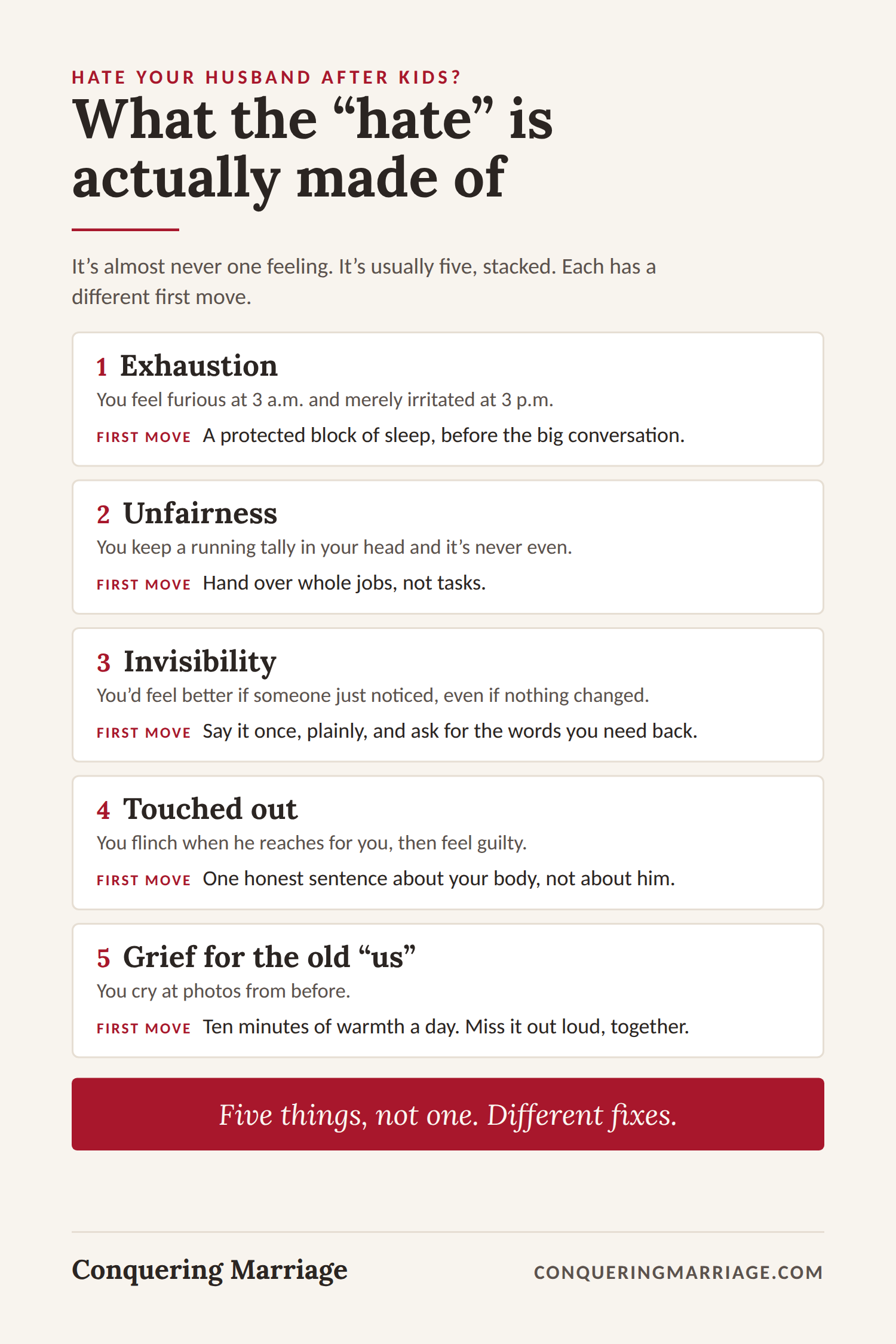
The short version: the resentment is usually five things at once: exhaustion, unfairness, invisibility, being touched out, and grief for the old “us.” Get sleep first. Then put a little warmth back, say it once while it’s still a request, and hand him whole jobs, not tasks. Give it six weeks.
If what you’re feeling isn’t resentment but something darker (rage you can’t explain, fear of him, or thoughts that scare you), skip everything else and go to when it’s more than resentment.
Table of Contents
First: what the “hate” is actually made of
“I hate my husband” is the sentence, but it’s almost never the feeling. When a wife says it after kids, what she’s describing is usually a stack of five smaller, more specific things. Read these and notice which ones make your stomach drop. Many wives have two or three. That’s not a disaster; it’s a list.
1. Exhaustion. You’re not sleeping, or not sleeping in stretches long enough to feel like a person. Nothing about your marriage can be judged fairly from inside that. The tell: you feel furious at 3 a.m. and merely irritated at 3 p.m. The first move: a protected block of sleep (step 1), before the big conversation.
2. Unfairness. You do more, and you both know it. You’re the one who knows the daycare pickup time, the pediatrician’s name, when the diapers run out, which cousin’s birthday is Saturday. He “helps.” The tell: you keep a running tally in your head and it’s never even. The first move: hand over whole jobs, not tasks (step 6).
3. Invisibility. Nobody sees what you carry. He comes home and asks what’s for dinner. Your mother says you look tired. Strangers tell him he’s a wonderful dad for pushing a stroller. The tell: you’d feel better if someone just noticed, even if nothing changed. The first move: say it once, plainly (step 5), and ask for the specific thing you need said back.
4. Being touched out. Someone has been on your body since 6 a.m. By bedtime the idea of one more person wanting something from you, even affection, makes you want to climb out of your skin. And he takes it personally. The tell: you flinch when he reaches for you and then feel guilty. The first move: an honest sentence about your body, not his (step 9).
5. Grief for the old “us.” You miss who you were together before, and you’re not allowed to say so because you’re supposed to be grateful. Underneath the anger is loss. The tell: you cry at photos from before. The first move: put warmth back in ten minutes a day (step 4), and let yourselves miss it out loud.
And sometimes, it’s not the marriage at all. If the anger feels out of proportion, comes with rage, dread, or thoughts that frighten you, or you can’t feel much of anything, that can be a postpartum mood or anxiety disorder, not ordinary postpartum resentment. It’s common and treatable, and it isn’t a verdict on you or your marriage. Read the exceptions first.
Why do I hate my husband after having a baby? (It isn’t in your head)
The question underneath “is it normal?” is really “is it me?” So here’s the picture.
In a well-known study that followed newlywed couples for several years, Alyson Shapiro, John Gottman, and colleagues found that about two-thirds of the wives who became mothers saw their satisfaction with the marriage drop, and about one-third didn’t. That’s the source behind the “67%” line you’ll see everywhere. The part people leave out is the third who held steady, and what set them apart: husbands who kept expressing fondness for their wives and stayed aware of what was going on in their wives’ lives and in the marriage, and wives who stayed aware of their husbands too. In other words, the drop is common, not inevitable, and what protected those couples is exactly what this article is trying to rebuild.
The unfairness isn’t imagined either. Pew Research Center’s work on modern marriages finds that even when husband and wife earn about the same, she still does more of the caregiving and housework, and he has more leisure time. The baby didn’t invent that gap. It just made it impossible to ignore, because the hours stopped being spare.
Add sleep deprivation, a body that doesn’t feel like yours, a hormonal cliff after birth, and an identity that got folded into “mom” overnight while his stayed mostly intact. Then there’s a culture that congratulates him for doing what you do unnoticed every day. Put all that together and the resentment isn’t a character flaw. It’s an accurate reading of the situation, delivered by a nervous system that hasn’t slept. The reading is right. The volume is just turned all the way up.
The mistake resentful wives make most often
Not saying it. Or, more exactly: not saying it while it’s still a request.
Here’s how the pattern usually goes. She does everything, quietly, because asking feels like nagging and because she’s decided he should just see it. She keeps score, silently. The score gets lopsided. The requests she never made turn into complaints (“you never…”), then into contempt (the eye-roll, the sigh, correcting how he holds the baby), then into a settled private verdict about who he is. By the time she finally says it, it comes out as an indictment, and he’s blindsided, defensive, and hurt, because from where he sits, nothing was said and now everything’s wrong.
The exit from that pattern is boring and it works: say the specific thing while you can still say it as a request. That’s step 5. Everything before it exists to make step 5 land, and everything after it exists to make it stick.
One more thing, because it’s the part that’s hard to hear. If you’ve spent a year re-doing what he does, taking the baby back when he’s “doing it wrong,” and running everything through you, then some of the load is load you’re holding onto. That’s not a character flaw either; it’s what happens when you’re the one who knows how and there’s no time to teach. But it means that handing over a job has to include handing over the standard. We’ll get to that in step 7.
How not to hate your husband after kids: 9 steps, in order
The order matters. Sleep before the big conversation. Warmth before the fairness talk. Whole jobs after the talk, not instead of it.
1. Get one protected block of sleep, before anything else
This is not a marriage step. It comes first because nothing you decide about your marriage while running on four broken hours is trustworthy. And exhaustion is the one piece of the “hate” you can fix this week without any change in him at all.
Find one block, five hours or more, at least twice a week, that is yours to sleep through. If you’re breastfeeding, that may mean a pumped bottle and him on the first feed, or you going to bed at 8 and him handling everything until the 1 a.m. feed. If the baby is older, it’s him on every wake-up Tuesday and Saturday, full stop. If there is truly nobody (he works nights, no family nearby, no friend to call), then the block is the nap you take while someone else holds the baby, and asking for that is the first ask.
“I need to say something about sleep. I’m at the point where I’m not safe to drive and I’m not fair to you or the baby. I need two nights a week where I sleep from 9 to 3 and you take every wake-up, even if it means a bottle. Can we start Tuesday?”
Notice it’s specific (which nights, which hours), it’s about you (not about what he’s failing to do), and it has a start date. That is the shape of every ask in this article.
2. Write down what you’re actually angry about
Take the five things above and, for each one that’s yours, write the single most specific example from the last week. Not “he doesn’t help.” “He scrolled his phone on the couch Saturday while I did bath, books, and bed, then asked if I wanted to watch something.” Not “he doesn’t see me.” “He said ‘what did you do all day’ on Thursday.”
You are not doing this to hand him the list. You are doing it because “I hate him” is unworkable and “I need Saturday bath-to-bed handed over entirely” is workable. Often, three specific things account for most of the feeling. Those three become the asks.
3. Stop the four things that make it worse
You can’t control what he does. You can stop feeding the pattern from your side, starting today. That isn’t the same as letting him off the hook. It’s clearing the ground so your ask can be heard.
- Silent martyrdom. Doing it all with a sigh and waiting for him to notice. He will not notice. He will learn that everything gets done.
- Correcting. The diaper’s on backwards, the onesie doesn’t match, the bottle’s too warm. Every correction teaches him that the job is yours and he’s the assistant, and he will act accordingly.
- Keeping the tally out loud. “I’ve done six nights in a row.” Even when it’s true, especially when it’s true, it turns the marriage into a ledger and puts him on the defensive before the sentence is over.
- Contempt in front of the kids. The eye-roll, the “your father,” the mocking voice. Contempt is the habit John Gottman’s research flags as the strongest predictor of divorce, and children pick up on it long before they can name it.
If you want more on doing any of this while you’re running on empty, the “too tired and too resentful” section of how to be a better wife covers it.
4. Put ten minutes of warmth back, before the fairness talk
This is the step that feels unfair, so let me explain why it’s here. A fairness conversation with a man who feels criticized and shut out usually lands as an attack, however carefully you word it. The same conversation, one week after he’s felt liked by you again, lands as a request from someone who’s on his side. Warmth isn’t the reward for him doing better; it’s what makes doing better feel possible to him.
Ten minutes. Not sex, not a date night you can’t get a sitter for. A real “how was your day” with your phone face down. A hand on his back when you pass in the kitchen. One sincere “thank you for doing the daycare run” said like you mean it, and not followed by “but.” One thing you noticed him doing well with the baby, said out loud, in front of the kids.
If you’d rather not improvise this, the free plan below is this step, scripted.
Too tired to work out where to begin? Start with two weeks of small steps. Free: The 14-Day Reconnect Plan. One ten-minute action a day, with the exact words to say. Every day is something you can start on your own.
5. Say it once, plainly, while it’s still a request
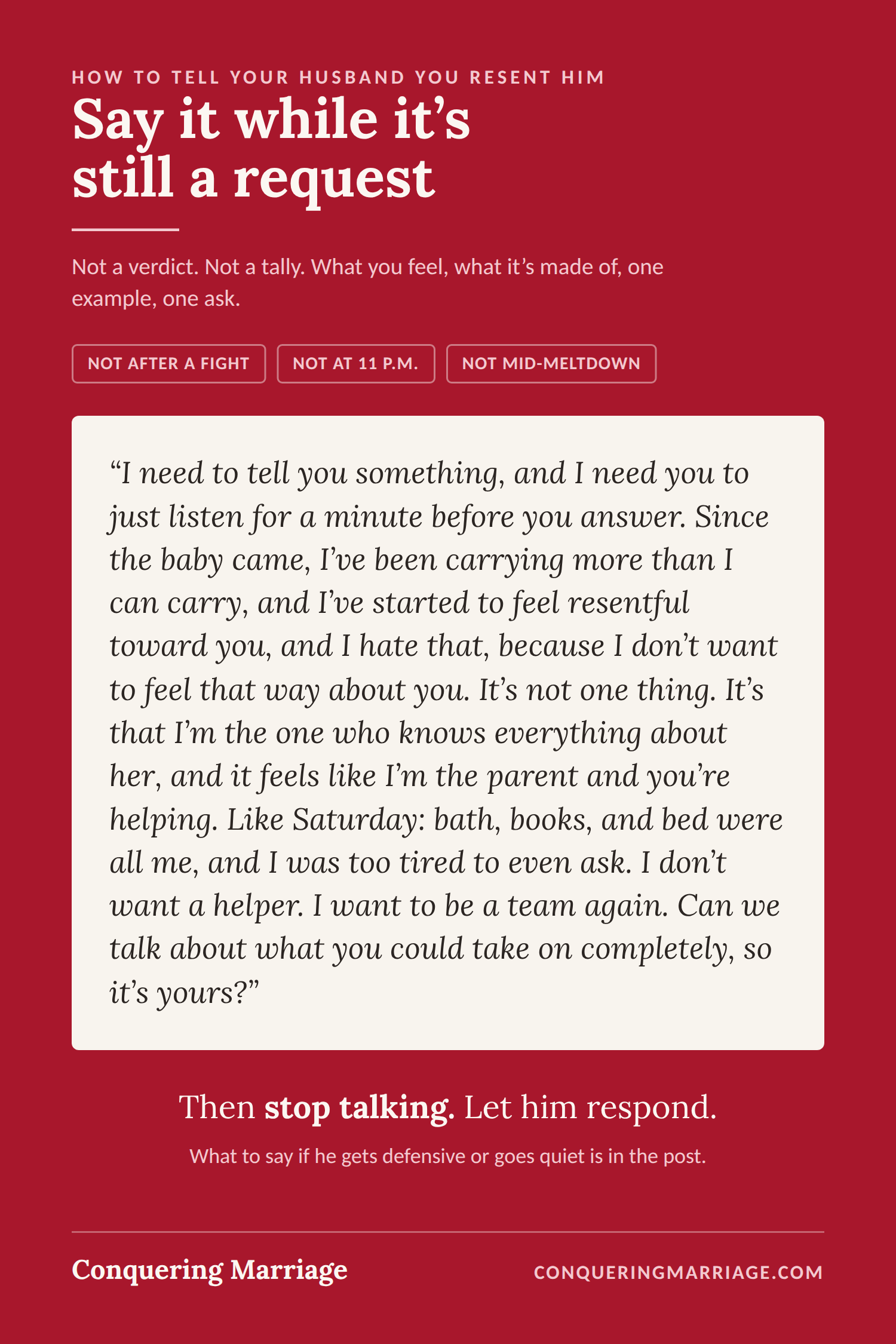
Pick a time when nobody’s on empty: not after a fight, not at 11 p.m., not while one of you is holding a screaming child. A Sunday morning walk with the stroller works; so does a car ride with the baby asleep. Then say it, once, in this shape: what you’re feeling, what it’s made of, one specific thing, and what you want him to do about it.
“I need to tell you something, and I need you to just listen for a minute before you answer. Since the baby came, I’ve been carrying more than I can carry, and I’ve started to feel resentful toward you, and I hate that, because I don’t want to feel that way about you. It’s not one thing. It’s that I’m the one who knows everything about her, and it feels like I’m the parent and you’re helping. Like Saturday: bath, books, and bed were all me, and I was too tired to even ask. I don’t want a helper. I want to be a team again. Can we talk about what you could take on completely, so it’s yours?”
Then stop talking. Let him respond.
He may get defensive (“I do plenty”). He may go quiet. He may say “just tell me what to do” (that’s step 6, and it’s a yes). If he gets defensive, don’t argue the tally; go back to the feeling: “I’m not keeping score. I’m telling you I’m drowning and I’d rather tell you than keep pretending I’m fine.” If he goes quiet, give him the night: “You don’t have to answer now. Can we pick it up tomorrow after she’s down?”
6. Hand over whole jobs, not tasks
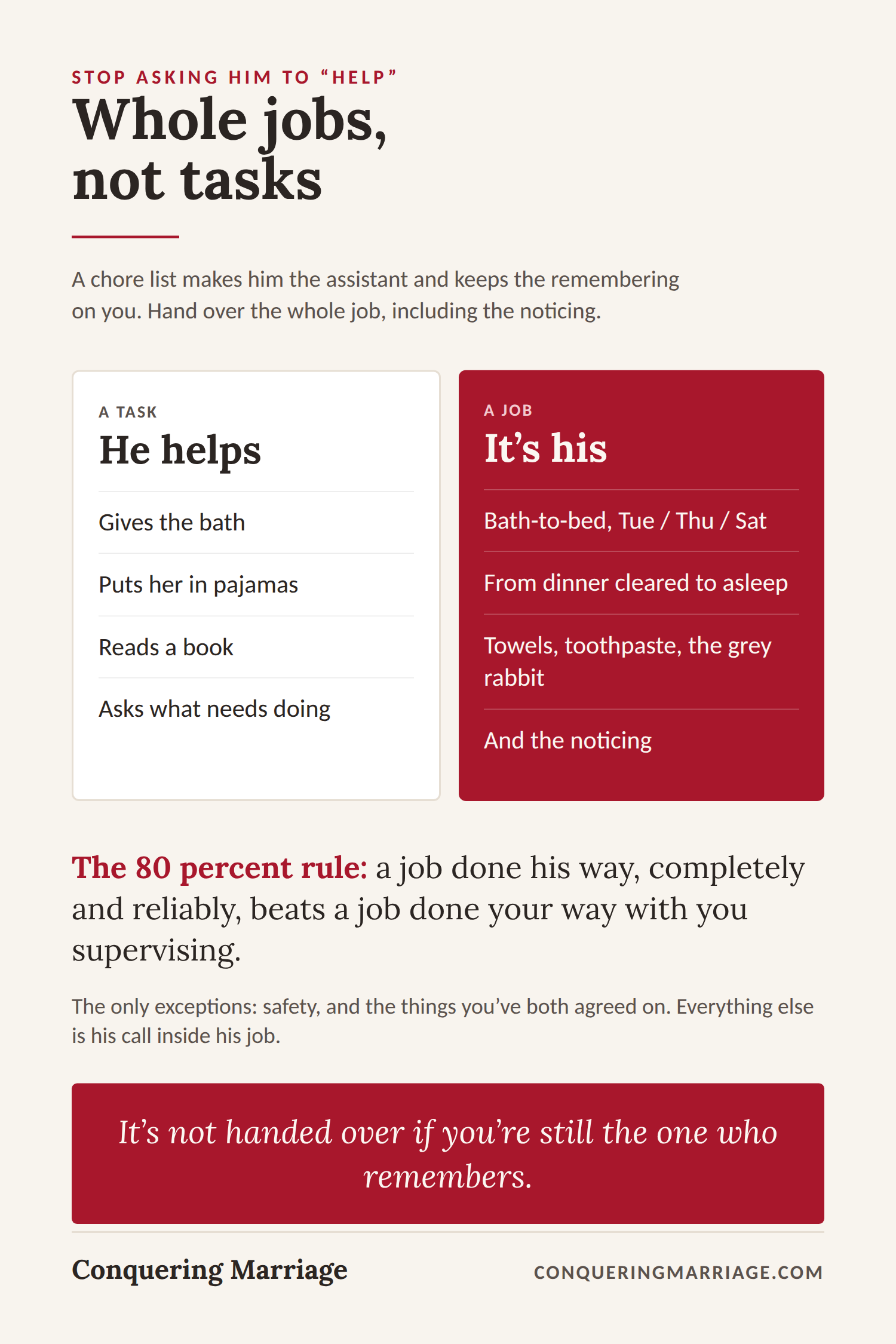
This is the step that changes the unfairness, and it’s where most “divide the chores” advice goes wrong. A chore list makes him the assistant: you still remember, plan, notice, and delegate, and he executes and expects credit. The mental load stays yours. What works is handing over the whole job, including the noticing.
“Bath-to-bed on Tuesday, Thursday, and Saturday” is a job. It includes knowing when the towels are dirty, that the toothpaste is running out, and that she won’t sleep without the grey rabbit. “Daycare” is a job: the app, the forms, the sick-day calls, the fee. “Dinner Monday to Wednesday” is a job, including the shopping. If you’ve read Eve Rodsky’s Fair Play, this is the same idea: a job means conceiving it, planning it, and doing it, and it’s not handed over if you’re still the one who remembers.
Pick one from your step-2 list. One. Then:
“I’d like bath-to-bed to be yours on Tuesdays, Thursdays, and Saturdays, from the minute dinner’s cleared until she’s asleep. Everything in it: the bath stuff, the pajamas, the toothpaste when it runs out. I’ll stay out of it completely. Is there anything you need from me to make that work?”
Then, and this is the hard part, stay out of it completely. If the pajamas don’t match, if bedtime runs late, if you can hear it going sideways from the kitchen, you stay in the kitchen. Which brings us to step 7.
7. Let him do it his way (the 80 percent rule)
A job done his way at 80 percent of your standard, completely and reliably, is worth more to your marriage than a job done your way at 100 percent with you supervising. He will be slower. He’ll do things you’d never do. Your daughter will go to daycare in a swimsuit top under a cardigan one Wednesday and survive it. The only exceptions are safety (car seat straps, medication doses, bath water) and things you’ve both agreed on (screen time, what she eats). Everything else is his call inside his job.
If you can’t stand to watch, leave the house during his jobs for the first few weeks. That’s not avoidance. It’s how the job becomes actually his, and how you get step 8.
8. Put one thing back that’s yours
Resentment thrives where there’s no self left. Pick one thing, weekly, that’s yours: a Saturday-morning run, coffee alone with a book, a class, a friend, a bath with the door locked and the monitor with him. Put it in the calendar as an appointment, not a hope. Ask for it the same way you asked for sleep: specific day, specific hours, start date.
He should have one too. Say so. A marriage where each of you gets three protected hours a week is easier to like than one where you both white-knuckle it and quietly count who’s had it worse.
9. Bring the couple back, including your body, honestly
Sex after kids is where a lot of the resentment silently lives, on both sides. He reads “not tonight” as rejection of him; you read his reaching for you as one more demand on a body that’s been handled all day. Neither of you says so. The fix is an honest sentence about your body that isn’t a sentence about him:
“I want to want you again, and right now my body’s had a small person on it for fourteen hours and I’ve got nothing left. It’s not you. Can we start with just lying together with no expectation, and see what comes back?”
Then keep it small and real: ten minutes on the couch touching, a shower together with no agenda, a kiss that’s longer than a peck. Many couples find that when the sleep and the fairness improve, desire follows; it usually doesn’t work the other way around, which is why this is step 9 and not step 1. If desire doesn’t come back at all after the rest is better, that’s worth talking to your doctor about, because it can have a medical cause (recovery from birth, breastfeeding, hormonal birth control, or a postpartum mood disorder), and it isn’t a character flaw either.
Then give it six weeks
Give the whole thing a fixed season. Do steps 1 through 9, hold your side, and don’t re-litigate every night. At six weeks, look again: is there one whole job that’s reliably his? Do you feel seen at least sometimes? Is the tally quieter? If yes, keep going and add a second job. If it’s no on every count, skip to if he won’t step up.
“I shouldn’t have to ask” (and other reasons the asking is hard)
Every wife reading step 5 has thought it: I shouldn’t have to ask. He lives here. He has eyes. You’re right. You shouldn’t have to. Being right doesn’t help you, though, because the man who would have noticed on his own would already have noticed, and you’re married to this one, whom you love, who didn’t.
Here’s what makes it easier to hear: many husbands were raised in a house where a woman quietly ran everything, and they learned, without ever deciding it, that the running is background. Not because they think less of you, but because they’ve never once had to hold the whole picture. Asking isn’t admitting he’s a child. It’s handing him a piece of the picture he’s never been shown. Once it’s his, the goal is that you never ask about that piece again.
The other thing that stops the ask is fear of the reaction: that he’ll sulk, or say you’re never satisfied, or agree and then not do it. Two of those three are answered by the shape of the ask (specific, about you, with a start date). The third is answered by the six-week season: you’ll know.
If he won’t step up, or you’re the only one trying
Sometimes you do all nine steps, and he takes the job for a week and lets it slide, or agrees with everything and changes nothing. That’s real, and it’s exhausting in a different way, because now the tally has a new line: I even did the work on the resentment.
Three things. First, hold your side a little longer than feels fair, because change in a husband who’s felt criticized for a year often lags by several weeks. The first sign is usually a small thing done without being asked, not a transformation. Second, make the second ask smaller than the first, not bigger: one job, one night, one specific thing. Third, say the fairness part once more, plainly, and then stop saying it and watch:
“I asked for bath-to-bed on Tuesdays, Thursdays, and Saturdays to be yours, and it’s drifted back to me. I’m not angry; I’m telling you because I’d rather say it than go back to being quietly resentful. I need it to actually be yours. Starting this Tuesday?”<