
You’ve tried bringing it up at dinner. You’ve tried bringing it up in bed. You’ve tried waiting for a good moment, and the good moment never came. Every time, it ends the same way: he goes quiet, or says “can we not do this right now,” or gets up and finds something that suddenly needs doing in the garage.
If your husband won’t talk about your problems, you’re probably exhausted, a little furious, and starting to wonder whether he cares at all. Usually, he does. A man who shuts down is usually a man who has learned that these talks go badly for him, not a man who has stopped caring about the marriage. That doesn’t make the silence okay. It does mean there’s more you can do than keep knocking on the same closed door.
The short version: “won’t talk” can mean five different things, so find yours first. Usually the fix isn’t a better argument. It’s a smaller, softer, better-timed conversation, with a break when he needs one and a way back in. The six steps give the order. If his silence makes you afraid, or it’s used to punish you, start here instead.
Table of Contents
Why your husband won’t talk about problems
It helps to know what’s usually going on behind the silence, because what you do next depends on it. These are the common reasons.
His body is overwhelmed. When a conversation feels like a threat, the body reacts before the mind does. The Gottman Institute calls this flooding: once your heart rate climbs past about 100 beats a minute, the part of you that can listen and find words goes offline. Plenty of men flood quickly in conflict and don’t recognize it. From the outside, it looks like he’s shutting you out (you may see this called stonewalling). From the inside, he has no words left.
He’s learned these talks go badly for him. If past conversations about problems have turned into long nights, a list of what he’s done wrong, or a fight he can’t win, his brain files “we need to talk” under danger. He isn’t avoiding the problem as much as the conversation he expects.
He doesn’t think talking helps. Some men grew up in homes where problems were handled by not mentioning them, or by fixing them quietly. To him, going over it again can feel like making it worse.
He doesn’t have the words. Being able to name what you feel is a skill, and not everyone was taught it. “I don’t know” is sometimes the honest answer, at least on the first try.
You’re both caught in a loop. This one is so common it gets its own section below.
Sometimes, something else is going on. An affair he’s hiding, an addiction, depression, or silence that’s being used to control you. Those aren’t communication problems, and they need a different starting point. They’re covered here.
The chase-and-retreat loop
Researchers who study couples describe a pattern called pursue–withdraw (you may also see it called demand–withdraw). One partner pushes for the conversation. The other pulls back. And here’s the trap: each one’s move makes the other’s worse. The more you push, the more he retreats. The more he retreats, the more alarmed you get, so you push harder.
From inside the loop, it feels like he’s the problem. You’re just trying to solve things, and he won’t. From his side, it often feels like he’s being chased, so he runs. Neither of you is the villain. The loop is.
This matters because you can’t make him come forward, but you can change your half of the loop. When you stop chasing, not by giving up on the issue but by changing how you bring it up, a lot of men stop running. That’s what the steps below are built on.
Which kind of “won’t talk” is it?
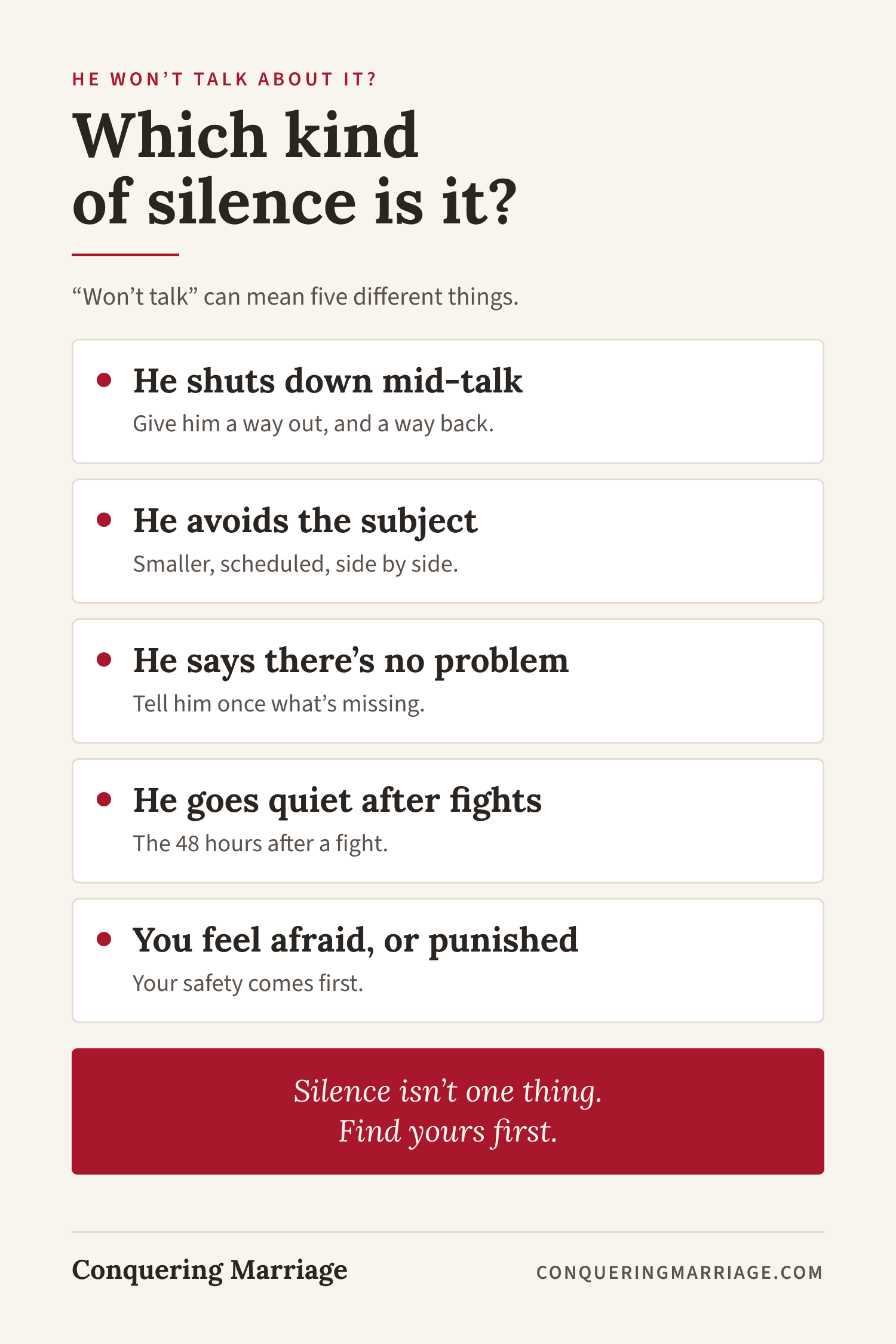
Read these and notice which one sounds like your house. Many wives see a bit of two.
1. He shuts down mid-conversation. The conversation starts, then he goes blank, stares at the floor, gives one-word answers, or walks away halfway through. When a husband shuts down like this, it’s usually flooding. You’ll need a way to give him a break that doesn’t end the conversation for good. Start with the six steps, especially step 4.
2. He avoids the subject altogether. You can see him bracing the moment you say “can we talk?” He changes the subject, makes a joke, or says “not now,” and now never comes. This is usually the “these talks go badly” reason. The fix is a much smaller, scheduled, lower-stakes conversation. Start with the six steps from step 1.
3. He says there’s no problem. He isn’t refusing to discuss it. He just doesn’t see what you see. Things look fine from his side: nobody’s fighting, the house runs. This is especially common when a marriage has drifted. What to say when he says there’s no problem is below, and if you feel more like roommates than a couple, this section on the husband who seems fine goes deeper.
4. He goes quiet after fights. He talks normally most of the time, but after an argument he disappears for hours or days. That’s a different problem with its own clock. How to heal a relationship after a fight walks through it, including how to tell a man who needs an hour from a man who’s punishing you.
5. The silence feels like punishment, or you feel afraid. He goes silent for days to make a point, refuses to speak until you apologize for things you didn’t do, or you’re careful about bringing anything up because of how he might react. That isn’t a communication style. Please read this first.
What not to do (the moves that make him close up more)
You’ve probably already tried some of these. Almost every wife has, because they’re what you do when you’re desperate to be heard. They tend to make the wall higher.
- “We need to talk.” Those four words are the starter pistol for flooding. Say what it’s about and how long it’ll take instead.
- The ambush. Bringing it up the moment he walks in, at 11 p.m., in the car with the kids in the back, or when he’s in the middle of something. Bad timing turns a reasonable topic into an attack.
- The whole case at once. Everything that’s bothered you for a year, in one go. Even if every point is fair, he’ll only hear “you’re failing,” and he’ll defend instead of listen.
- The long text. A thousand-word message gives him a document to defend against and no face to respond to. Use texts to set up a talk, not to have it.
- Following him, or narrating his silence. If he walks away and you follow, or you say “So you’re just not going to say anything? Typical,” he’ll feel cornered and his shutdown becomes the topic. Now there are two problems.
- Threatening to leave to get a reaction. If you’re seriously considering it, that’s a real conversation for a calm day. As a way to force him to talk, it usually backfires, and it teaches him the stakes of every talk are the whole marriage. (If you’re thinking about leaving because you feel afraid, start here.)
- Recruiting an audience. Venting to his mother or your group chat about how he won’t talk. You need support, and a friend or a counselor is a good place for it. His family is not.
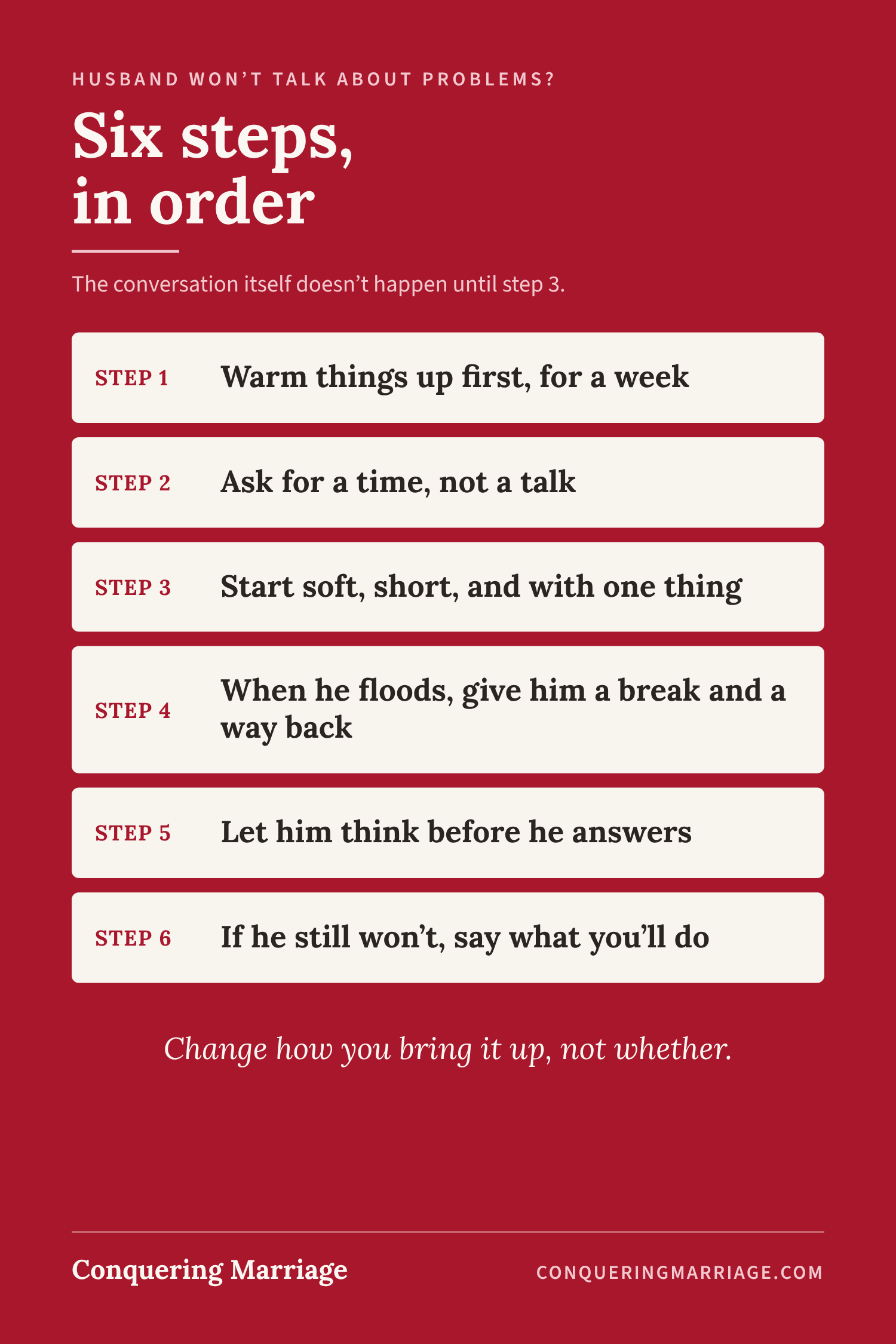
How to get your husband to talk about problems: six steps, in order
These are in order for a reason. The conversation itself doesn’t happen until step 3. Steps 1 and 2 make it more likely he’ll still be in the room for it.
Step 1: warm things up first, for a week
If every conversation he can remember lately has been a problem conversation, his guard will be up before you open your mouth. So before you raise the issue again, spend about a week making the everyday between you a little warmer, with no agenda.
Small things. Turn toward him when he says something, even something trivial. John Gottman studied these little moments, which he called “bids”: a comment, a question, a “look at this.” In his research, couples still together six years later turned toward each other’s bids about 86 percent of the time. Couples who later divorced did it about 33 percent of the time. Ask about his day and listen to the answer. Laugh at the joke. Touch his shoulder as you pass.
This isn’t a trick, and it isn’t you rewarding bad behavior. It’s lowering the temperature so that when you do bring something up, it lands in a marriage that feels safe instead of one that feels like a courtroom.
Step 2: ask for a time, not a talk
Instead of starting the conversation, ask for one. Tell him roughly what it’s about, that it isn’t a fight, and how long it will take. Then let him pick when.
“There’s something I’d like to talk through with you. It’s not a big fight, but it matters to me. Twenty minutes, tops. Would tonight after the kids are down or Saturday morning be better?”
Three things are doing the work here. He knows what’s coming, so he isn’t ambushed. He knows it has an end, so it doesn’t feel like it could swallow the whole night. And he picked the time, so he’s agreed to it rather than been cornered.
A note on setting: many men find it easier to talk side by side than face to face. A walk, a drive, doing the dishes together, sitting on the porch. Less eye contact can mean less pressure. If face to face at the kitchen table hasn’t worked, try a walk.
Step 3: start soft, short, and with one thing
Gottman’s research found that the way a conversation starts, gently or harshly with criticism and blame, usually predicts how it ends. So the first thirty seconds matter more than anything else you say.
Start with you, not him. Name one issue, not five. And say out loud that you’re on the same side.
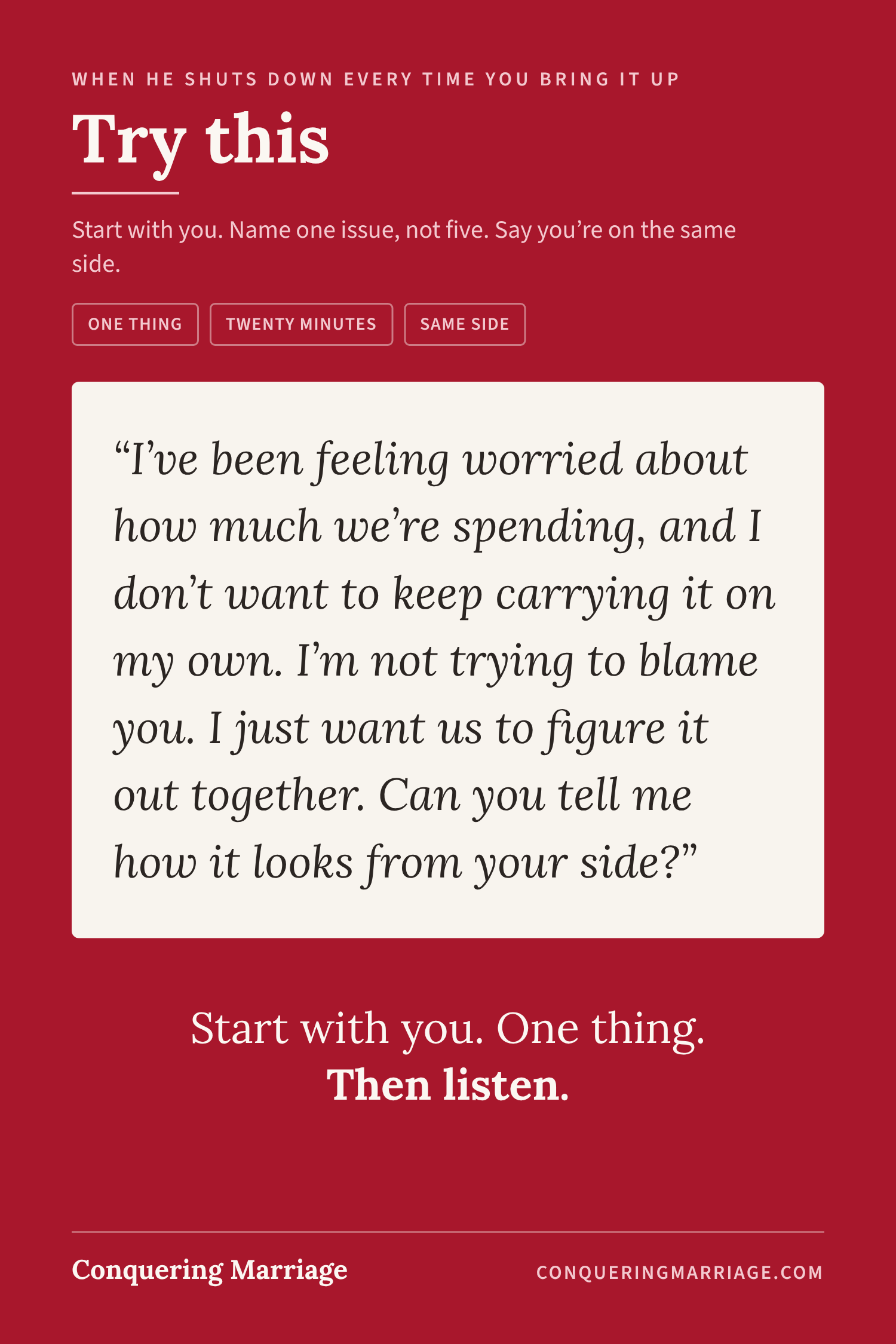
“I’ve been feeling worried about how much we’re spending, and I don’t want to keep carrying it on my own. I’m not trying to blame you. I just want us to figure it out together. Can you tell me how it looks from your side?”
Swap in your own issue, but keep the shape: what you feel, about one specific thing, that you’re not looking for someone to blame, and a question that invites his side. Then stop talking and let him answer. If there’s a pause, let it sit. Silence in the first few seconds is often him thinking, not him shutting down.
Keep to one topic, and keep to the time you promised. If you said twenty minutes, end at twenty, even if it’s going well. “Thank you. That helped. Can we pick this up again next week?” Ending on time is how he learns these conversations are survivable, and that’s what makes the next one easier.
Want the words for every day? Free: The 14-Day Reconnect Plan. One ten-minute action a day, with the exact words to say, to bring the warmth back before the hard conversations. Every day is something you can start on your own.
Step 4: when he floods, give him a break and a way back
Even with a perfect start, he may still shut down. You’ll see it: the blank face, the one-word answers, the jaw going tight, the look at the door. When that happens, more talking won’t get through. His body needs to settle first, and so might yours.
Don’t wait for him to walk out. Offer the break yourself, and attach a way back to it:
“I can see this is a lot right now. Let’s stop for a bit. I’m not dropping it, I just want us both to be able to think. Can we come back to it after dinner?”
The Gottman Institute’s guidance is a break of at least 20 minutes apart, and Julie Gottman puts the ceiling at about 24 hours before you come back to each other. During the break, the point is to calm down, not to rehearse your case. Walk, do the dishes, breathe out longer than you breathe in.
The way back is what makes this work. A break with no return teaches him that shutting down ends the conversation for good. A break with a return teaches him he can step out and still be safe stepping back in. If he says yes to “after dinner,” hold him to it gently: “Is now still okay?” If he walks off before you can offer the break, here’s what to say.
Step 5: let him think before he answers
Some men can’t answer a feelings question on the spot, and pushing for one gets “I don’t know” or “fine.” Giving him time to think isn’t letting him off the hook. It’s often the only way to get a real answer.
“You don’t have to have an answer right now. Will you think about it and tell me tomorrow what you think?”
Then actually wait until tomorrow. If he comes back with something, even something small, thank him for it. “Thanks for thinking about it. That helps.” You’re teaching both of you that his answers are welcome, even when they’re short.
Some couples find writing easier for the first round, as long as the writing sets up a conversation rather than replacing it. If he keeps saying “I don’t know,” here’s an answer for that.
Step 6: if he still won’t, say what you’ll do
If you’ve done the first five steps for a few weeks and he still won’t discuss anything that matters, the next move isn’t a bigger argument. It’s telling him, calmly and once, what you’re going to do, rather than what he has to do.
“I’m not going to keep bringing this up in the kitchen. It matters too much to me to just drop it, so I’ve booked a session with a counselor. I’d really like you to come with me. If you don’t want to, I’m going to go anyway.”
Then go. A counselor can help you see your half of the pattern, practice the conversation, and work out what you want. Some husbands who won’t talk at home will come along once they see you’re serious and not just making a threat. Others come after a session or two, once they realize it isn’t a courtroom. If he doesn’t, you still get the help. How to save your marriage when only one of you is trying has more on keeping going on your own without losing yourself.
Give counseling and the steps about six weeks, then take stock. If nothing at all has moved, is my marriage over? can help you think about where you are. And if, at any point, you’re bringing things up carefully because you’re afraid of how he’ll react, stop here and read this first.
What to say when he says…
These are the lines that end most conversations before they start. Here’s a calm answer for each. None of them is a magic phrase. The point is to stay warm and steady instead of either chasing or giving up.
“Not this again.”
“I know we’ve been here before, and I know it’s frustrating. I’m not trying to go over everything. I just want to sort out this one thing. Twenty minutes, and then we stop.”
If it’s genuinely the tenth time in a month, he may have a point about how often, even if he’s wrong about whether it matters. Fewer, shorter, scheduled conversations usually help.
“There’s no problem.” / “We’re fine.”
“I’m glad it feels okay from your side. It doesn’t feel okay from mine, and I’d rather tell you than let it build up. You don’t have to agree there’s a problem. I just need you to know I’m feeling it.”
Then make one small, specific ask, and drop it for now. A man who doesn’t see a problem usually needs to notice a change before he can talk about one.
“Whatever you want.” / “Fine, do what you like.”
“I don’t want to decide this on my own. I want to know what you think, even if it’s different from me. Can you tell me one thing you’d want?”
“Whatever you want” often means “I’ve given up winning these,” not “I don’t care.” Asking for one small preference is easier to answer than “how do you feel?”
“I don’t know.”
“That’s okay. Can you think about it and tell me tomorrow?”
Or offer him a choice instead of an open question: “Is it more that you’re tired of talking about it, or that you don’t agree with me?” Choices are easier than blank pages.
He walks out mid-sentence.
Don’t follow him. Say one sentence to his back, calmly: “Okay. I’m not dropping this, but we can take a break. Can we try again tonight?” Then let him go. If he comes back, start smaller. If walking out is how every conversation ends, it’s worth naming once on a calm day: “When you walk out, I feel shut out. If you need a break, can you tell me, and tell me when we’ll come back to it?” (If walking out comes with slamming, blocking a door, or anything that frightens you, please read this.)
What if he never talks?
Some men will always talk less than their wives would like. A quiet husband isn’t necessarily a problem. A husband who’s quieter than you, but who will show up for the important conversations when they’re kept short, kind and specific, is a marriage you can work with.
What’s harder is a marriage where nothing that matters can ever be discussed: money, the kids, sex, his drinking, your loneliness, all off-limits, for years. That’s not a personality difference. It means the two of you have no way to solve problems, and problems that can’t be solved tend to pile up.
If that’s where you are, here’s what’s in your control:
- Keep your half of the loop changed. Warm, short, specific, scheduled. Stop chasing, but don’t go silent yourself.
- Get support of your own. A counselor, even alone, is one of the most useful steps you can take. A friend who listens helps too. You shouldn’t have to carry this in your head on your own.
- Make decisions you can make. If he won’t discuss the budget, you can still decide what you’ll spend. If he won’t discuss counseling, you can still go. Not every decision has to wait for a conversation he won’t have.
- Notice how long it’s been. If months of honest effort have changed nothing, that’s information, not a failure on your part. Signs of a failing marriage sorts what a long silence might mean.
And if his silence comes with fear, contempt, or being shut out of money or friends, that’s a different situation.
When his silence is something else
Usually, a husband who won’t talk about problems is a man who doesn’t know how, or who has learned to dread it. But sometimes the silence is a symptom of something else, and the steps above aren’t the right place to start.
If it’s fear, or the silence is used to punish you. If you manage his moods, if you’re careful what you say, or if he’s hurt you or threatened to, then the problem isn’t communication. The same goes if he uses silence as