
He’s right there. He’s on the other end of the couch, or across the dinner table, or asleep next to you. And you have never felt more alone.
If you’re married but lonely, you’re not imagining it, you’re not ungrateful, and you’re not the only one. Plenty of wives feel lonelier inside their marriage than they ever did single, and most of them don’t say it out loud, because how do you explain being lonely when you’re never actually alone?
If you’ve ever typed “I feel alone in my marriage” into your phone at midnight, this is for you. It won’t tell you to plan a date night and call it fixed.
The short version: loneliness in marriage isn’t about time together. It’s about whether you feel known. There are five kinds, and each starts in a different place, so find yours first. If he misses your reaches or you carry everything, the seven steps build warmth first and the conversation fourth. If you feel afraid of him rather than lonely, start here instead.
Table of Contents
Why you can feel lonely with your husband right there
Being alone is about who’s in the room. Being lonely is about whether anyone in the room is with you.
You can share a bed, a mortgage, and three kids with someone and still feel that nobody really knows what your days are like, what you’re worried about, or what you’ve been thinking lately. That’s what feeling lonely in marriage usually is: not an absence of company, but an absence of being met. You say something that matters to you and it lands nowhere. You carry something heavy and nobody notices it’s heavy. You reach, and there’s nothing there to reach back.
It can actually feel worse than being single. When you’re single, loneliness has an obvious explanation. When you’re married, it comes with confusion (he’s right here, so why do I feel like this?) and often with guilt (he’s a good man, I shouldn’t feel this way). The confusion and the guilt keep a lot of wives quiet for a long time.
Here’s what’s worth knowing up front. Feeling lonely in your marriage is a signal, not a verdict. It tells you something important has gone missing between you. It doesn’t tell you the marriage is over, and it doesn’t tell you it’s your fault or his. Very often, what’s missing can be rebuilt.
Why it happens
There’s rarely one cause. Usually a few of these are stacked on top of each other:
Life got loud. Kids, jobs, aging parents, a move, money stress. Every hour goes to something urgent, and the marriage is the one thing that doesn’t scream when it’s ignored. So it gets ignored.
The small moments stopped landing. John Gottman studied everyday “bids”: a comment, a question, a sigh, a “look at this.” In his research, couples still together six years later turned toward each other’s bids about 86 percent of the time. Couples who later divorced did it about 33 percent of the time. Loneliness is often built out of thousands of tiny moments where one of you reached and the other one didn’t notice.
One of you is carrying more than the other knows. If you hold the calendar, the worry, the kids’ emotional weather, and the running list of everything that needs doing, you can feel lonely in a very specific way: alone in the work of your own life.
You stopped saying the real things. At some point, telling him what you’re actually feeling started to seem pointless or risky, so you stopped. He doesn’t know what you’ve stopped telling him. He just knows things are quiet.
Your own world got smaller. Friends faded, hobbies went, and the marriage became the only place your need for closeness could go. No one person can hold all of it, so the gap between what you need and what you get feels enormous.
Something else is in the way. Resentment, an affair, an addiction, depression, or fear. Those are covered further down, because they change where you start.
Which kind of lonely is it?
Read these and notice which one makes you go quiet. You might recognize more than one; start with the one that hurts most.
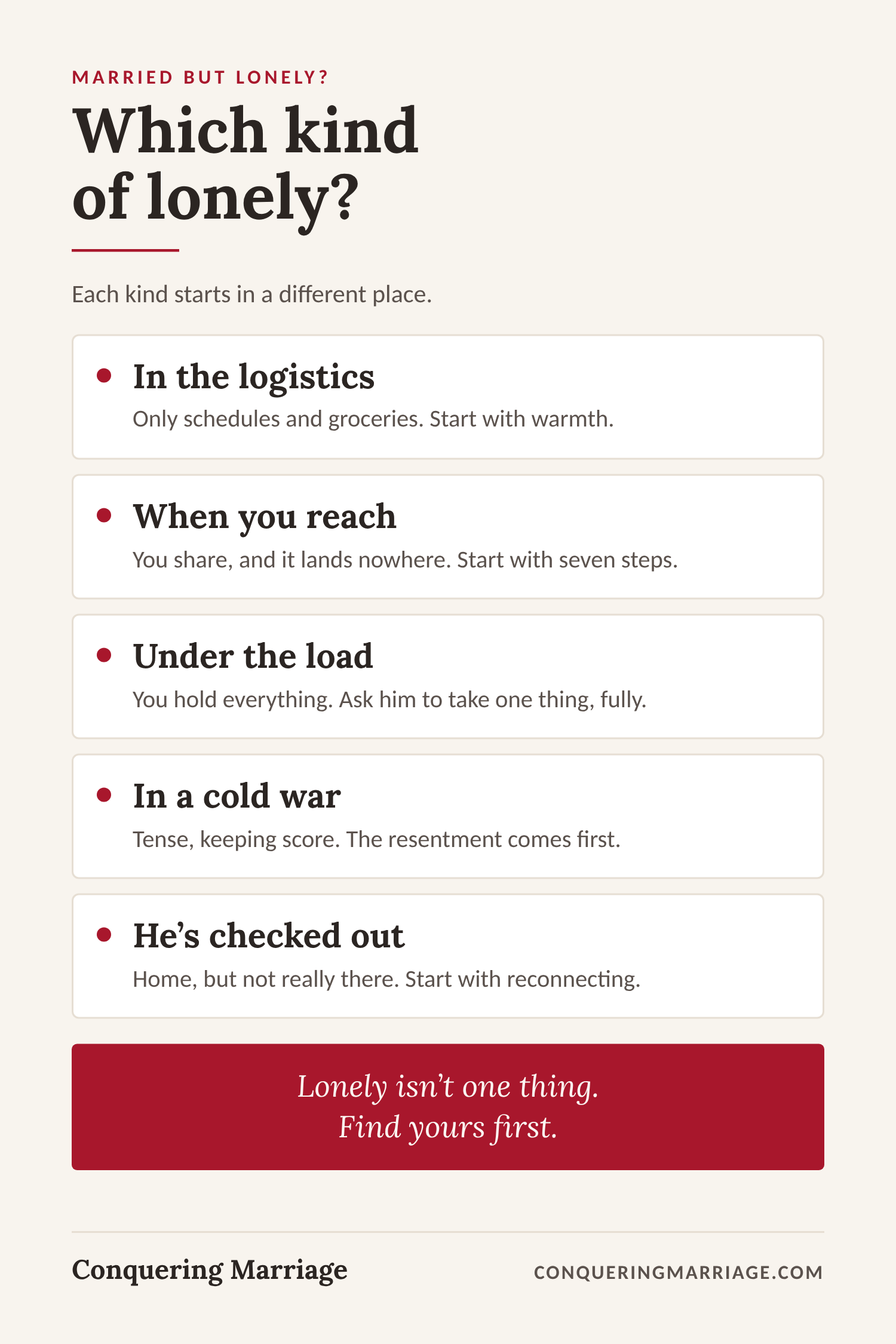
1. Lonely in the logistics. You get along. You run the house well together. But every conversation is about schedules, groceries, and who’s picking up whom, and you can’t remember the last time you talked about anything else. That’s the roommate kind of lonely, and it’s very fixable. Feel like roommates with your husband? has the first two weeks in order.
2. Lonely when you reach. You do try. You tell him about your day, share something that’s worrying you, send him the funny thing. And it lands nowhere: a nod, an “mm-hm,” his eyes on his phone. You’ve started to feel that the things that matter to you don’t matter to him. This is the kind this guide goes deepest on. Start with the seven steps.
3. Lonely under the load. You feel alone in the work of your life: the planning, the remembering, the worrying, the noticing. He helps when asked, maybe, but you’re the one who has to ask, and asking is one more job. The seven steps cover this too, especially step 5. If you have young kids, how not to hate your husband after kids goes deeper on the load.
4. Lonely in a cold war. It isn’t just quiet. It’s tense. You’re both keeping score, you avoid each other on purpose, and there’s a list of grievances neither of you says out loud. The loneliness here sits on top of resentment, and warmth alone won’t get through it. Start with how to fix a broken marriage, which covers the cold war in order.
5. Lonely because he’s checked out. He’s home, but he isn’t really there: no interest in you, the family, or the future, and he doesn’t seem to notice or care that you’re lonely. Or you suspect his attention is somewhere, or with someone, else. Start with how to reconnect to your husband, which covers the checked-out husband. If an affair or fear is part of it, read when loneliness is covering something else first.
What not to do first
When you’ve been lonely a long time, the instinct is to do something big. Big moves usually backfire. Before the steps, here’s what to put down:
The 11 p.m. talk. Telling him everything you’ve been holding for a year, late at night, when you’re both exhausted, almost always turns into a fight or a shutdown. Then you feel lonelier, and you’ve proven to yourself that talking doesn’t work.
The case against him. “You never ask about my day. You’re always on your phone. You haven’t touched me in weeks.” Every line might be true. He’ll still hear a trial, not a wife who misses him, and he’ll defend himself instead of moving toward you.
The silent test, or the silent retreat. Waiting to see if he notices you’re upset, or pulling back so it hurts less. He usually won’t notice the test, not because he doesn’t care, but because he doesn’t know there’s one. And pulling back tells him you’re fine, which makes the distance wider from both sides.
Pouring it all somewhere else. A friendship, an online space, or a coworker who “really gets you” can quietly become where your closeness goes. Friends matter enormously (that’s step 2). But if you notice a connection with another man starting to feel like the place you’re truly known, that’s worth being honest with yourself about now, while it’s still easy to step back.
What to do when you’re married but lonely: seven steps, in order
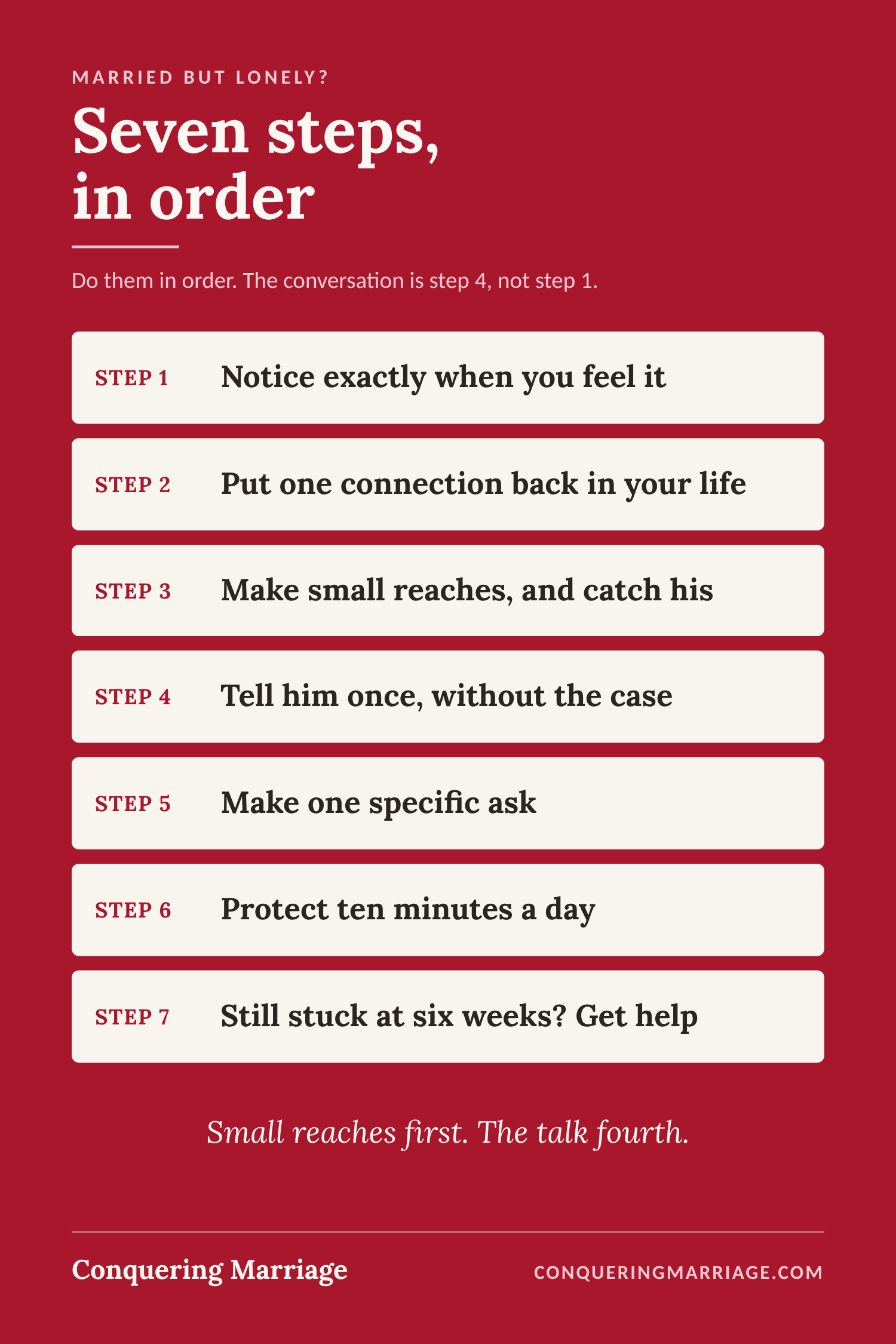
This works best for the “lonely when you reach” and “lonely under the load” kinds. Do them in order. The conversation is step 4, not step 1, because it lands much better when it isn’t the first warm thing he’s felt from you in months.
Step 1: notice exactly when you feel it
“I’m lonely” is too big to fix. “I’m loneliest at 9 p.m. when he goes to the garage and I fold laundry by myself” is something you can work with.
For three or four days, notice the moments the loneliness spikes. Jot them in your phone if it helps. You’re looking for a pattern: a time of day, a kind of moment, or a topic you’ve stopped bringing up. Maybe it’s when you share something and he doesn’t respond, or when you’re handling something hard alone.
Often it’s three or four specific moments, not all day. Those moments are where you’ll make your change, and they’re what you’ll describe to him in step 4.
Step 2: put one connection back in your own life
This one surprises people, so here’s the reason first. When your marriage has become the only place your need for closeness goes, every missed moment with him hurts twice as much, because there’s nowhere else for that need to land. You’ll also go into the conversation with him more desperate than you want to be.
So this week, reach out to one person: a friend you’ve drifted from, your sister, a woman from church or work you’ve always liked. Not to vent about your marriage (you can, but it’s not the point). Just to be with someone who knows you. Something as simple as:
“I’ve missed you. Can I take you for coffee one morning this week? No agenda, I just want to catch up properly.”
This isn’t instead of your husband. It’s so that you aren’t asking him to be your entire world, which nobody can be. A wife whose life has other warm places in it is easier to be close to, and she’s looking after herself either way.
Step 3: make small reaches, and catch his
For a week, put your energy into tiny moments, not big ones.
Catch his bids. He says something about work, sighs at the news, shows you a video. Turn toward it: put your phone down, look at him, respond with something real. “Wait, what happened? Tell me.” This is the habit the couples who stayed together kept, and it’s the single highest-return thing you can do, because it’s often how both of you started feeling unmet.
Make small bids of your own, and keep them light. Share one small thing a day that isn’t logistics: something that made you laugh, something you’re looking forward to. No expectations attached. If he responds, good. If he doesn’t, don’t count it against him yet. He may simply be out of practice.
Ask one real question a day. Not “how was your day,” which gets “fine.” Try “What was the worst part of today?” or “What’s on your mind lately?” Then listen without fixing. Gottman calls a version of this the stress-reducing conversation: the two of you on the same side against the world.
You’re not running a campaign, and you don’t need to announce anything. You’re making it easier for him to be near you, and finding out how much of the distance is habit.
Want a day-by-day plan to follow? Free: The 14-Day Reconnect Plan. One ten-minute action a day, with the exact words to say. Every day is something you can start on your own.
Step 4: tell him, once, without the case
After a week of small warmth, tell him. Pick a calm moment: not bedtime, not in the middle of logistics, not right after he’s let you down. Keep it short, start with you, and end with something he can do.
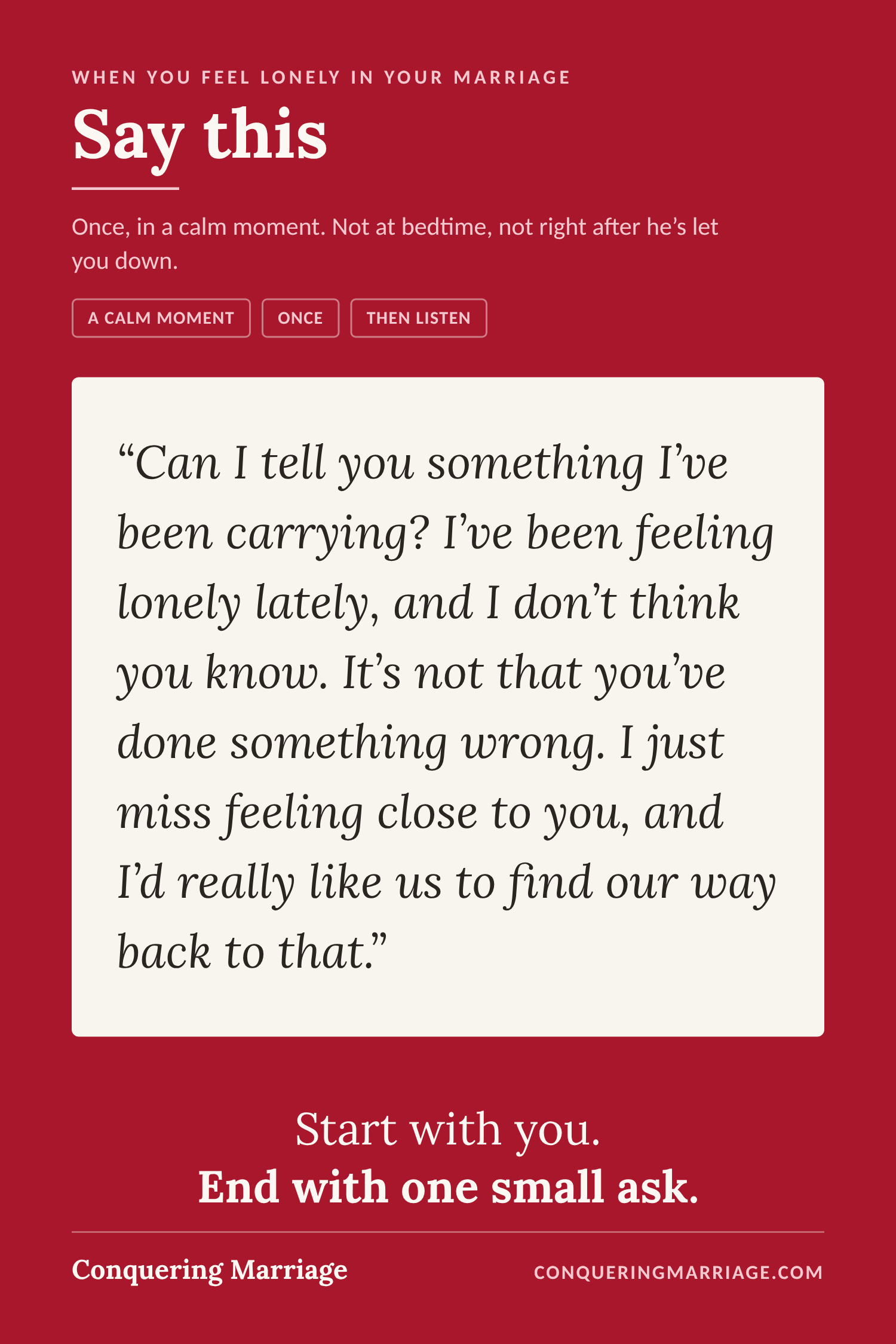
“Can I tell you something I’ve been carrying? I’ve been feeling lonely lately, and I don’t think you know. It’s not that you’ve done something wrong. I just miss feeling close to you, and I’d really like us to find our way back to that.”
Then stop talking, and let him respond. It’s okay if there’s a silence. Don’t fill it with examples or reasons.
If he asks what you mean, give him one or two of the moments from step 1. Say them as moments, not charges: “Like at night, when you go out to the garage and I’m inside on my own. I miss you then.” That’s very different from “you always disappear.”
If he says “I’m right here” or “We’re fine”: he probably means it. To him, being home is being together. Don’t argue about whether you’re allowed to feel this way. Try:
“I know you’re here, and I’m glad you are. I think I mean something different. I miss talking to you about real things, not just the schedule. Can we try ten minutes most evenings, just us?”
If he gets defensive: let it go for tonight. “I’m not blaming you. I just wanted you to know where I am. Let’s come back to it.” Bring it up once more in a few days, calmly. Many husbands hear it better the second time, once the first sting has worn off.
If he says you’re too needy: that one hurts, and it needs its own answer. See what if he says you’re too needy? below.
If you’re afraid of how he’ll react: don’t have this conversation. Read this instead.
Step 5: make one specific ask
“I need you to be more present” is impossible to act on. “Could you put your phone down when I’m telling you something?” is easy. After the conversation, give him one small, concrete thing to say yes to:
“When I tell you about something that’s on my mind, could you put your phone down and ask me one question about it? That’s all. It would make a big difference to me.”
If your kind is “lonely under the load,” the ask is different. The loneliness there comes from being the only one who holds things, so the ask is for him to fully take one thing, start to finish, including the remembering:
“I’ve realized part of why I’ve been feeling so alone is that I’m the one who keeps track of everything, and it’s a lot. Would you take over [the kids’ doctor appointments / the weekly grocery order / bedtime on weeknights] completely, so it’s off my mind and not just off my hands?”
One thing, fully his. Not “help more.” Then let him do it his way, even if his way is different from yours.
Step 6: protect ten minutes a day
The specific ask is how you start. The daily ten minutes is how you keep it. Once the specific ask has settled in, suggest it: “Could we keep ten minutes for each other most days? Just us, no phones.” Same time most days if you can: after dinner, after the kids are down, or the first ten minutes after he gets home. Phones away. One real question each. No problem-solving unless someone asks for it.
It will feel a bit awkward at first. That’s normal. Couples who’ve been lonely together for a long time are out of practice at just talking. The awkwardness wears off in a week or two, and those ten minutes often become the part of the day you both look forward to.
Step 7: if nothing moves in six weeks, get help
If you’ve done the small things for six weeks or more, told him kindly, made a specific ask, and nothing has changed, that’s important information. It doesn’t mean it’s over. It means it’s time for a counselor.
Ask him to come with you: “I’ve been trying, and I don’t think I can fix this on my own. Would you come to a counselor with me? I’m asking because I want this to work.” If he won’t, go on your own. A counselor of your own can help you see the pattern more clearly, take care of yourself inside it, and think through what you want next. Going alone isn’t giving up. (If you’re afraid of him, couples counseling isn’t the right first step; the fear paragraph explains why.)
What if he says you’re too needy?
Sometimes a wife says “I’m lonely” and hears back “You’re too needy,” or “Nothing I do is ever enough.” That can make you want to stop asking for anything ever again. Please don’t.
Wanting to feel close to your husband isn’t needy. It’s what marriage is for. But it’s worth asking yourself, honestly and without beating yourself up, two questions:
Is everything I need for closeness going through him? If he’s your only real confidant, your only company, and your only source of feeling known, anyone would feel the weight of that. It can come out as “too needy.” That isn’t a flaw in you. It’s a sign your world has narrowed, and step 2 is the fix.
Is he hearing the ask, or the score? If what he hears is a long list of the ways he’s failed, he may be reacting to feeling like he can never get it right, not to the closeness you want. A short, specific ask (step 5) is much harder to call needy than a general “you’re never there.”
If you’ve done both of those and he still treats every reach for closeness as too much, try:
“I’m not asking you to be everything for me. I’ve got friends and my own life, and I’m glad I do. But you’re my husband, and I want to feel close to you. That’s a normal thing to want, and I’d like us to figure out what it looks like for both of us.”
If being told you’re too needy is part of a bigger pattern, please read the next section before anything else. That pattern can look like being made to feel your feelings are the problem, no longer asking for things because it isn’t safe to, or friends and family slowly pushed out of your life.
What if he doesn’t change?
Sometimes you do everything right and he doesn’t move, or moves for a week and slides back. Some honest things to know:
You can only control your half. Your half is real, though. Turning toward him, the ten minutes, the specific ask, and your own full life change the marriage even when he isn’t trying yet. How to save your marriage when only one is trying has the ground rules for that season.
Don’t stop living your life while you wait. Keep the friendships, the interests, and the plans that are yours. A marriage where you’re lonely is hard enough without also being lonely for yourself.
Watch for change, not perfection. A husband who forgets the ten minutes twice a week but has started asking about your day is moving. A husband who says “I’ll try” and changes nothing over months is telling you something different.
There’s a point where it’s a bigger question. If months have gone by, you’ve asked plainly, you’ve suggested counseling, and he won’t meet you anywhere, the loneliness has become information about the marriage itself. Is my marriage over? has a self-check to help you think it through calmly, and a counselor of your own is the right place to work through it. If you’re afraid of him, though, start here, not with the self-check.
When loneliness is covering something else
Usually, loneliness in marriage is two people who’ve stopped reaching for each other. But sometimes the loneliness is a symptom of something else, and the steps above aren’t the right place to start.
If it’s fear. If you manage his moods, if you’re careful what you say, or if he’s hurt you or threatened to, then the distance in your house isn’t drift. It’s you keeping yourself safe. The same goes if he controls the money, your phone, or where you go, if he’s slowly cut you off from friends or family, or if he pressures you into sex or won’t take no for an answer. Feeling isolated is one of the ways control can show up. Your safety is the question. Please don’t use any of the scripts on this page. You don’t have to decide anything about the marriage to talk to someone who does this every day. The National Domestic Violence Hotline is free and confidential: call 1-800-799-7233, text START to 88788, or chat at thehotline.org. They’ll help you think it through without telling you what to do. Please reach out even if you’re not sure it “counts.” You’re not failing at your marriage. You’re being asked to handle something no marriage advice was built for. If you’re having thoughts of harming yourself, call or text 988. If anyone is in immediate danger, call 911.
If there’s an affair. Sometimes the loneliness is because his closeness is going somewhere else. If you suspect it, or you k